
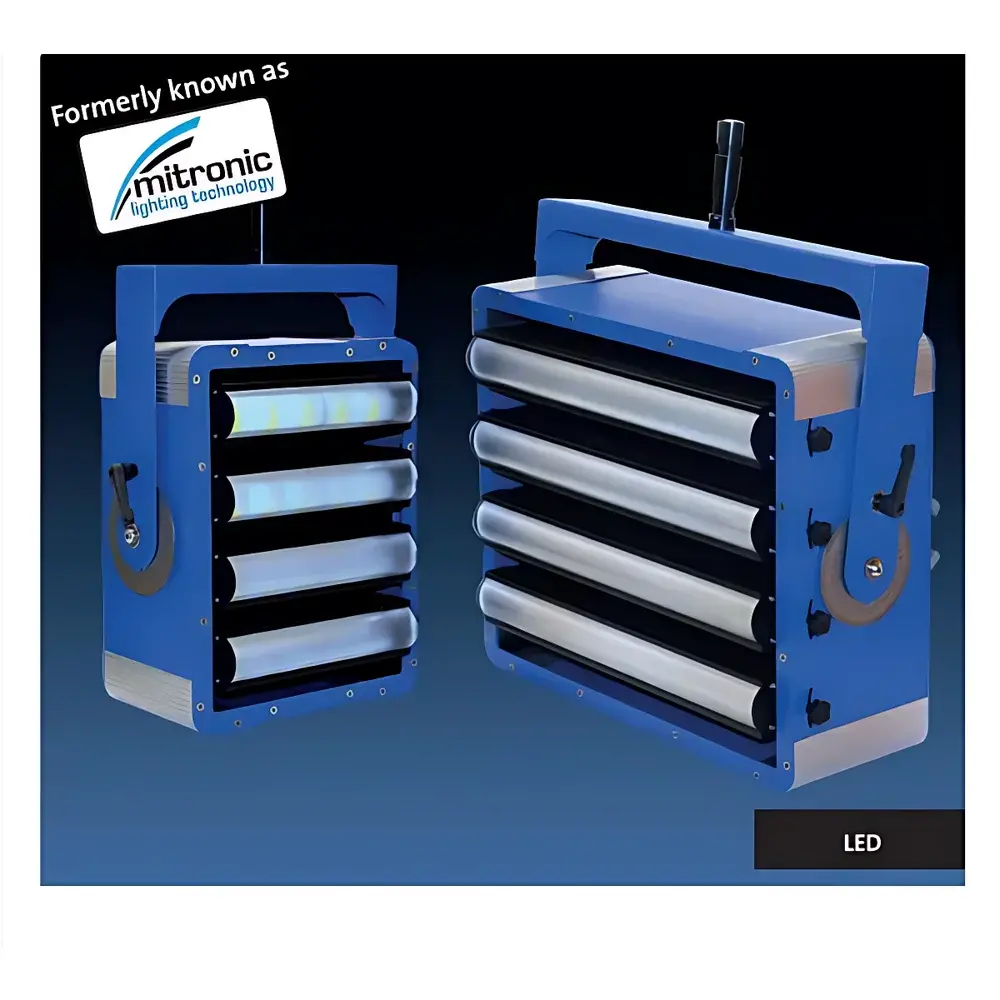
Hoenle LED Floodlight for High-Speed Impact Testing
| Brand | Hoenle |
|---|---|
| Origin | Germany |
| Model | LED Floodlight |
| Power Options | 3000 W / 4500 W / 6000 W (main array) |
| Cooling | Integrated forced-air cooling system with aluminum heat sinks |
| Control Interface | Dedicated power supply with remote ON/OFF input and programmable boost timer (up to 15 s at full channel output) |
| Optical Flexibility | Five interchangeable lenses with distinct beam angles (e.g., 10°, 25°, 40°, 60°, 90° FWHM) |
| Illuminance Output | ≥100,000 lux at 6–12 m distance (per fixture, calibrated per ISO/CIE photometric standards) |
| Compliance | Designed for ISO 17025-accredited crash test laboratories |
| Mounting | Modular aluminum extrusion chassis for rigid multi-unit alignment |
Overview
The Hoenle LED Floodlight is an engineered high-intensity illumination system specifically developed for ultra-high-speed imaging environments—primarily automotive and aerospace crash testing. Unlike conventional continuous-output lighting, this system operates on a dual-mode photometric architecture: low-power standby mode during setup and calibration, followed by precisely timed high-flux boost mode immediately prior to impact event capture. Its core design leverages high-efficiency, narrow-bin white LEDs mounted on thermally optimized aluminum extrusions, each integrated with active air-cooling to sustain luminous flux stability under transient thermal load. The system delivers uniform, flicker-free illumination across wide fields—critical for synchronization with high-frame-rate cameras (≥10,000 fps) and photogrammetric analysis software. As a purpose-built solution for ISO/IEC 17025-compliant test facilities, it replaces legacy metal-halide SFL systems while meeting the stringent temporal stability and spectral consistency requirements of SAE J211-2022, ECE Regulation 94, and FMVSS 208 validation procedures.
Key Features
- Multi-channel modular architecture: Up to four independently controllable LED arrays housed in a single ruggedized enclosure with integrated forced-air cooling.
- Dual-mode operation: Standby mode (≤30% nominal power) for safe setup and alignment; programmable boost mode (100% per channel, up to 15 seconds) triggered via TTL or dry-contact input.
- Precision optical versatility: Five CIE-compliant interchangeable lenses—10°, 25°, 40°, 60°, and 90° full-width half-maximum (FWHM)—enabling tailored irradiance distribution for near-field cabin illumination or far-field barrier coverage.
- Onboard vehicle lighting module: Separate 300–1200 W LED unit with independent power supply, designed for interior mounting and synchronized triggering with main array.
- Robust mechanical integration: Aluminum extrusion chassis supports DIN-rail, tripod, and custom rig mounting; IP54-rated housing for controlled lab environments.
- Traceable photometric performance: Factory-calibrated luminous flux (lumens) and illuminance (lux) data provided per unit, traceable to PTB (Physikalisch-Technische Bundesanstalt) reference standards.
Sample Compatibility & Compliance
The Hoenle LED Floodlight is validated for use in accredited crash laboratories performing frontal, side-impact, and rollover simulations per global regulatory frameworks. Its spectral power distribution (SPD) conforms to CIE 015:2018 for daylight-mimicking illumination (CCT ≈ 5600 K, CRI > 92), ensuring color fidelity in high-speed RGB imaging. The system meets electromagnetic compatibility (EMC) requirements per EN 61000-6-3 and EN 61000-6-4, and its control interface supports deterministic latency (<1 ms) for integration into time-critical test orchestration platforms (e.g., National Instruments VeriStand, dSPACE SCALEXIO). All firmware and configuration logs retain audit trails compliant with GLP principles and support FDA 21 CFR Part 11 electronic record requirements when deployed with validated SCADA-level supervision.
Software & Data Management
Each floodlight is supplied with Hoenle LightControl Suite—a Windows-based configuration utility enabling remote parameterization of boost duration, channel enable/disable states, and thermal derating thresholds. The suite exports CSV-formatted operational logs (timestamped power state transitions, temperature telemetry, and fault codes) compatible with MATLAB, Python Pandas, and LabVIEW for post-test correlation with high-speed video metadata. Optional OPC UA server integration allows real-time exposure synchronization with camera trigger networks and central test management systems. Firmware updates are digitally signed and version-locked to prevent unauthorized modification—supporting ISO/IEC 17025 clause 5.9.2 requirements for equipment integrity assurance.
Applications
- Automotive crash testing: Frontal offset, side-impact (pole & barrier), and pedestrian protection assessments requiring ≥100,000 lux at 6–12 m working distance.
- Aerospace impact simulation: Landing gear drop tests, bird strike validation, and composite panel penetration studies.
- Ballistics and structural dynamics: High-speed deformation analysis of materials under transient loading.
- On-vehicle lighting validation: Interior cabin illumination mapping during dynamic crash sequences using synchronized onboard modules.
- Photogrammetry-grade motion capture: Uniform field illumination for markerless surface tracking in 3D reconstruction workflows.
FAQ
What is the maximum recommended operating distance for achieving 100,000 lux?
At 6 meters, the 6000 W configuration achieves ≥115,000 lux (measured at center beam axis, ISO/CIE standard conditions); at 12 meters, ≥102,000 lux is maintained with 90° lens configuration.
Can the boost mode be triggered externally via TTL signal?
Yes—dedicated 5 V TTL input accepts rising-edge pulses with configurable debounce (1–100 ms); latency from trigger to full output is ≤800 µs.
Is thermal derating implemented during extended boost cycles?
Yes—the embedded microcontroller monitors heatsink temperature at three points and automatically reduces channel output if >75 °C is sustained beyond 5 seconds.
Are photometric calibration certificates included with shipment?
Each unit ships with a NIST-traceable calibration report (PTB-accredited), including spatial illuminance maps and spectral radiance data.
Does the system support integration with NI TestStand or dSPACE ControlDesk?
Native drivers and XML-based API documentation are provided for seamless integration into both platforms via TCP/IP or USB CDC ACM interface.




