
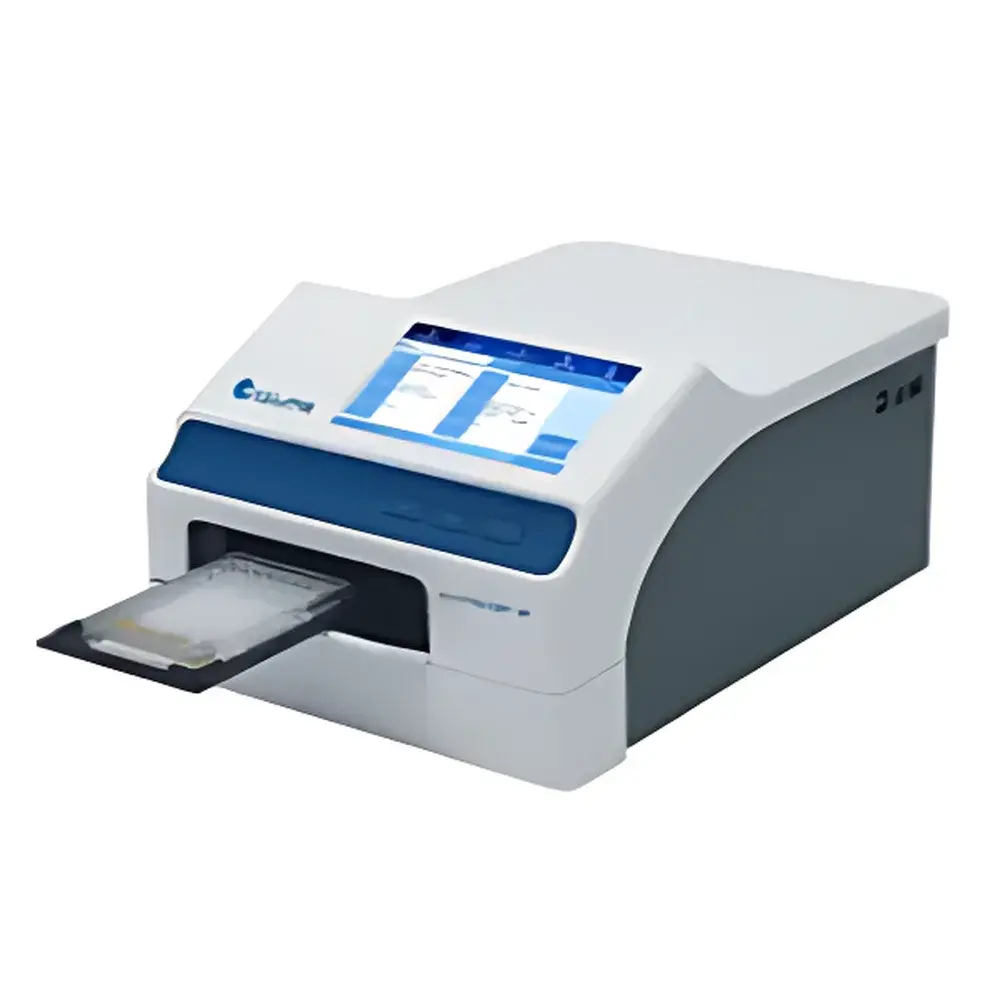
Benchmark MR9600 Microplate Reader
| Brand | Benchmark |
|---|---|
| Origin | USA |
| Manufacturer Type | Authorized Distributor |
| Origin Category | Imported |
| Model | MR9600 |
| Price Range | USD 1,400 – 4,200 |
Overview
The Benchmark MR9600 Microplate Reader is a benchtop absorbance-based detection system engineered for precision, reliability, and operational autonomy in routine life science laboratories. Utilizing fixed-wavelength optical filtration and vertical 8-channel photometric measurement, the MR9600 applies Beer–Lambert law-based quantification across standard 96-well microplates. Its optical architecture features zero-scatter vertical light path design—minimizing well-to-well crosstalk and ensuring high inter-plate reproducibility. Unlike network-dependent or PC-reliant platforms, the MR9600 integrates all firmware, protocol logic, and data handling into its onboard electronics, enabling full standalone operation without external software installation or licensing. Designed for GLP-aligned workflows, it supports traceable assay execution through timestamped run logs, user-defined protocol naming, and audit-ready CSV export.
Key Features
- 7-inch high-resolution color touchscreen interface with intuitive graphical navigation—no external computer required for setup, programming, or result review
- Fixed-bandwidth optical filter system covering 340–750 nm; includes four pre-installed filters (405 nm, 450 nm, 492 nm, 630 nm) and support for up to 26 additional user-selectable filters
- Integrated 8-position filter wheel—enables rapid, programmable wavelength switching within a single assay protocol
- Vertical 8-channel optical path with independent photodiode detection per channel—eliminates lateral scatter and ensures consistent pathlength across all wells
- Onboard multi-speed orbital shaker (200–1,200 rpm) with adjustable amplitude and duration—optimized for homogeneous mixing prior to endpoint or kinetic reads
- Wide dynamic absorbance range: 0.0000–4.0000 Abs (OD), calibrated per ASTM E275 and ISO 15195 standards for clinical and research-grade photometry
- Dual-filter comparative analysis mode—supports ratiometric calculations (e.g., background subtraction, dual-wavelength correction) using two independently selected filters
- USB 2.0 port for direct export of results as comma-separated values (.csv) files—compatible with Excel, GraphPad Prism, and LIMS integration
Sample Compatibility & Compliance
The MR9600 is validated for use with standard flat-bottom, U-bottom, and V-bottom 96-well polystyrene, polypropylene, and cyclo-olefin copolymer (COC) microplates—including non-sterile, sterile, and low-binding formats. It accommodates opaque, clear, and UV-transparent plates (with appropriate filter selection). All optical calibrations are traceable to NIST-traceable photometric standards. The instrument complies with IEC 61010-1 for laboratory equipment safety and meets electromagnetic compatibility requirements per FCC Part 15 Class B and CE EN 61326-1. While not FDA 510(k)-cleared, its performance aligns with CLIA-waived assay validation parameters and supports USP endotoxin testing workflows when paired with chromogenic LAL reagents.
Software & Data Management
All operational logic resides in embedded firmware—not cloud-hosted or PC-resident software. Users define protocols via the touchscreen: selecting excitation/emission filters (where applicable), setting shake parameters, defining read modes (endpoint, kinetic, spectral scan), configuring data reduction (linear fit, % control, ΔAbs/min), and naming output files. Each protocol stores metadata including operator ID (optional), date/time stamp, plate layout annotation, and filter configuration history. Exported .csv files include column headers specifying wavelength(s), time points, well coordinates, raw OD values, and calculated metrics. No proprietary file format is used—ensuring long-term data accessibility and interoperability with institutional data repositories or ELN systems. Audit trail functionality satisfies basic GLP documentation requirements, though advanced electronic signature or 21 CFR Part 11 compliance requires external LIMS integration.
Applications
- ELISA quantification (IgG, cytokines, hormones) using standard 450 nm or dual-wavelength (450/630 nm) correction
- Cell viability assays (MTT, XTT, WST-1) at 450–492 nm
- Protein concentration determination via Bradford or BCA methods (595 nm or 562 nm with optional filter)
- Kinetic enzyme assays (e.g., β-galactosidase, alkaline phosphatase) with configurable time intervals from 10 seconds to 24 hours
- Microbial growth monitoring (OD600) in antibiotic susceptibility or fermentation studies
- Endotoxin detection via chromogenic LAL assays (405 nm endpoint or kinetic read)
- Quality control of conjugated antibodies and labeled secondary reagents
FAQ
Does the MR9600 support fluorescence or luminescence detection?
No. The MR9600 is an absorbance-only microplate reader. It does not include excitation sources, emission filters, or PMT detectors required for fluorescence or luminescence measurements.
Can I upgrade the filter set after purchase?
Yes. Optional filter kits are available directly from Benchmark Scientific and authorized distributors. All filters conform to ISO 9022-3 spectral tolerance specifications and are mechanically compatible with the integrated 8-position filter wheel.
Is calibration verification documented?
Yes. A factory calibration certificate is included with each unit, listing wavelength accuracy (±2 nm), photometric linearity (R² ≥ 0.9995 over 0–3.5 Abs), and inter-channel variability (<1.5% CV at 1.0 Abs). Users may perform routine verification using NIST-traceable neutral density filters.
What operating system is required for data transfer?
None. The USB port functions as a mass-storage device—no drivers or OS-specific software are needed. Any Windows, macOS, or Linux system recognizes the MR9600 as a removable drive upon connection.
How many users can be registered on the device?
The MR9600 does not support multi-user authentication or password protection. Operator identification is manual and text-based—suitable for shared-core facilities but not for regulated environments requiring role-based access control.



