
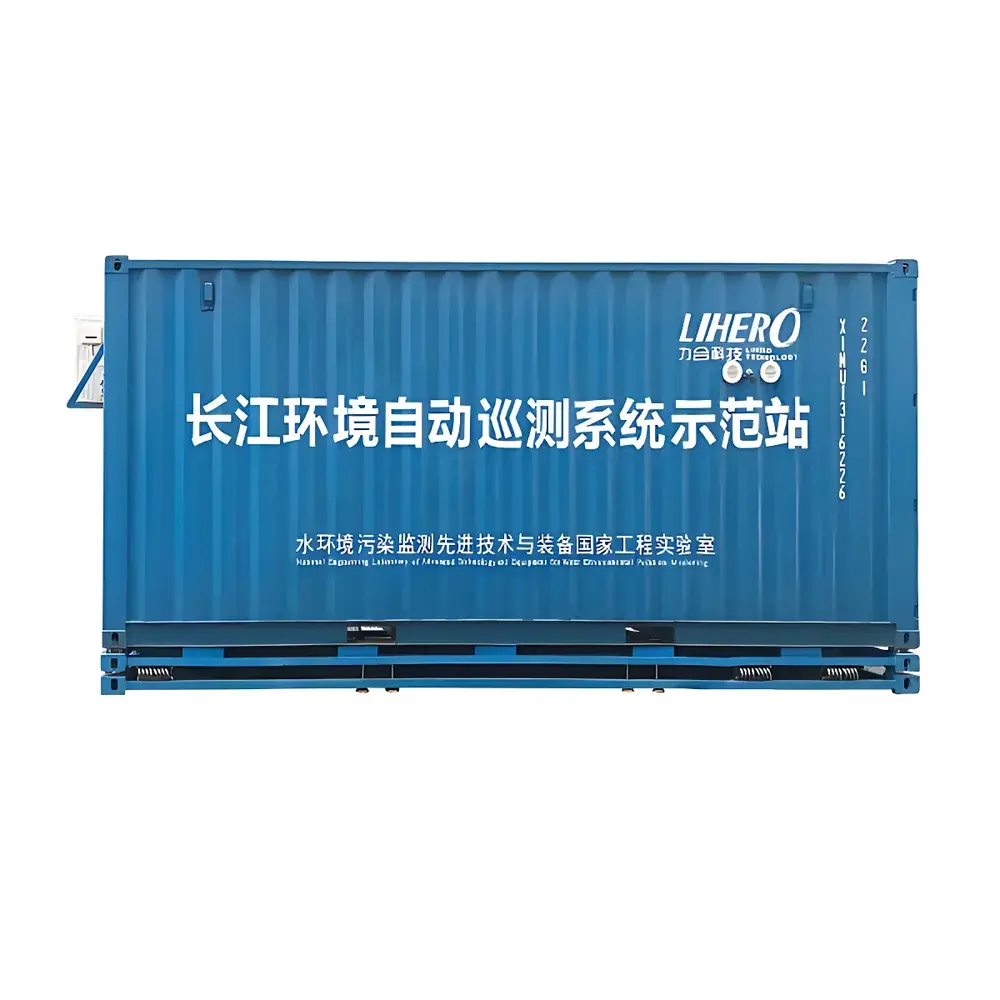
Lihero Cruise-Mode Autonomous Water Quality Monitoring System
| Brand | Lihero |
|---|---|
| Origin | Hunan, China |
| Manufacturer Type | Authorized Distributor |
| Country of Origin | China |
| Model | Cruise-Mode Autonomous Water Quality Monitoring System |
| Pricing | Available Upon Request |
Overview
The Lihero Cruise-Mode Autonomous Water Quality Monitoring System is an engineered mobile environmental monitoring platform designed for longitudinal, high-resolution water quality assessment across large riverine systems. Unlike fixed-station or buoy-based systems, this solution leverages commercial inland cargo vessels as stable, navigable platforms—integrating analytical instrumentation, sample intake and conditioning modules, embedded control architecture, automated quality control (QC) routines, secure data acquisition, and telemetry subsystems into a standardized ISO shipping container. The system operates on the principle of *spatiotemporally resolved in-situ analysis*, combining periodic transect-based profiling with targeted定点 (stationary) sampling at pre-defined geographic coordinates. It supports concurrent measurement of over 100 physicochemical and biological parameters—including but not limited to pH, dissolved oxygen (DO), conductivity, turbidity, nitrate, ammonia, phosphate, total organic carbon (TOC), heavy metals (via ICP-MS or AAS-compatible preconcentration), chlorophyll-a, and fecal indicator bacteria (via ATP or enzymatic assays)—enabling multi-dimensional characterization of aquatic ecosystem health, pollutant transport dynamics, and seasonal biogeochemical cycling.
Key Features
- Modular Instrument Integration Architecture: Accommodates compact benchtop analyzers, portable field-grade sensors, and floor-standing wet-chemistry instruments within a single climate-controlled, vibration-damped containerized enclosure—ensuring mechanical stability and thermal consistency during vessel motion.
- Adaptive Sampling & Analysis Protocol Engine: Supports programmable dual-mode operation—cruise-mode (continuous flow-through analysis during transit) and station-mode (discrete grab sampling with onboard digestion, filtration, and reaction incubation).
- Multi-Layered Quality Assurance Framework: Implements automated internal QC including blank spikes, standard recoveries, duplicate injections, and drift correction at user-defined intervals; integrates external QC via certified reference materials (CRMs) and inter-laboratory comparison protocols aligned with ISO/IEC 17025 requirements.
- Dynamic Calibration Management: Onboard calibration verification using NIST-traceable standards; automatic recalibration triggered by sensor drift thresholds or scheduled time intervals.
- Redundant Data Integrity Systems: Dual-path data logging (local SSD + encrypted cloud backup); timestamped audit trails compliant with GLP/GMP documentation standards; optional FDA 21 CFR Part 11–enabled electronic signature support for regulated environments.
Sample Compatibility & Compliance
The system is validated for use with surface freshwater (rivers, reservoirs, canals) and estuarine transitional waters (salinity ≤ 15 ppt). Sample handling components—including peristaltic pumps, stainless-steel intake manifolds, ceramic filter housings (0.45 µm pore size), and UV sterilization modules—are chemically inert and compatible with EPA Method 1600-series, ISO 5667-3:2018 (sampling), ISO 7027-1:2016 (turbidity), and ASTM D3370 (flow-proportional sampling). All onboard reagents meet ACS grade specifications; wastewater matrices require optional pretreatment add-ons (e.g., acid digestion for metals, solid-phase extraction for organics).
Software & Data Management
The Lihero AquaNav™ Control Suite provides unified supervision via web-based HMI accessible from shore-side workstations or mobile devices. Real-time dashboards display live sensor outputs, QC status flags, GPS-referenced location metadata, and system health diagnostics. Raw data are stored in structured CSV/NetCDF format with embedded ISO 19115-compliant metadata headers. Export modules support direct ingestion into national monitoring databases (e.g., China’s National Surface Water Monitoring Platform), WFD-compliant reporting templates, and third-party GIS platforms (ArcGIS, QGIS). Cybersecurity includes TLS 1.3 encryption, role-based access control (RBAC), and firmware-signed OTA updates.
Applications
- Longitudinal river basin monitoring for ecological status assessment under EU Water Framework Directive (WFD) Article 5 reporting requirements.
- Source-to-mouth contaminant tracking during flood events or industrial discharge incidents.
- Baseline characterization prior to hydropower dam construction or inter-basin water transfer projects.
- Validation of hydrodynamic-transport model outputs through high-density spatiotemporal observation networks.
- Supporting UN SDG Indicator 6.3.2 (proportion of bodies of water with good ambient water quality) through standardized, auditable data generation.
FAQ
What vessel types are compatible with the system?
Standardized for Class II–IV inland cargo vessels (≥ 300 GT) with deck space for 20-ft ISO containers and stable power supply (220 V AC / 50 Hz, ±10% voltage tolerance). Retrofit integration kits available for barges and survey boats.
How is sensor fouling mitigated during extended cruises?
Integrated anti-fouling strategies include automated air-pulse cleaning, low-energy ultrasonic transducers (40 kHz), and scheduled citric acid backflush cycles—validated for >72-hour continuous operation in high-turbidity (>100 NTU) conditions.
Can the system be operated remotely without onboard personnel?
Yes. Fully autonomous mode supports unattended 14-day missions with satellite-based telemetry (Iridium Short Burst Data), remote diagnostics, and emergency shutdown via geofence-triggered protocols.
Is the system certified for regulatory compliance reporting?
Meets technical prerequisites for inclusion in national environmental monitoring networks per China’s HJ 91.2-2022 standard; CE marking pending; full ISO/IEC 17025 accreditation support provided through partner laboratories.
What maintenance interval is recommended between cruises?
Comprehensive service every 30 operational days or 500 km of cumulative navigation—includes sensor recalibration, filter replacement, reagent replenishment, and integrity validation of fluidic pathways per manufacturer SOP-AMQ-07.







