
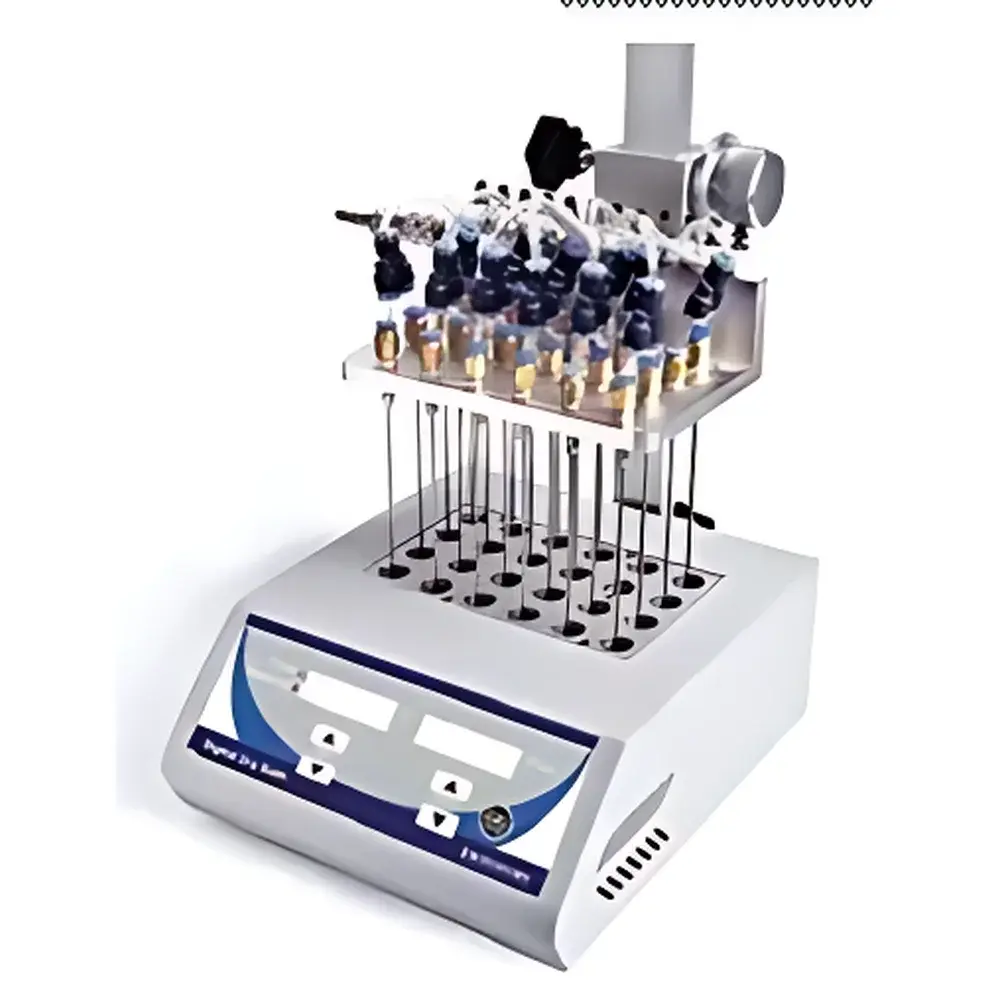
Hercuvan TT-200-VSC Visual Nitrogen Evaporator
| Brand | Hercuvan |
|---|---|
| Origin | Malaysia |
| Model | TT-200-VSC |
| Heating Method | Dry Block Heating |
| Temperature Range | Ambient +5°C to 150°C |
| Temperature Stability | ≤±0.5°C at 100°C |
| Tube Diameter Compatibility | 10–29 mm |
| Nitrogen Flow Rate | 0–15 L/min |
| Sample Capacity | 24 positions |
| Heating Power | 400 W |
| Dimensions (L×W×H) | 280 × 220 × 500 mm |
| Timer Range | 1–5999 min |
| Max Operating Pressure | ≤0.1 MPa |
Overview
The Hercuvan TT-200-VSC Visual Nitrogen Evaporator is an engineered solution for parallel, inert-gas-assisted solvent evaporation in analytical and preparative laboratories. It operates on the principle of controlled nitrogen gas impingement onto the surface of heated liquid samples—accelerating solvent volatilization while minimizing thermal degradation, oxidation, and cross-contamination. Unlike rotary evaporation—which requires vacuum infrastructure, individual flask handling, and sequential processing—the TT-200-VSC enables simultaneous concentration of up to 24 discrete samples under identical, reproducible thermal and gaseous conditions. Its transparent front panel provides real-time visual monitoring of sample meniscus levels throughout the evaporation process, a critical capability for endpoint determination in quantitative workflows such as LC-MS/MS sample preparation, steroid hormone profiling, pesticide residue analysis, and pharmaceutical stability testing.
Key Features
- Real-time visual observation through integrated tempered glass viewport—enables precise endpoint detection without interrupting operation or removing samples.
- Independent flow control per gas needle: Each of the 24 stainless-steel needles features a dedicated precision flow valve, allowing selective activation and fine-tuned nitrogen delivery (0–15 L/min total range) to conserve gas and eliminate unnecessary purging.
- Adjustable needle height mechanism: Gas needles can be vertically repositioned to accommodate tubes ranging from 10 mm to 29 mm in diameter, ensuring optimal gas jet alignment over the meniscus across heterogeneous sample formats.
- Dry block heating system with PID-controlled thermal regulation: Delivers rapid ramp-up (≤30 min from 40°C to 150°C) and exceptional thermal uniformity (≤±0.5°C at 100°C), validated per ISO/IEC 17025 calibration practices.
- Integrated safety architecture: Includes dual-stage overtemperature protection, self-diagnostic fault detection, audible/visual alarm triggers, and automatic shutdown upon sensor anomaly or door interlock breach.
- Compact footprint (280 × 220 × 500 mm) designed to fit standard laboratory fume hoods—ensuring safe handling of volatile, toxic, or low-boiling solvents including chloroform, hexane, and ethyl acetate.
- LED digital interface displaying setpoint temperature, real-time chamber temperature, and countdown timer (1–5999 min) with memory retention after power interruption.
- Interchangeable aluminum heating blocks: Standard configuration includes one 24-position block; optional blocks (e.g., 12-, 48-, or 96-well formats) are mechanically compatible and thermally certified for use.
Sample Compatibility & Compliance
The TT-200-VSC accommodates a broad spectrum of sample containers—including culture tubes, GC vials, HPLC autosampler vials, and conical-bottom centrifuge tubes—within its 10–29 mm diameter range. Its dry-block design ensures consistent heat transfer regardless of solvent volume or tube wall thickness, supporting applications compliant with USP , ASTM D7097, and ISO 17025 method validation requirements. The instrument meets IEC 61010-1:2010 safety standards for laboratory electrical equipment and is CE-marked. While not inherently 21 CFR Part 11 compliant, audit trails and electronic records may be generated via optional RS-232/USB data logging modules configured to support GLP/GMP documentation protocols.
Software & Data Management
The TT-200-VSC operates as a standalone benchtop device with embedded firmware controlling all thermal and pneumatic parameters. No proprietary software is required for basic operation; however, optional connectivity kits enable serial (RS-232) or USB communication with LIMS or ELN platforms. Time-stamped temperature and timer logs can be exported in CSV format for traceability. Firmware supports password-protected parameter locking—critical for regulated environments where operator intervention must be restricted to authorized personnel only.
Applications
- High-throughput sample prep for LC-MS, GC-MS, and ICP-MS analyses requiring solvent exchange or volume reduction prior to derivatization or injection.
- Residue analysis in food safety and environmental testing (e.g., multi-residue pesticide screening per EN 15662).
- Pharmaceutical QC/QA workflows involving dissolution testing, extractables/leachables studies, and forced degradation product isolation.
- Clinical toxicology and endocrinology labs performing cortisol, testosterone, or vitamin D metabolite quantification using immunoassay or mass spectrometry.
- Academic research labs conducting natural product isolation, metabolomics, or lipidomics where reproducibility across dozens of biological replicates is essential.
FAQ
Can the TT-200-VSC be used with corrosive solvents such as trifluoroacetic acid (TFA) or hydrochloric acid solutions?
Yes—provided appropriate corrosion-resistant gas needles (e.g., PTFE-coated or Hastelloy variants) and chemically inert heating blocks are installed. Standard stainless-steel components are rated for general organic solvents but not prolonged exposure to strong acids or halogenated oxidizers.
Is the nitrogen flow rate calibrated per needle or as a total system value?
Each needle is independently adjustable via a calibrated microvalve; total system flow is the sum of individual settings and is monitored via an integrated rotameter with ±5% full-scale accuracy.
Does the unit include validation documentation for IQ/OQ/PQ protocols?
Factory-supplied documentation includes a Certificate of Conformance and a basic OQ checklist. Full IQ/OQ/PQ packages—including temperature mapping reports, flow verification data, and alarm response logs—are available upon request and performed by certified field service engineers.
What maintenance intervals are recommended for sustained accuracy?
We recommend quarterly verification of temperature uniformity and annual recalibration of the RTD sensor and flow meter against NIST-traceable standards. Needle cleaning with ultrasonic solvent baths is advised after each use with viscous or particulate-laden samples.
Can the TT-200-VSC be integrated into automated liquid handling workcells?
Yes—via optional I/O trigger ports (TTL-compatible) that accept external start/stop signals and emit status outputs (e.g., “run complete”, “overtemp fault”), enabling synchronization with robotic arms or scheduling software.



