
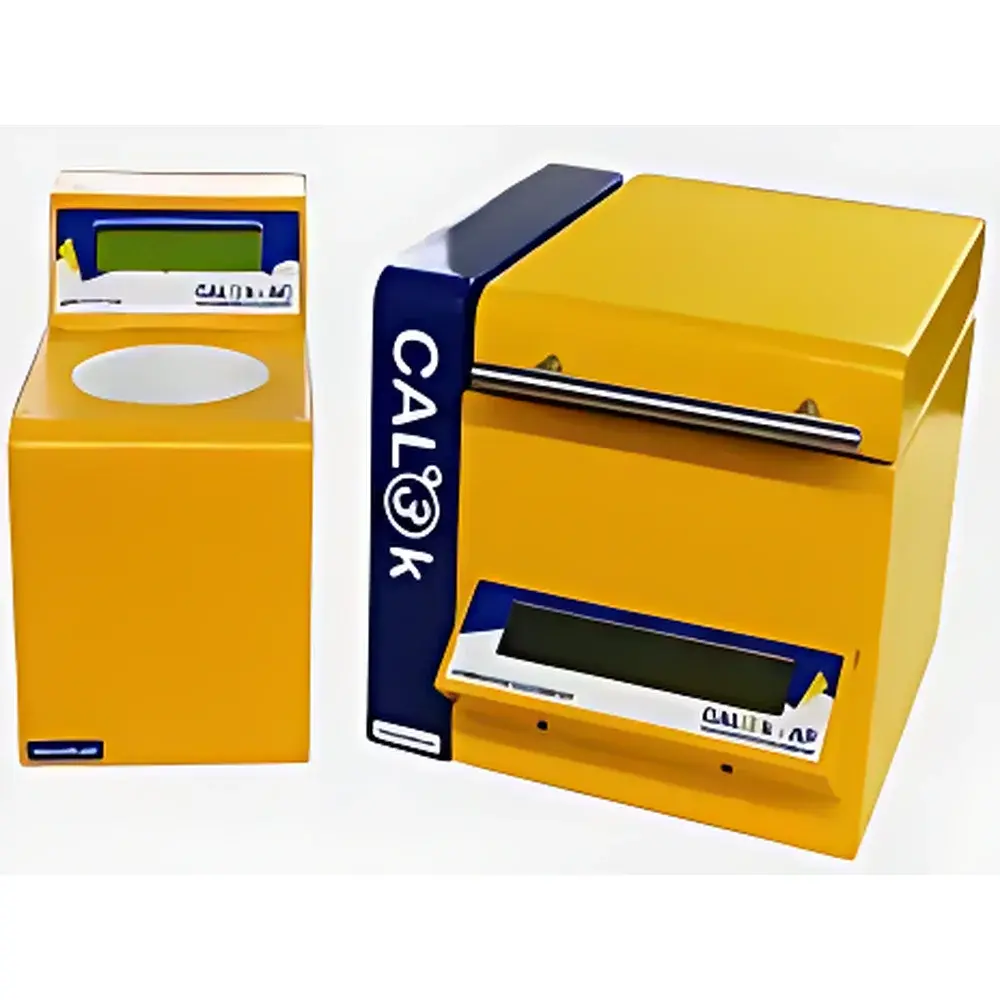
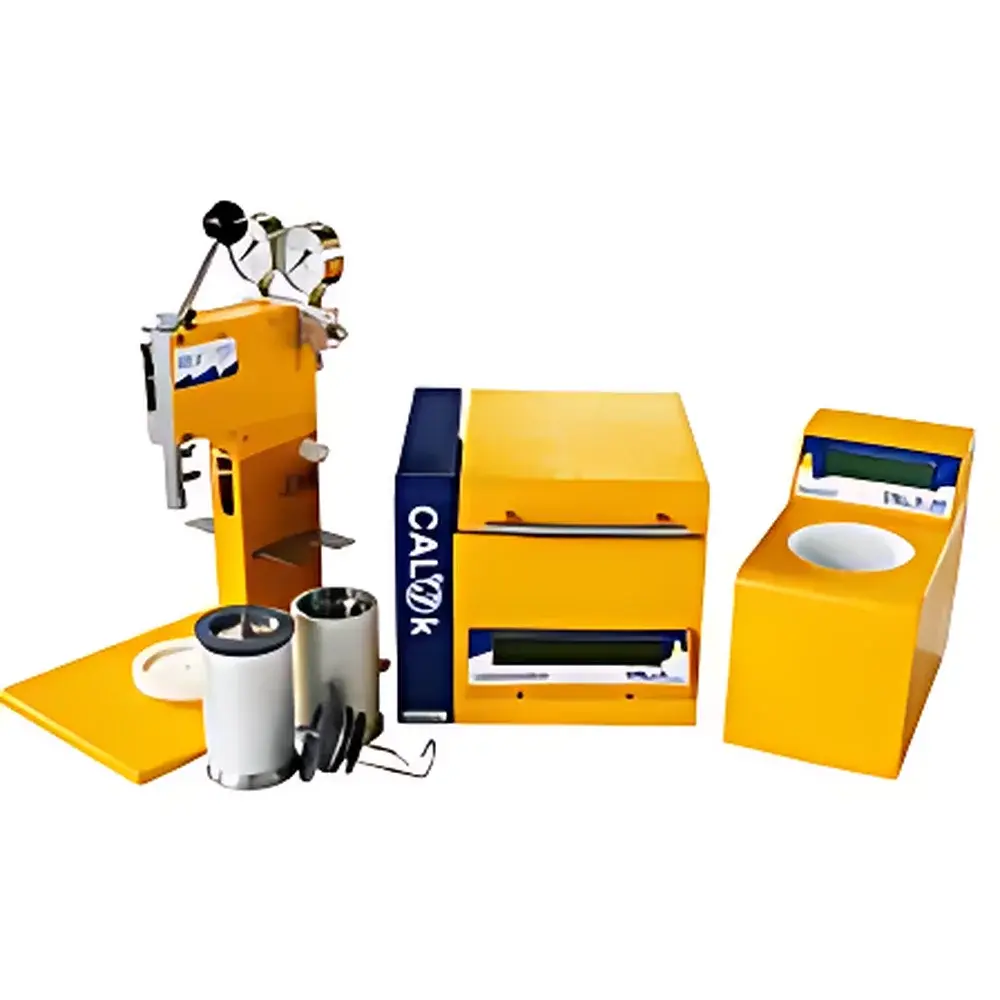
DDS CAL3K-AP Isoperibolic Oxygen Bomb Calorimeter
| Brand | DDS |
|---|---|
| Origin | South Africa |
| Manufacturer Type | Authorized Distributor |
| Origin Category | Imported |
| Model | CAL3K-AP |
| Instrument Type | Oxygen Bomb Calorimeter |
| Measurement Mode | Isoperibolic (Constant-Temperature Jacket) |
| Temperature Range | 0–40 °C |
| Temperature Resolution | 0.0001 °C |
| Precision | ±0.1% RSD |
| Single-Sample Test Time | ~15 min (standard), down to 4–6 min with dual-bomb operation |
| Heat Capacity Calibration Range | 99,000 J/K |
| Cooling Medium | Forced Air |
| Water-Free Operation | Yes |
| Max. Energy Measurement | 99 MJ |
| Min. Operating Temp. | 0 °C |
| Max. Operating Temp. | 50 °C |
| Temp. Stability Resolution | 10 ppm |
| Throughput | ≥10 samples/h (with dual bomb + air cooler) |
| Compliance | ASTM D240, D5865, D4809, D5468, E144, E711 |
| BS 4791 | 1985 |
Overview
The DDS CAL3K-AP Isoperibolic Oxygen Bomb Calorimeter is a high-precision, water-free combustion calorimetry system engineered for accurate gross calorific value (GCV) determination across diverse solid and liquid fuels and organic materials. Unlike traditional adiabatic or isothermal bomb calorimeters requiring large water jackets, the CAL3K-AP employs an isoperibolic measurement principle—maintaining a highly stable external jacket temperature while precisely tracking the temperature rise of the inner combustion vessel via ultra-stable platinum resistance thermometers (PRTs) with 0.0001 °C resolution and 10 ppm thermal stability. This architecture eliminates dependence on water volume calibration, minimizes thermal lag, and delivers reproducibility better than 0.01% RSD—meeting or exceeding the stringent repeatability requirements of ASTM D5865-04 (coal), ASTM D240-02 (petroleum products), and ISO 1928 (solid biofuels). Designed and manufactured by DDS (South Africa), the system integrates fully automated oxygen charging, gas venting, and bomb handling—enabling robust, operator-independent operation in QC laboratories, energy certification facilities, and R&D environments subject to GLP, GMP, or ISO/IEC 17025 accreditation.
Key Features
- Water-free isoperibolic design: Eliminates water bath calibration drift, evaporation loss, and maintenance associated with traditional calorimeters; reduces consumables and environmental footprint.
- Modular dual- or triple-bomb configuration: Supports continuous throughput of ≥10 samples per hour (with air cooler); enables unattended sequential analysis without manual bomb transfer.
- Quick-lock bayonet-style oxygen bomb: Fully sealed automatic latching mechanism with integrated PRT; allows rapid bomb exchange, complete sample residue removal, and simplified cleaning/maintenance.
- Forced-air active cooling system: Integrated air cooler maintains precise jacket temperature control (±0.01 °C) across ambient conditions from 15–70 °C, ensuring stable baseline and minimal thermal inertia.
- USB-configurable firmware: Lab-specific parameters—including ignition delay, oxygen pressure setpoint (up to 3.5 MPa), post-combustion hold time, and result reporting format—are programmable via standard USB interface.
- Self-calibrating thermal reference: Built-in NIST-traceable reference resistor network validates temperature measurement linearity and offset prior to each test cycle.
Sample Compatibility & Compliance
The CAL3K-AP accommodates heterogeneous solid and liquid matrices including bituminous and anthracite coal, biomass pellets, animal feed, cement raw meal, explosives, propellants, diesel, kerosene, biodiesel blends, and foodstuffs. Its low-thermal-mass combustion chamber and optimized oxygen flow dynamics ensure complete, soot-free oxidation of high-ash, high-sulfur, or chlorine-containing samples—critical for compliance with ASTM E144 (bomb preparation), ASTM D4809 (liquid fuels), and ISO 1928 Annex A (correction for nitric acid and sulfuric acid formation). All hardware and firmware are validated against FDA 21 CFR Part 11 requirements for electronic records and signatures, including full audit trail logging of operator ID, method version, calibration history, and raw thermogram data. System documentation supports IQ/OQ/PQ protocols aligned with ISO/IEC 17025:2017 Clause 6.4 (equipment verification) and ASTM E711-87 (calorimeter qualification).
Software & Data Management
Control and analysis are performed via DDS CalWin v4.x software (Windows 10/11 compatible), providing real-time thermogram visualization, automated baseline correction (using polynomial regression over pre- and post-ignition segments), and stoichiometric correction algorithms per ASTM D5468-02. Raw temperature vs. time datasets are stored in HDF5 format with embedded metadata (sample ID, operator, date/time, bomb serial, O2 pressure, ambient RH/T). Export options include CSV, PDF reports compliant with ISO 17025 record retention, and direct integration into LIMS via ODBC or REST API. Audit trails capture all user actions, parameter changes, and calibration events with immutable timestamps and digital signatures—fully traceable for regulatory inspections.
Applications
- Coal and coke quality control in power generation and metallurgical plants (ASTM D5865, GB/T 213)
- Gross calorific value certification of biomass and waste-derived fuels (ISO 18125, EN 14918)
- Nutritional energy evaluation in animal feed and human food R&D (Atwater system validation)
- Explosives performance testing and safety compliance (UN Test Series 3, MIL-STD-1751A)
- Alternative fuel development (HVO, FT-diesel, pyrolysis oils) under ASTM D7457 and ISO 12952
- Cement and lime manufacturing process optimization (heat of reaction profiling)
FAQ
Does the CAL3K-AP require distilled water or coolant refills?
No. The system operates without any water bath, jacket fluid, or refrigerant—relying solely on precision air cooling and digital thermal modeling.
Can it measure samples with high sulfur or chlorine content?
Yes. The corrosion-resistant Inconel 600 bomb liner and optional silver nitrate scrubber cartridge mitigate acid gas interference; corrections for HNO3 and H2SO4 formation are applied automatically per ISO 1928.
What is the minimum sample mass required for reliable results?
Typical range is 0.5–1.2 g for coal and biomass; 0.2–0.8 g for liquid fuels. Minimum detectable energy increment is 0.02 MJ/kg at 99,000 J heat capacity.
Is third-party calibration certification included?
Each unit ships with a factory-issued NIST-traceable calibration certificate covering temperature sensor linearity, oxygen pressure transducer accuracy, and energy equivalence (benzoic acid CRM verification).
How is data integrity ensured during power interruption?
The embedded controller retains volatile thermogram buffers in non-volatile RAM and resumes acquisition upon recovery; no data loss occurs below 200 ms outage.



