
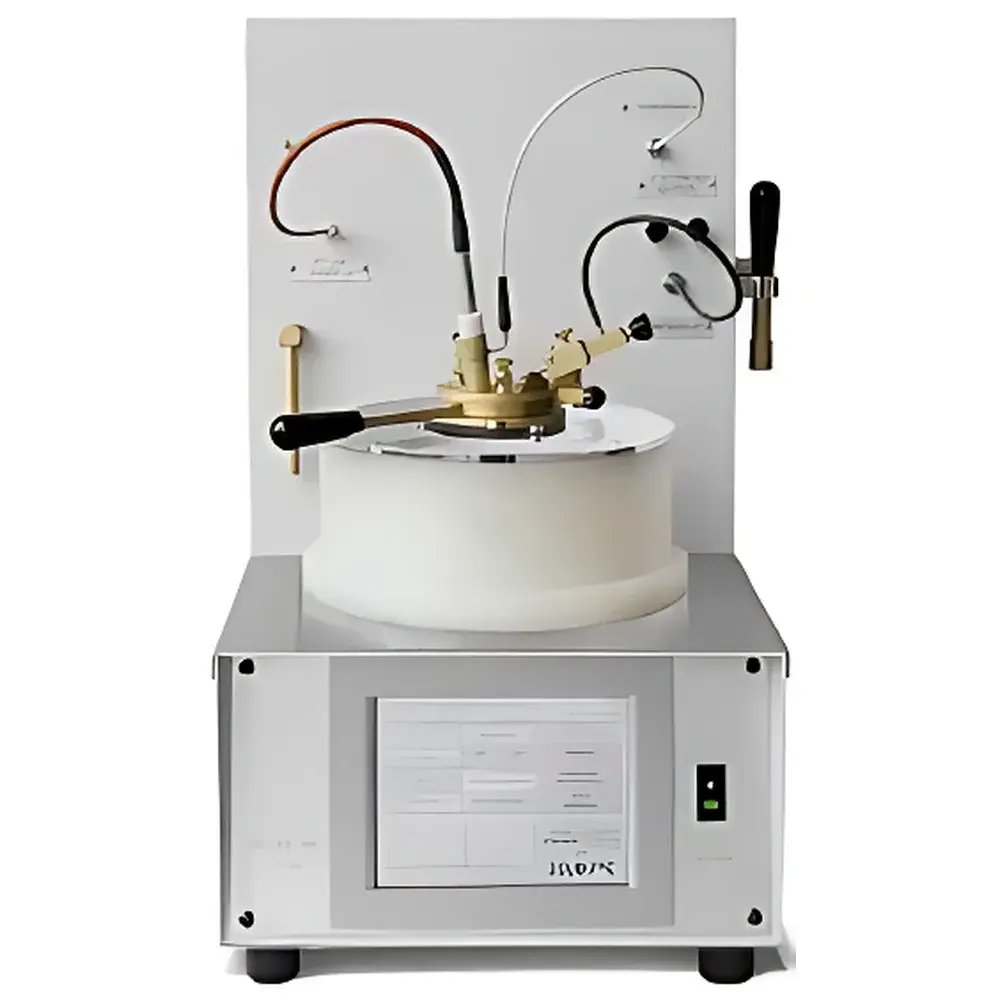
SDM MiniFlash 930AUT Fully Automated Closed-Cup Flash Point Tester
| Brand | SDM |
|---|---|
| Origin | Italy |
| Model | MiniFlash 930AUT |
| Test Method | Closed-Cup (Tag Method) |
| Compliance | ASTM D56, D3278, D3934, D3941 |
| Temperature Sensor | PT100 |
| Temperature Accuracy | ±0.1 °C |
| Display | 800×480 Touchscreen |
| Power Supply | 220 V, 50 Hz, 600 W |
| Sample Cup | Copper |
| Heating System | Electronic Regulated Heater |
| Cooling System | Integrated Internal Cooling Coil |
| Ignition | Dual-Mode (Gas Flame or Electric Spark), Auto-Triggered per Standard Protocol |
Overview
The SDM MiniFlash 930AUT is a fully automated closed-cup flash point tester engineered for precision, regulatory compliance, and operational robustness in petroleum, chemical, and environmental testing laboratories. It implements the standardized Tag closed-cup method (ASTM D56) — a dynamic equilibrium-based thermal ignition test where a small sample is heated incrementally under a sealed cup, and an ignition source is automatically introduced at predefined temperature intervals. The instrument detects the lowest temperature at which vapors above the sample ignite momentarily upon exposure to flame or spark, defining the flash point. This principle ensures high reproducibility across volatile liquid matrices including gasoline, diesel, kerosene, solvents, waste streams, and industrial intermediates. Designed and manufactured in Italy, the 930AUT integrates electrothermal control, ionization-based flame detection, and real-time thermal feedback to meet the stringent repeatability and traceability requirements of ISO/IEC 17025-accredited facilities.
Key Features
- Fully automated Tag method execution with programmable temperature ramping, auto-ignition triggering, and ionization-based flash detection — eliminating operator-dependent variability.
- Dual ignition system: configurable gas flame or electric spark ignition, both compliant with ASTM D56 and ISO 1523 protocols.
- Copper sample cup with precision-machined sliding lid mechanism ensuring consistent vapor containment and thermal uniformity.
- PT100 platinum resistance thermometer calibrated to NIST-traceable standards, delivering ±0.1 °C accuracy across the operational range.
- Integrated internal cooling coil enables rapid temperature stabilization between tests, supporting high-throughput workflows without external chillers.
- Robust enclosure finished with acid-resistant epoxy coating, suitable for long-term operation in corrosive laboratory environments.
- 800×480 high-contrast touchscreen interface with intuitive navigation, multilingual support, and on-device method storage.
Sample Compatibility & Compliance
The MiniFlash 930AUT accommodates a broad spectrum of liquid samples beyond refined petroleum products — including hydrocarbon solvents, biofuels, paint thinners, cleaning agents, and regulated hazardous waste streams. Its closed-cup design minimizes vapor loss and improves safety during analysis of highly volatile substances. The instrument is formally validated against key international standards: ASTM D56 (Tag method), D3278 (small-scale Tag), D3934 and D3941 (low-flash and viscous materials), IP 491/492/304, and ISO 1516, 1523, and 3679. All firmware and calibration routines are structured to support GLP and GMP documentation requirements, including full audit trails, user access levels, and electronic signature capability when integrated with compliant LIMS environments.
Software & Data Management
The embedded Windows-based software suite (compatible with Windows 2000 through Windows Vista) provides comprehensive method development, diagnostics, calibration, and data handling capabilities. Users define custom test sequences via the Analysis Menu, configure alarm thresholds and pass/fail criteria, and select report templates supporting PDF, CSV, and graphical export (e.g., temperature vs. time curves). The Diagnostic Menu enables real-time monitoring of heater status, sensor drift, ignition timing, and detector response. Calibration procedures follow documented SOPs aligned with ISO 17025 Clause 6.5, allowing traceable adjustment using certified reference standards. All data entries — including operator ID, sample ID, method version, timestamp, and raw sensor logs — are stored with immutable timestamps and are exportable for regulatory submission or QA review.
Applications
This instrument serves critical quality control and safety assessment functions across multiple sectors: refinery QC labs verifying distillate specifications prior to shipment; petrochemical R&D teams screening solvent blends for formulation stability; environmental laboratories assessing flash hazards in contaminated soil leachates or wastewater extracts; and regulatory compliance units validating SDS flash point declarations per GHS and CLP regulations. Its adaptability to low-viscosity and moderately viscous samples — combined with minimal sample volume requirement (typically 1–2 mL) — makes it especially valuable for high-value or limited-availability materials.
FAQ
What standards does the MiniFlash 930AUT support?
ASTM D56, D3278, D3934, D3941; IP 491, 492, 304; ISO 1516, 1523, and 3679.
Is external cooling water required?
No — the unit features an integrated internal cooling coil, eliminating dependency on external chillers or tap water connections.
Can the instrument be integrated into a LIMS or ELN environment?
Yes — via RS-232 or optional Ethernet interface, supporting ASTM E1384-compliant data transfer and 21 CFR Part 11–ready audit trail generation when configured with appropriate security policies.
What is the typical sample volume required?
1–2 mL per test, depending on cup geometry and sample volatility.
How is calibration verified and maintained?
Using certified flash point reference standards (e.g., n-decane, n-dodecane), with calibration logs stored internally and exportable for QA documentation.





