
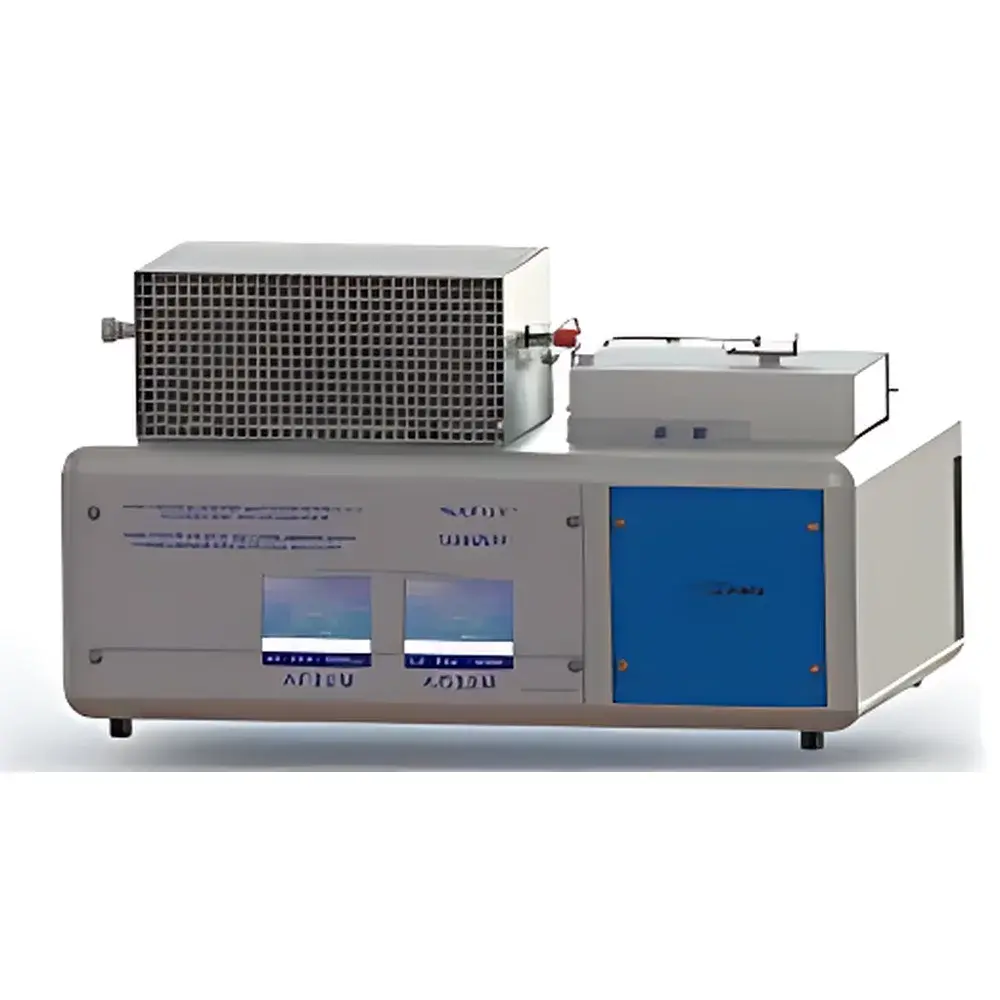
ERALYTICS SulfUV Total Sulfur Analyzer by UV Fluorescence
| Brand | ERALYTICS |
|---|---|
| Origin | France |
| Model | SulfUV |
| Measurement Principle | UV Fluorescence Detection of SO₂ |
| Heating System | High-Frequency Combustion Furnace (1000 °C) |
| Measurement Range | 10 ppb – ~10 wt% S |
| Sensitivity | 0.001 ppm |
| Accuracy | ±0.05 ppm at 0.5 ppm |
| Analysis Time | 5 min (liquids/gases), 5–10 min (solids) |
| Sample Introduction | Liquid (20–100 µL syringe), Gas/LPG (1–10 mL via gas injector), Solid (0.5–100 mg in sample boat) |
| Dimensions | 80 cm × 55 cm × 30 cm (L×H×D) |
| Weight | 35 kg |
Overview
The ERALYTICS SulfUV Total Sulfur Analyzer is a high-precision, laboratory-grade elemental analyzer engineered for quantitative determination of total sulfur content across liquid, gaseous, and solid matrices using ultraviolet fluorescence (UVF) detection. Its operational principle relies on complete oxidative pyrolysis of sulfur-containing compounds in a high-frequency induction furnace operating at a precisely controlled temperature of 1000 °C. During combustion, all organic and inorganic sulfur species are quantitatively converted to sulfur dioxide (SO₂). The resulting SO₂ gas stream is carried by ultra-pure oxygen or synthetic air into a dedicated UV fluorescence detector chamber. There, SO₂ molecules are excited by pulsed 190–230 nm UV radiation and emit characteristic fluorescence at ~310 nm upon relaxation. A low-noise photomultiplier tube (PMT) detects this emission with high specificity and linearity over six orders of magnitude — enabling trace-level quantification down to 10 ppb while maintaining robust performance up to ~10 wt% sulfur. This method conforms to internationally recognized principles outlined in ASTM D5453, ISO 20846, and UOP 971 for total sulfur analysis in fuels, petrochemicals, and environmental samples.
Key Features
- High-frequency induction furnace with closed-loop temperature control at 1000 °C, ensuring complete and reproducible sulfur oxidation independent of matrix complexity
- Dedicated quartz combustion tube with fluororubber outlet coupling — chemically inert and resistant to halogenated or acidic byproducts
- Optimized UV fluorescence detection system featuring a thermoelectrically cooled PMT, narrow-band optical filtering, and background-subtracted signal processing
- Graphical LCD interface with real-time process flow visualization, programmable measurement ranges, and linear calibration support
- Multi-language interactive menu-driven software (English, French, German, Spanish) for intuitive method setup, run control, and diagnostics
- Modular sample introduction: syringe-based liquid/gas injection (20 µL–25 mL), dedicated LPG/Gas injector (1–10 mL), and solid sample boat (0.5–100 mg)
- Robust architecture designed for unattended operation in QC laboratories complying with GLP and ISO/IEC 17025 requirements
Sample Compatibility & Compliance
The SulfUV accommodates diverse sample types without derivatization or pre-treatment: hydrocarbon fuels (gasoline, diesel, jet fuel), lubricants, crude oil, LPG, natural gas condensates, polymers, catalysts, coal, and environmental solids (e.g., soils, sediments). Its detection specificity for SO₂ eliminates interferences from nitrogen oxides, hydrocarbons, or CO₂ — a critical advantage over electrochemical or microcoulometric alternatives. The system meets essential regulatory alignment for routine testing under ASTM D5453 (determination of total sulfur in light hydrocarbons, spark ignition engine fuels, and motor oils), ISO 20846 (petroleum products — determination of sulfur content — UV fluorescence method), and UOP 971 (total sulfur in gasoline and naphthas). All calibration, validation, and audit trails are fully documented in accordance with FDA 21 CFR Part 11-compliant data management protocols when paired with optional secure software modules.
Software & Data Management
The embedded firmware supports method storage, multi-point calibration curve generation (linear and quadratic), limit checking, and automatic report generation in PDF or CSV formats. Raw detector signals, furnace temperature logs, and gas flow parameters are timestamped and archived with full metadata. Optional PC-based software enables advanced data review, trend analysis, instrument qualification (IQ/OQ), and integration with LIMS via ASTM E1384-compliant export. Audit trail functionality records user actions, parameter changes, and calibration events — satisfying GLP, GMP, and ISO/IEC 17025 traceability requirements. Electronic signatures and role-based access control are available in validated configurations.
Applications
- Quality control of refinery streams and finished fuels to meet Euro 5/6, Tier 3, and IMO 2020 sulfur cap specifications (≤0.10 wt% or ≤0.50 wt% in marine fuels)
- Monitoring sulfur content in catalysts and process intermediates during petrochemical synthesis
- Environmental compliance testing of soil, fly ash, and industrial sludge per EPA Method 5050B equivalents
- R&D analysis of sulfur speciation in novel battery electrolytes, elastomers, and pharmaceutical excipients
- Verification of desulfurization efficiency in hydrotreating units and amine scrubbing systems
FAQ
What sulfur species does the SulfUV detect?
It measures total sulfur — all organic (e.g., thiophenes, sulfides, mercaptans) and inorganic (e.g., sulfate, sulfide) forms — by quantitative conversion to SO₂ during high-temperature combustion.
Is carrier gas purity critical for accurate results?
Yes. Ultra-high-purity oxygen (≥99.999%) or synthetic air (hydrocarbon-free) is required to prevent quenching of UV fluorescence and baseline drift.
Can the SulfUV analyze viscous or halogenated samples?
Yes — the quartz combustion tube and fluororubber interface tolerate chlorinated solvents and heavy distillates; optional ceramic liners extend lifetime for highly abrasive or corrosive matrices.
How often must the UV lamp and PMT be replaced?
The pulsed UV source has a typical service life of ≥5,000 hours; the PMT is rated for ≥10,000 hours under standard operating conditions — both monitored via built-in diagnostics.
Does the system support automated calibration verification?
Yes. Daily system suitability checks using certified reference materials (e.g., DBT in toluene) can be scheduled and logged with pass/fail criteria per ISO/IEC 17025 Annex A.3.





