
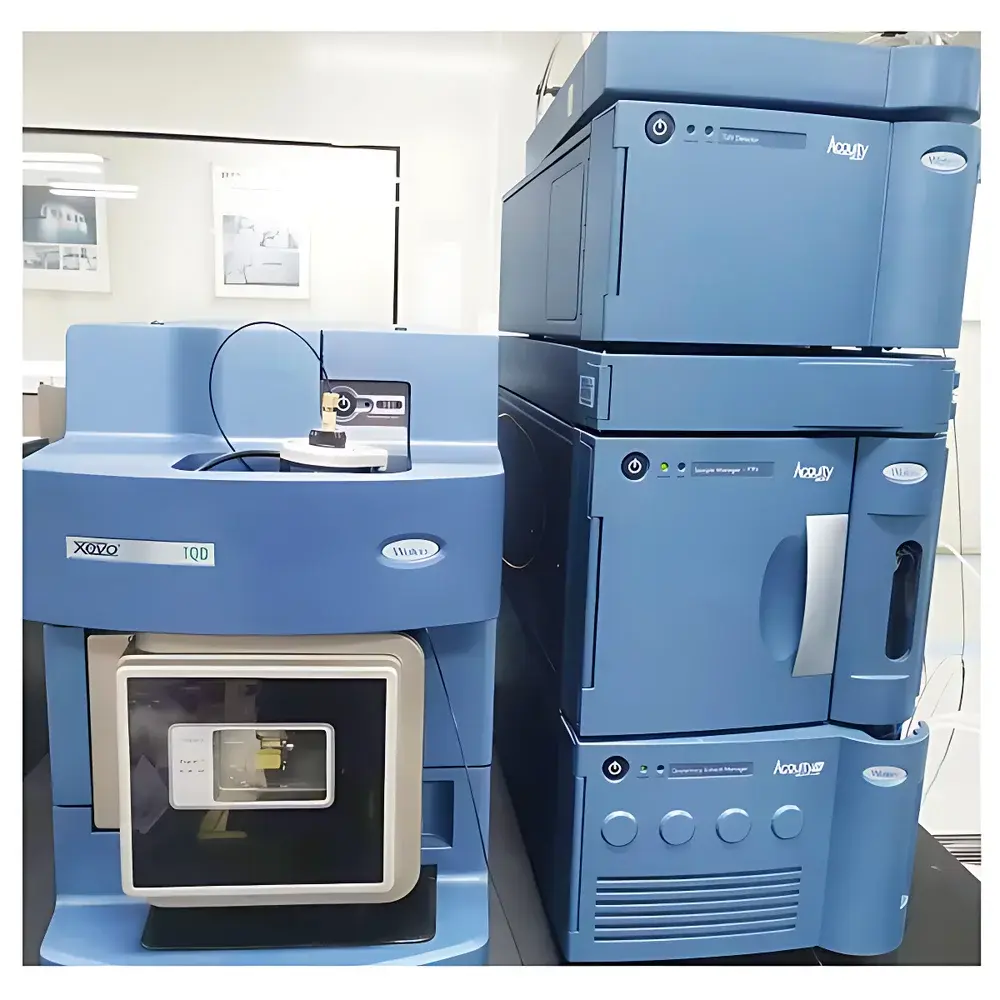
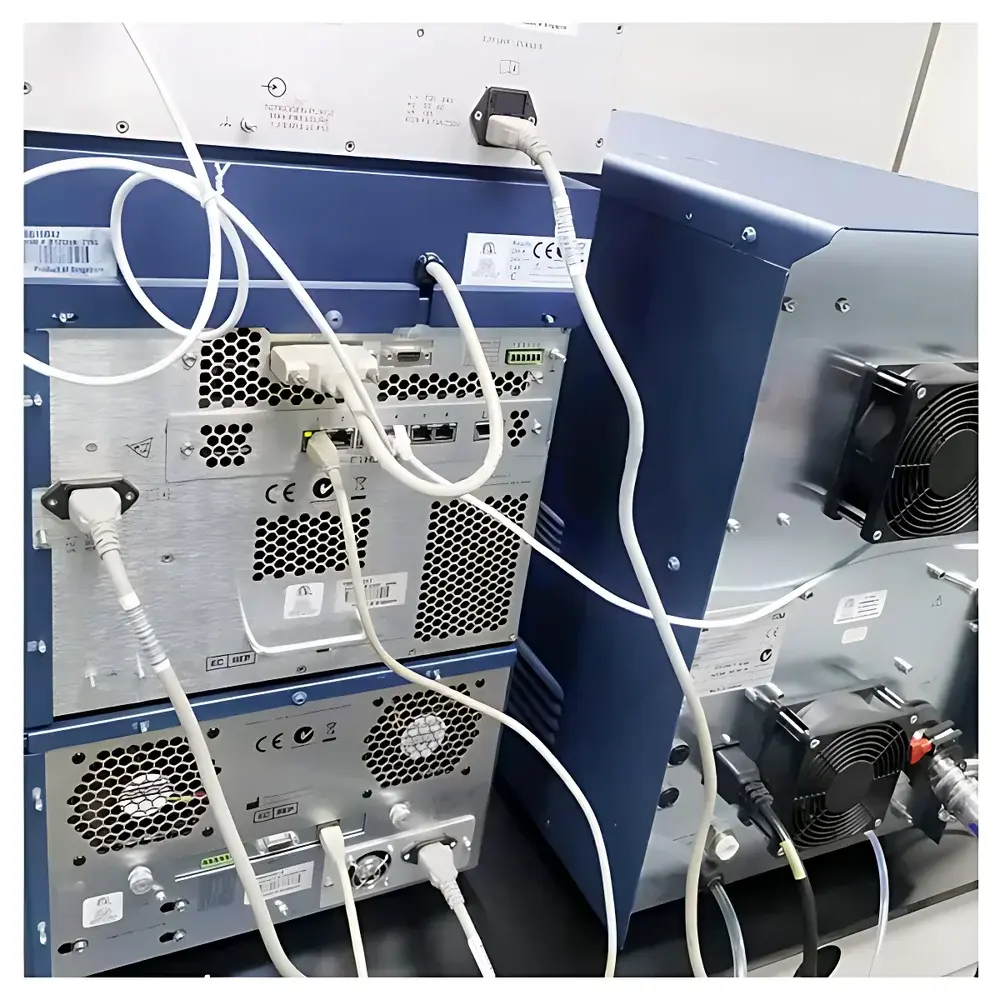
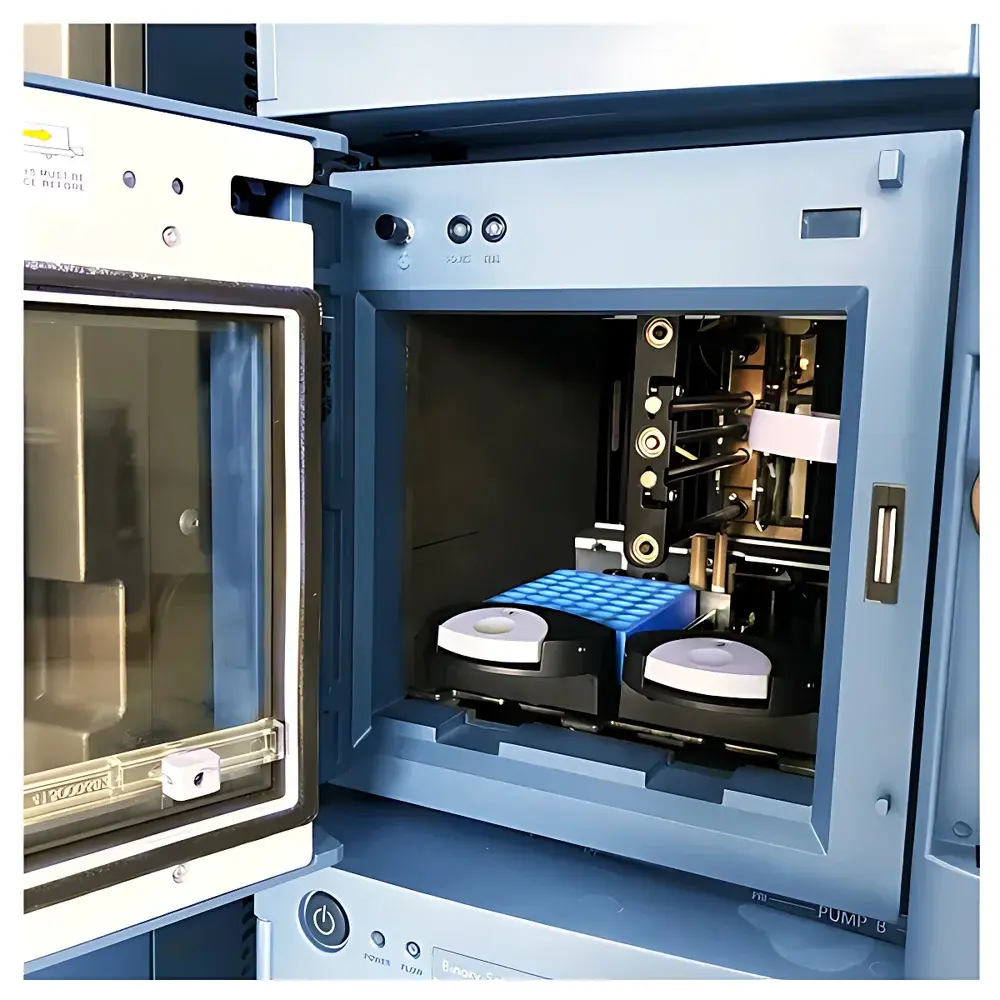
Waters ACQUITY TQD Triple Quadrupole Liquid Chromatography Mass Spectrometer
| Brand | Waters |
|---|---|
| Origin | USA |
| Instrument Type | Triple Quadrupole (TQ) |
| Mass Range | 10–2,000 m/z |
| Sensitivity | <100 fg on-column for reserpine (S/N ≥ 50:1, MRM) |
| Resolution | Unit mass resolution (0.5–0.7 Da full width at half maximum) |
| Mass Accuracy | ±0.1 Da (calibrated) |
| Operating Pressure Range | Up to 1200 bar (UPLC-compatible) |
| Ionization Modes | ESI, APCI, ESCi (electrospray + APCI hybrid), APPI (optional) |
| Collision Cell | T-Wave™ RF-only ion guide with CID capability |
| Vacuum System | Dual-stage differential pumping with Edwards turbomolecular pump and backing pump |
| Detector | Sealed photomultiplier tube (PMT), >10-year operational lifetime |
| Software Platform | MassLynx v4.2 or Empower 3 CDS (21 CFR Part 11 compliant configuration available) |
Overview
The Waters ACQUITY TQD is a high-performance triple quadrupole liquid chromatography mass spectrometer engineered for robust, high-throughput quantitative analysis in regulated and research laboratories. Built upon the foundational architecture of the ACQUITY UPLC platform, the TQD integrates seamlessly with ultra-high-pressure liquid chromatography (up to 1200 bar) to deliver exceptional chromatographic resolution, speed, and sensitivity. Its core measurement principle relies on tandem mass spectrometry (MS/MS) using three quadrupole mass filters: Q1 selects precursor ions, Q2 serves as a collision-induced dissociation (CID) cell utilizing T-Wave™ ion transmission technology, and Q3 analyzes product ions in selected reaction monitoring (SRM) or multiple reaction monitoring (MRM) mode. This configuration ensures high specificity, low chemical noise, and superior signal-to-noise ratios—critical for trace-level quantification in complex matrices. The system is designed for routine operation in GLP- and GMP-compliant environments, supporting method validation requirements per ICH, USP , and FDA Bioanalytical Method Validation Guidance.
Key Features
- Triple quadrupole mass analyzer with unit-resolution quadrupoles (Q1/Q3) and a T-Wave™ collision cell for efficient ion transmission and controlled fragmentation
- ZSpray™ dual orthogonal atmospheric pressure ion source with integrated gate valve, enabling rapid source maintenance without venting the mass spectrometer vacuum
- Multi-mode ionization support: electrospray ionization (ESI), atmospheric pressure chemical ionization (APCI), ESCi™ (simultaneous ESI/APCI), and optional atmospheric pressure photoionization (APPI)
- IntelliStart™ software automates mass calibration, resolution optimization, and compound-specific MRM method generation
- QuanOptimize™ (optional add-on) provides end-to-end automation for quantitative workflows—including method setup, acquisition, processing, and report generation
- MassLynx MS software v4.2 with full instrument control, real-time data acquisition, and customizable processing templates; Empower 3 CDS integration available for enterprise-scale chromatographic data management and 21 CFR Part 11 compliance
- Differential vacuum system featuring Edwards turbomolecular pump and oil-free backing pump, with automatic power-failure recovery and vacuum interlock protection
- Compact footprint (<60 cm depth) optimized for benchtop deployment in space-constrained laboratories
Sample Compatibility & Compliance
The ACQUITY TQD accommodates a broad range of sample types—from small-molecule pharmaceuticals and metabolites to peptides, lipids, and environmental contaminants—without requiring hardware modification. Its ZSpray source design minimizes matrix effects and suppresses ion suppression through efficient desolvation and orthogonal ion injection. The system complies with international regulatory frameworks including ISO/IEC 17025:2017 for testing laboratories, ASTM D7622–19 for LC-MS/MS pesticide residue analysis, and EPA Method 1694 for pharmaceuticals and personal care products in water. When configured with audit-trail-enabled Empower 3 CDS and electronic signatures, it meets FDA 21 CFR Part 11 requirements for electronic records and signatures in clinical bioanalysis and quality control settings.
Software & Data Management
Instrument control and data handling are managed via MassLynx MS software (v4.2), which supports real-time MRM optimization, dynamic dwell time adjustment, polarity switching (<20 ms), and scheduled MRM acquisition synchronized with UPLC gradients. For integrated chromatography–mass spectrometry workflows, Empower 3 CDS provides centralized method storage, cross-platform instrument scheduling, automated peak integration, and validated reporting modules. All software versions support secure user access levels, change control logs, and electronic signature functionality required under GLP and GMP practices. Data files adhere to open formats (e.g., .RAW, .CDF) compatible with third-party processing tools such as TargetLynx, QuanLynx, and commercial LIMS platforms.
Applications
The ACQUITY TQD is routinely deployed across diverse application domains demanding rigorous quantification and method reproducibility. In bioanalysis, it supports pharmacokinetic (PK) and toxicokinetic (TK) studies, achieving sub-pg/mL detection limits for drugs and metabolites in plasma and tissue homogenates. In ADME screening, its fast polarity switching and multi-analyte MRM capability enable simultaneous assessment of metabolic stability, CYP inhibition, and permeability assays. Food safety labs utilize the system for multi-residue pesticide and veterinary drug analysis per EU SANTE/11813/2021 guidelines. Environmental laboratories apply it to trace-level detection of PFAS, pharmaceuticals, and endocrine disruptors in wastewater and soil extracts. Clinical and forensic toxicology workflows benefit from its ability to quantify opioids, benzodiazepines, and synthetic cannabinoids with high precision and minimal carryover.
FAQ
What is the maximum operating pressure supported by the ACQUITY TQD system?
The TQD is fully compatible with ACQUITY UPLC systems operating up to 1200 bar, enabling use of sub-2-µm particle columns for enhanced chromatographic efficiency.
Does the TQD support both positive and negative ionization modes within a single run?
Yes—the system enables rapid polarity switching (<20 ms) during acquisition, allowing simultaneous detection of analytes requiring different ionization polarities in one analytical sequence.
Is the ZSpray ion source compatible with dirty or protein-rich samples?
The dual orthogonal geometry and gate valve design significantly reduce source contamination; source components are modular and can be cleaned or replaced without breaking vacuum.
Can the TQD be validated for use in regulated pharmaceutical QC environments?
When paired with Empower 3 CDS and configured with 21 CFR Part 11 controls, the system supports full IQ/OQ/PQ validation protocols and meets ICH Q2(R2) method validation criteria.
What detector technology does the TQD employ?
A sealed photomultiplier tube (PMT) detector with >10-year service life under continuous operation, housed within the high-vacuum region for long-term signal stability and reduced maintenance frequency.
Related Products





