
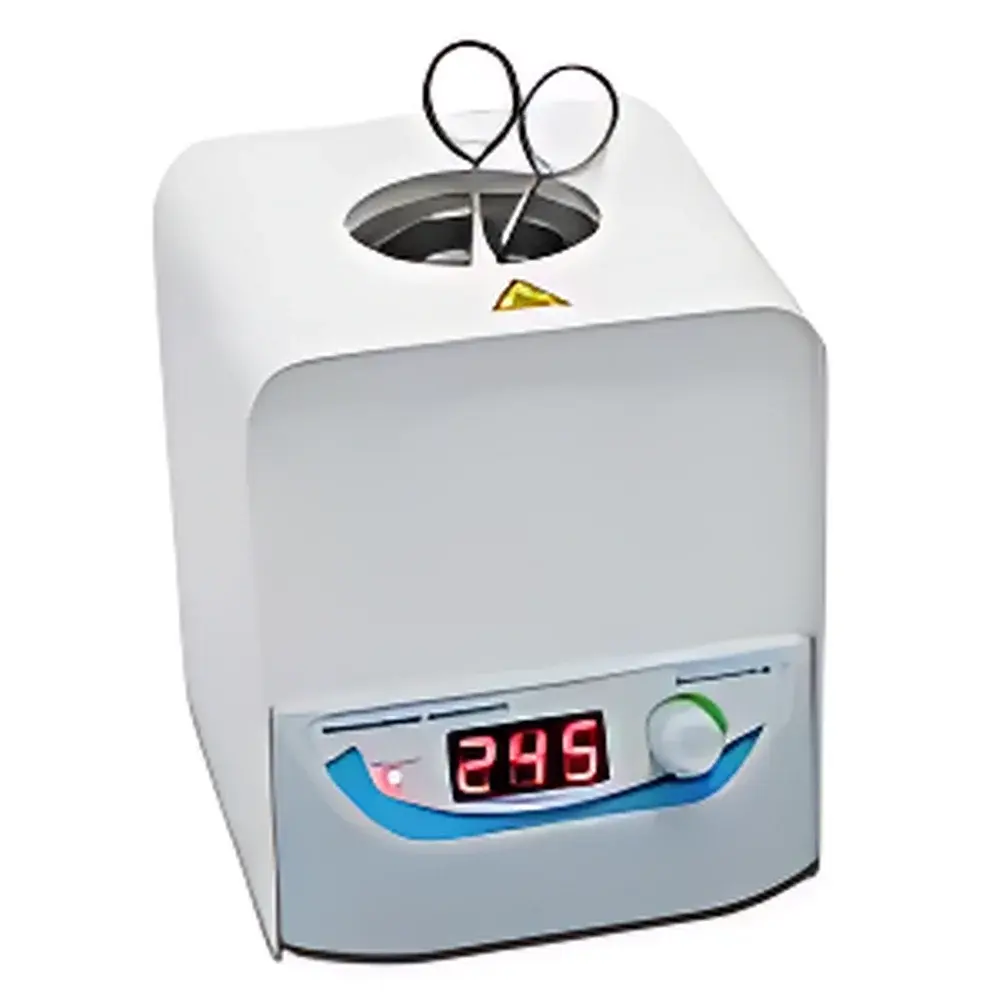
Benchmark MicroBead B1201 Dry Heat Sterilizer with Bead Bath Technology
| Brand | Benchmark |
|---|---|
| Origin | USA |
| Model | MicroBead B1201 |
| Convection Type | Natural Convection |
| Temperature Range | 100–300 °C |
| Temperature Uniformity | ±5 °C across chamber |
| Temperature Control Accuracy | ±2 °C at setpoint |
| Heating Power | 300 W |
| Internal Chamber Dimensions (W×D×H) | 14.5 × 15.5 × 15.5 cm |
| Chamber Diameter | 40 mm |
| Chamber Height | 80 mm |
| Bead Capacity | 150 g |
| External Dimensions | 14.5 × 15.5 × 15.5 cm |
| Net Weight | 2.0 kg |
| Preheat Time to 300 °C | ~25 min |
Overview
The Benchmark MicroBead B1201 is a compact, digitally controlled dry heat sterilizer engineered for rapid, residue-free sterilization of heat-stable laboratory instruments—including forceps, needles, scalpels, pipette tips, and microtome blades—without reliance on pressurized steam, chemical agents, or ultraviolet radiation. Unlike conventional hot-air ovens or autoclaves, the B1201 employs thermally stable aluminum oxide beads (Al2O3) as a high-efficiency heat transfer medium. These inert, non-toxic beads are heated resistively within a precisely insulated stainless-steel chamber and maintain uniform thermal energy distribution via natural convection and conductive coupling. The system operates strictly within the validated dry heat sterilization range of 100–300 °C, enabling microbiological lethality through sustained thermal denaturation of proteins and nucleic acids in bacterial spores—including Bacillus atrophaeus (formerly B. subtilis) ATCC 9372—per ISO 14937 and ISO 11139 standards.
Key Features
- Digital PID temperature controller with real-time display, adjustable setpoint resolution of 1 °C, and automatic over-temperature cutoff at 310 °C
- Compact footprint (14.5 × 15.5 × 15.5 cm) and lightweight design (2.0 kg) optimized for benchtop deployment in biosafety cabinets, laminar flow hoods, or shared core facilities
- Stainless-steel inner chamber with ceramic-coated heating elements and low-thermal-mass bead bath ensuring rapid heat-up (~25 min to 300 °C) and minimal cooldown lag
- Natural convection architecture eliminates internal fans—reducing particulate generation, vibration, and maintenance requirements
- UL-listed electrical safety compliance (UL 61010-1) and CE marking for Class I equipment under IEC 61010-1:2010
- Integrated timer function (0–99 min) with audible end-of-cycle alert and auto-shutdown
Sample Compatibility & Compliance
The B1201 accommodates instruments with maximum dimensions of Ø40 mm × 80 mm, making it suitable for sterilizing standard surgical tools, glass capillaries, metal loops, and reusable microfluidic connectors. It is not intended for plastic, rubber, or heat-labile polymers. The device complies with key international sterilization validation frameworks: its thermal performance supports verification per ISO 17665-1 (dry heat), and routine operation aligns with GLP/GMP documentation requirements when paired with external data loggers. While not FDA-cleared as a medical device, its operational parameters meet ASTM E530-22 criteria for dry heat sterilizer qualification and support AAMI ST46:2022 guidance on low-temperature sterilization alternatives.
Software & Data Management
The MicroBead B1201 operates as a standalone instrument without embedded software or network connectivity. All controls and status indicators are hardware-based—ensuring deterministic response, immunity to firmware vulnerabilities, and compatibility with regulated environments where IT validation is constrained. For auditability, users may integrate third-party calibrated thermocouple loggers (e.g., Omega OM-DAQPRO-5300) into the bead bath during qualification runs. Temperature profiles, exposure durations, and operator IDs can be recorded manually in lab notebooks or electronic lab notebooks (ELNs) compliant with 21 CFR Part 11 when using digital signature workflows.
Applications
- Routine sterilization of inoculating loops, spreaders, and needle holders in microbiology teaching labs and QC microbiology suites
- Pre-sterilization of glassware components prior to aseptic assembly in cell culture cleanrooms
- Decontamination of electron microscopy specimen holders and TEM grid tweezers without outgassing risk
- Validation support for dry heat depyrogenation studies targeting endotoxin reduction ≥3-log10
- Backup sterilization method during autoclave downtime or in field-deployable diagnostic laboratories with limited infrastructure
FAQ
Can the MicroBead B1201 be used for sterilizing plastic or coated instruments?
No. Only metal, borosilicate glass, and ceramic instruments rated for continuous exposure up to 300 °C should be processed.
What is the recommended bead replacement interval?
Aluminum oxide beads require no scheduled replacement; however, visual inspection for discoloration, cracking, or sintering is advised every 6 months or after 500 cycles.
Does this unit meet ISO 13485 manufacturing requirements?
The B1201 is distributed by Benchmark Scientific, Inc., a company certified to ISO 13485:2016; the device itself is supplied as a general-purpose laboratory instrument—not as a Class II medical device.
Is calibration traceable to NIST standards?
The unit ships with a factory calibration certificate. Users must perform periodic verification using NIST-traceable thermocouples per ISO/IEC 17025-accredited procedures.
How does bead-based heating compare to forced-air convection in terms of sterility assurance?
Bead baths provide superior thermal contact and reduced air turbulence, minimizing cold-spot formation. Validation studies show D-value consistency comparable to Class B vacuum-assisted dry heat ovens when cycle parameters are rigorously controlled.
Related Products



