
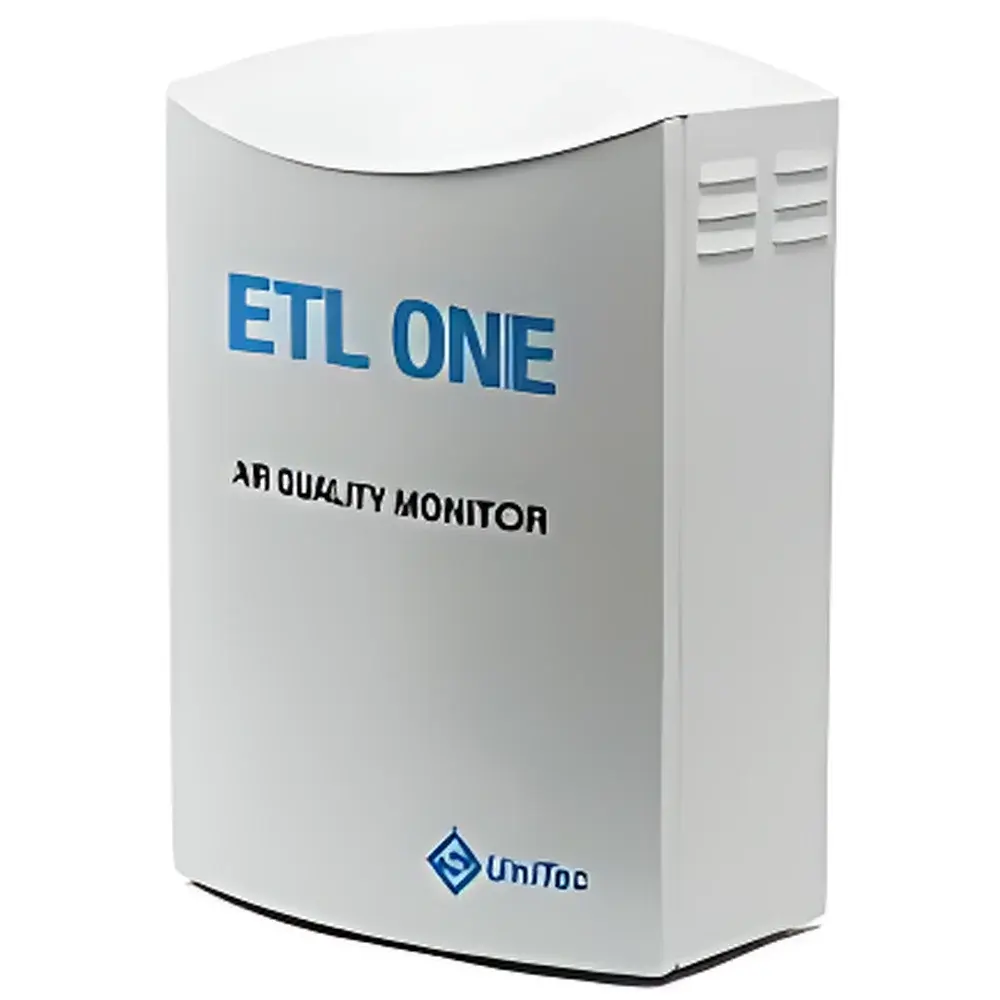
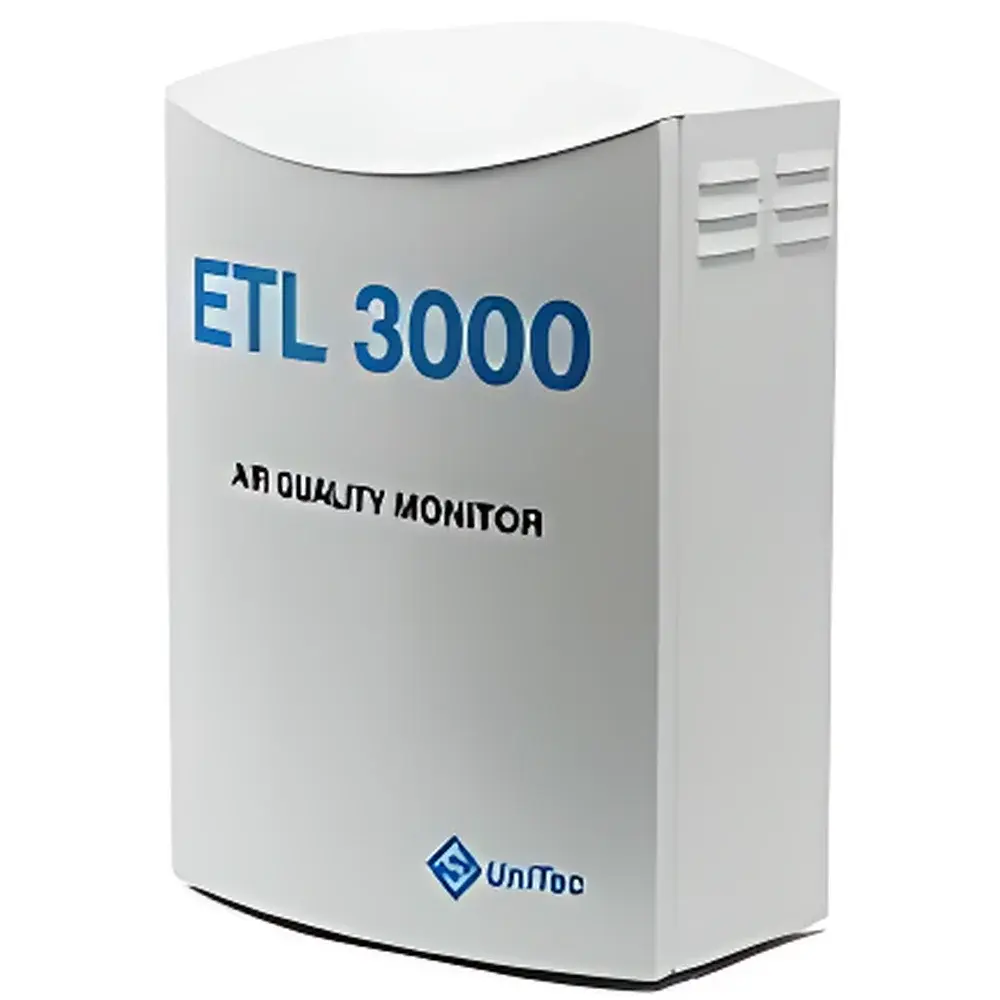
UNITEC ETL3000 Ambient Air Quality Monitoring Station
| Brand | UNITEC |
|---|---|
| Origin | Italy |
| Model | ETL3000 |
| Instrument Type | Fixed Online Monitor |
| Measured Gases | CO, NO₂, O₃, C₆H₆, CH₄, SO₂, H₂S, NH₃, VOC, CO₂ |
| Particulate Matter | PM₁, PM₂.₅, PM₁₀ |
| Response Time | 1 s |
| Measurement Accuracy | ±0.01 ppm |
| Measurement Range | 0.01–100 ppm |
| Operating Temperature | −20 °C to +60 °C |
| Relative Humidity | 10–95% RH (non-condensing) |
| Enclosure Rating | IP55 |
| Dimensions | 370 × 522 × 210 mm |
| Weight | 10 kg |
| Power Supply | 220 V / 110 V / 12 V DC |
| Max. Power Consumption | 30 W |
| Data Logging Interval | 1 s (acquisition), 1 h (storage) |
| Output Interface | RS232 (ASCII protocol) |
| Compliance | EU Directive 2008/50/EC |
Overview
The UNITEC ETL3000 Ambient Air Quality Monitoring Station is a compact, fixed-location, multi-parameter environmental monitoring system engineered for continuous, unattended operation in outdoor urban, industrial, and peri-urban environments. Designed and manufactured in Italy, the ETL3000 implements UNITEC’s proprietary SENS-IT electrochemical and metal oxide semiconductor (MOS) sensor platform—optimized for high selectivity, long-term stability, and ppb-level detection sensitivity across a defined suite of regulated and emerging air pollutants. Unlike traditional extractive sampling systems requiring conditioned air lines, refrigerated chillers, or dilution modules, the ETL3000 employs direct ambient sampling architecture with passive diffusion and calibrated inlet paths, enabling true “plug-and-deploy” installation without auxiliary infrastructure. Its compliance with EU Directive 2008/50/EC ensures alignment with reference measurement methodologies for ambient air quality assessment across member states, supporting regulatory reporting, trend analysis, and public health surveillance programs.
Key Features
- Modular SENS-IT sensor architecture: Each gas-specific sensor (CO, NO₂, O₃, SO₂, H₂S, NH₃, C₆H₆, CH₄, CO₂, total VOC) connects via standardized electrical and mechanical interface—enabling rapid field replacement without recalibration of adjacent channels.
- Integrated particulate matter module: Real-time optical detection of PM₁, PM₂.₅, and PM₁₀ using orthogonal light scattering (OLS) technology; includes automatic zero calibration cycle synchronized with ambient temperature/humidity compensation.
- Robust outdoor-rated enclosure: IP55-rated housing with thermal mass design ensures stable internal operating conditions across −20 °C to +60 °C ambient range and up to 95% RH (non-condensing); no active cooling or air drying required.
- Low-power embedded data acquisition: Onboard microcontroller logs all analog and digital sensor outputs at 1 Hz resolution; stores averaged hourly values on internal flash memory with timestamped metadata (UTC sync via optional GPS or NTP).
- Flexible power options: Compatible with AC mains (220 V / 110 V) or DC sources (12 V), supporting solar-battery hybrid configurations for remote deployments.
- Standardized ASCII serial output: RS232 interface transmits real-time readings as human-readable ASCII strings—facilitating integration with SCADA systems, third-party DAQ platforms, or custom cloud ingestion pipelines.
Sample Compatibility & Compliance
The ETL3000 is validated for ambient air matrices under typical atmospheric pressure (80–106 kPa), wind speeds ≤15 m/s, and particulate loadings up to 1000 µg/m³ (PM₁₀). Sensor cross-sensitivity profiles are characterized per ISO 12039 and EN 14625 for interferent gases (e.g., humidity effects on NO₂ response, ozone quenching on VOC sensors), with built-in compensation algorithms applied in firmware. The system meets the performance criteria outlined in Annex III of EU Directive 2008/50/EC for indicative measurement methods—including data capture rate (>90%), measurement uncertainty (<15% for NO₂/SO₂ at 50% of limit value), and minimum uptime (≥90% annually). While not certified as an equivalent reference method per EN 14211 or EN 14625, the ETL3000 is intended for supplementary monitoring networks, source proximity studies, and community-level exposure assessment where cost-effective density and spatial granularity are prioritized over absolute metrological traceability.
Software & Data Management
Data retrieval and configuration are managed via UNITEC’s ETL Manager software suite (Windows-based), which supports secure local connection over RS232 or USB-to-serial adapters. Functions include sensor zero/span validation, firmware updates, logging interval adjustment, alarm threshold definition (per parameter), and export of CSV/Excel-compatible time-series files. Optional connectivity modules—including GSM, UMTS (with VPN tunneling), and Ethernet—enable automated FTP/SFTP upload or MQTT publishing to cloud platforms. All data transfers retain full audit trail integrity, with timestamps, sensor status flags (e.g., “calibrating”, “out-of-range”, “low-battery”), and CRC checksums. While the ETL3000 does not implement FDA 21 CFR Part 11 electronic signature controls, its logging architecture supports GLP-compliant record retention when deployed with external timestamping servers and write-protected storage media.
Applications
- Urban background and traffic-oriented air quality monitoring networks
- Industrial fence-line monitoring for fugitive emissions (e.g., NH₃ from agriculture, H₂S from wastewater treatment)
- Indoor-outdoor air quality correlation studies in schools, hospitals, and office districts
- Short-term campaign monitoring for construction sites, demolition zones, or wildfire-affected regions
- Calibration verification support for reference-grade analyzers in QA/QC workflows
- Educational and citizen science deployments requiring robust, low-maintenance instrumentation
FAQ
Does the ETL3000 require periodic calibration? How often?
Yes—though SENS-IT sensors exhibit extended baseline stability, UNITEC recommends zero calibration every 30 days and span verification every 90 days under typical urban deployment conditions. Automatic daily zero cycles mitigate drift in particulate and electrochemical channels.
Can the ETL3000 be integrated into existing municipal air quality platforms?
Yes—its ASCII RS232 output and optional UMTS/GSM telemetry modules support seamless ingestion into common environmental data infrastructures including AQMesh, Breeze, and open-source platforms such as SensorThings API or InfluxDB.
Is the PM measurement compliant with EN 13284-1 or ISO 20983?
The orthogonal light scattering (OLS) PM module meets the functional requirements of EN 13284-1 for indicative PM monitoring but is not type-approved as a reference method. It is suitable for comparative trend analysis and relative ranking—not statutory limit enforcement.
What meteorological parameters can be added via optional modules?
The integrated weather station option provides concurrent measurement of wind speed/direction, ambient temperature, relative humidity, barometric pressure, and rainfall—each sampled at 1 Hz and time-aligned with air quality data streams.
How is data security handled during wireless transmission?
UMTS modems support TLS 1.2 encryption and configurable VPN tunnels (IPsec or OpenVPN); authentication credentials are stored in encrypted onboard memory and never exposed in plain-text configuration files.







