
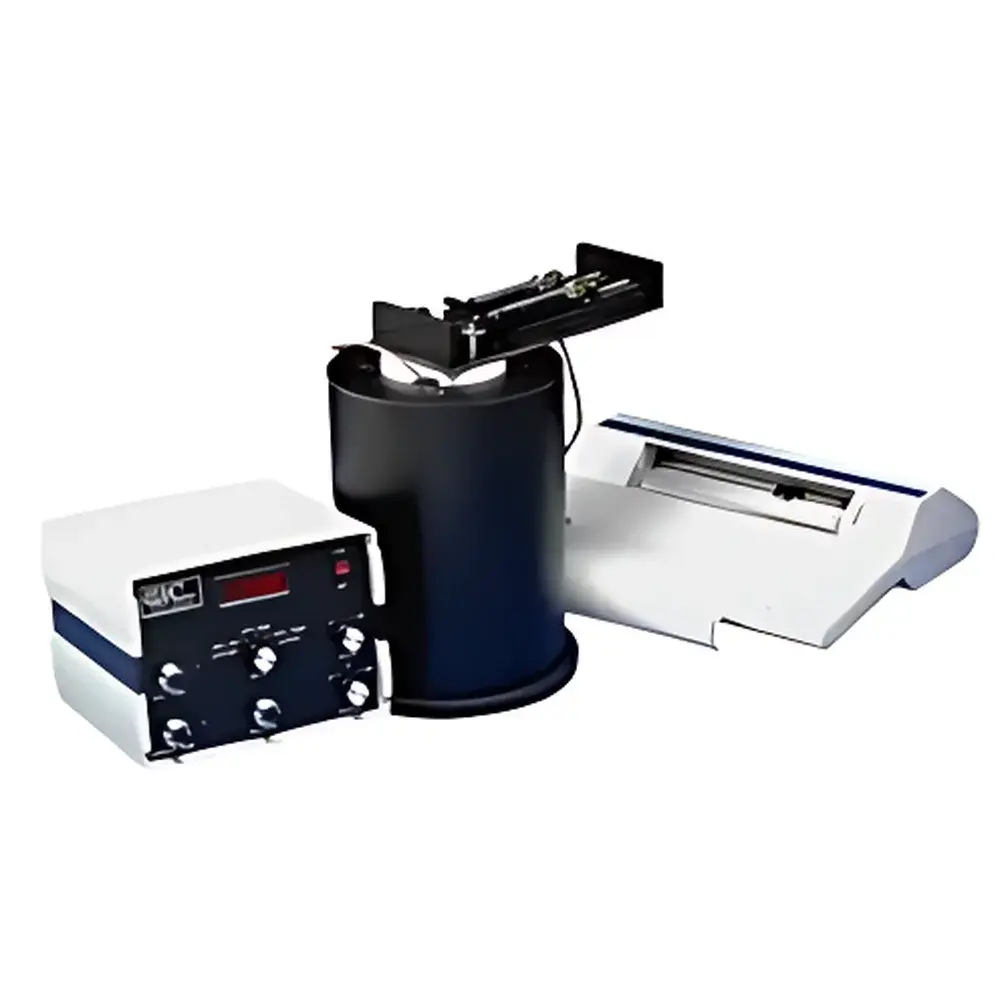
Knauer 833 Vapor Pressure Osmometry (VPO) Molecular Weight Analyzer
| Origin | USA |
|---|---|
| Manufacturer Type | Authorized Distributor |
| Origin Category | Imported Instrument |
| Model | 833 |
| Pricing | Available Upon Request |
Overview
The Knauer 833 Vapor Pressure Osmometry (VPO) Molecular Weight Analyzer is a precision laboratory instrument engineered for the determination of number-average molecular weight (Mn) of non-volatile solutes in solution. It operates on the fundamental thermodynamic principle of vapor pressure depression—a colligative property directly related to solute concentration. In a sealed, temperature-controlled chamber saturated with solvent vapor, two matched thermistors serve as differential thermal sensors: one exposed to pure solvent vapor, the other to vapor above a dilute solution. The osmotic pressure difference manifests as a measurable temperature gradient—induced by latent heat of condensation—causing a resistance shift in the solution-side thermistor. This shift is quantified via a high-stability Wheatstone bridge circuit and converted into a voltage output proportional to solute molality. The instrument delivers Mn values across a broad range without requiring calibration standards for each polymer type, provided a reference standard (e.g., polystyrene in toluene) is used to establish the instrument constant. Its design prioritizes thermodynamic fidelity, minimal perturbation of equilibrium, and robustness against operator variability—making it suitable for QC labs, polymer R&D, and academic physical chemistry laboratories adhering to ASTM D5296, ISO 13885, and USP guidelines.
Key Features
- Optimized thermistor geometry with bowl-shaped sensor housing ensures consistent thermal response regardless of minor variations in sample volume or viscosity—eliminating errors from over- or under-filling.
- Mechanically driven, independently heated dual syringes enable precise, reproducible micro-injection (0.25 mL capacity) with negligible disturbance to thermal equilibrium—reducing equilibration time to 2–5 minutes per measurement.
- Full stainless-steel reaction cell provides hermetic sealing with only two narrow needle ports; maintains stable vapor saturation and eliminates leakage-induced drift.
- Adjustable bridge current settings (5 / 20 / 100 µA) allow optimization for sensitivity and signal-to-noise ratio across diverse solvent systems—from low-polarity toluene to high-dielectric water.
- Temperature control spans ambient to 130 °C, extendable below ambient using external chiller circulation—enabling measurements across solvent volatility ranges while maintaining ±0.01 °C stability.
- Analog output (0–200 mV) compatible with strip-chart recorders, data loggers, or DAQ interfaces; supports traceable analog recording for GLP-compliant documentation.
Sample Compatibility & Compliance
The 833 VPO analyzer accommodates a wide spectrum of organic and aqueous solvents—including toluene, benzene, chloroform, dichloroethane, chloromethane, acetone, DMF, pyridine, and water—subject to solute non-volatility and thermal stability at operating temperatures. Minimum detectable concentrations are 5 × 10⁻⁵ mol/L in toluene and 2.5 × 10⁻⁴ mol/L in water, supporting analysis of low-MW oligomers and biomolecules. Molecular weight range: 100–25,000 Da (in toluene); 100–5,000 Da (in water). All wetted parts are chemically inert stainless steel or borosilicate glass. The system complies with ISO/IEC 17025 requirements for testing laboratories and supports audit-ready operation under FDA 21 CFR Part 11 when integrated with validated electronic lab notebook (ELN) or LIMS platforms.
Software & Data Management
While the 833 operates as a standalone analog instrument, its 0–200 mV output enables seamless integration with third-party acquisition software (e.g., LabVIEW, MATLAB, or custom Python-based scripts) for real-time plotting, baseline correction, peak integration, and calibration curve generation. Users may construct molality–voltage calibration curves using NIST-traceable polymer standards. Data files retain full metadata—including date/time stamp, temperature setpoint, bridge current, solvent ID, and operator ID—facilitating retrospective review and regulatory reporting. Optional analog-to-digital converter modules provide 16-bit resolution and timestamped CSV export for long-term trend analysis and statistical process control (SPC).
Applications
- Quality control of synthetic polymers (e.g., polyacrylates, polyesters, epoxies) for batch-to-batch Mn consistency.
- Characterization of pharmaceutical excipients (e.g., PEG, polysorbates) per USP monographs.
- Verification of oligomer distribution in peptide synthesis and dendrimer development.
- Educational use in physical chemistry courses for teaching colligative properties and osmotic theory.
- Supporting ISO 1628-1 (polymers in solution) and ASTM D2857 (vapor pressure osmometry) test protocols.
FAQ
What molecular weight range is reliably measurable with the 833 VPO in aqueous systems?
The instrument achieves accurate Mn determination from 100 to 5,000 Da in water, subject to solute thermal stability and absence of hydrolysis or aggregation at elevated temperatures.
Can the 833 be used with volatile solutes?
No—VPO requires non-volatile solutes. Volatile or semi-volatile analytes will produce erroneous readings due to concurrent vapor phase contribution.
Is the system compliant with 21 CFR Part 11 for electronic records?
The base unit is analog-only; compliance requires integration with a validated digital acquisition system featuring electronic signatures, audit trails, and role-based access control.
How does the bowl-shaped thermistor improve inter-laboratory reproducibility?
Its geometry equalizes heat transfer dynamics across variable meniscus heights and viscous drag effects—minimizing operator-dependent positioning error and enhancing cross-instrument comparability.
What maintenance is required for long-term accuracy?
Annual verification of thermistor matching, bridge balance, and temperature sensor calibration against NIST-traceable references is recommended; solvent purity and system cleanliness are critical operational prerequisites.
Related Products



