
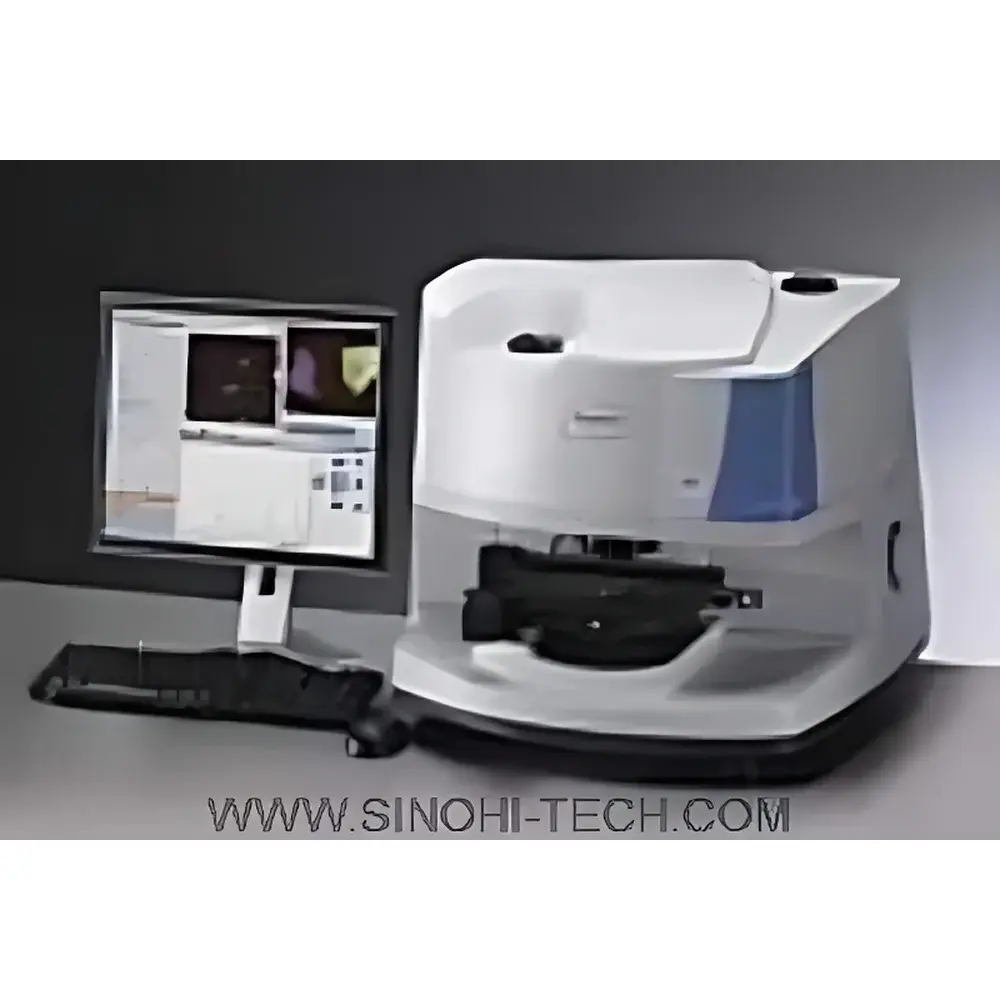
Thermo Scientific Nicolet iN10 FT-IR Microscope
| Origin | USA |
|---|---|
| Manufacturer Type | Authorized Distributor |
| Origin Category | Imported |
| Model | Nicolet iN10 |
| Pricing | Upon Request |
Overview
The Thermo Scientific Nicolet iN10 FT-IR Microscope is a fully integrated Fourier Transform Infrared (FT-IR) microspectroscopy platform engineered for high-fidelity chemical identification and spatially resolved molecular analysis at the microscopic level. Unlike conventional benchtop FT-IR spectrometers coupled to external microscopes via fiber optics or relay optics, the iN10 embeds a complete, optimized FT-IR interferometer directly within the microscope body—eliminating optical coupling losses and maximizing signal-to-noise ratio (SNR) and throughput. This monolithic architecture leverages Michelson interferometry with a KBr-beam splitter and liquid-nitrogen-cooled MCT detector, enabling diffraction-limited spatial resolution down to 3 µm using Micro-ATR objectives and ~10 µm in transmission/reflection modes. Designed for routine laboratory use in regulated and research environments, the system delivers quantitative spectral data compliant with ASTM E1252, ISO 18387, and USP , supporting materials characterization under GLP and GMP frameworks.
Key Features
- Fully integrated FT-IR spectrometer and optical microscope in a single, compact housing—no external interferometer or beam alignment required.
- Micro-ATR objective with diamond anvil enabling contact-mode analysis of sub-3 µm features without sample sectioning.
- Cryogenically cooled mercury cadmium telluride (MCT) detector for high sensitivity across the mid-IR range (7500–600 cm⁻¹).
- Motorized XYZ stage with sub-micron repeatability and real-time video overlay for precise region-of-interest (ROI) targeting.
- Automated aperture control with programmable field stops (10–100 µm) synchronized to spectral acquisition.
- Onboard visible-light camera with 5 MP resolution and LED illumination for simultaneous optical imaging and spectral correlation.
Sample Compatibility & Compliance
The Nicolet iN10 accommodates solid, thin-film, particulate, and layered samples—including polymers, pharmaceutical tablets, paint cross-sections, semiconductor residues, textile fibers, and geological inclusions—without requiring conductive coating or vacuum conditions. Transmission, reflection, and attenuated total reflectance (ATR) measurement geometries are supported natively. All hardware and software components comply with IEC 61000-4 electromagnetic compatibility standards and meet CE marking requirements. Data acquisition workflows support 21 CFR Part 11-compliant electronic signatures when deployed with OMNIC Picta’s audit-trail-enabled configuration, ensuring traceability for FDA-regulated QC/QA laboratories.
Software & Data Management
OMNIC Picta software provides a task-driven, wizard-based interface designed for both novice and expert users. It includes preconfigured analytical workflows for particle identification, layer thickness mapping, mixture deconvolution, and distribution quantification—each validated against NIST SRM reference spectra. Spectral libraries (e.g., Polymer, Forensic, Pharmaceutical) are searchable by name, functional group, or spectral similarity (using Pearson correlation and second-derivative matching). All raw interferograms, processed spectra, metadata (stage coordinates, aperture size, detector gain), and annotated optical images are stored in a structured HDF5 container format. Batch processing supports automated ROI extraction from mosaic scans, peak integration across multiple layers, and export to CSV, JCAMP-DX, or CDF for LIMS integration.
Applications
The Nicolet iN10 is routinely deployed in failure analysis, quality assurance, and R&D settings across industries including polymer science (additive migration, phase separation), pharmaceuticals (coating uniformity, API crystallinity), electronics (contamination ID on PCBs), forensics (fiber/paint chip analysis), and coatings (curing degree, binder degradation). Its ability to generate chemically specific maps—such as carbonyl index distribution across a polymer blend or hydroxyl band intensity gradients in a moisture-damaged film—enables root-cause investigation beyond morphological observation. The system supports method validation per ICH Q2(R2) guidelines and is referenced in ASTM D7212 for micro-FT-IR analysis of polymeric contaminants.
FAQ
Does the iN10 require external cooling or purge gas?
No—the instrument operates with internal dry-air purge and optional nitrogen purge for extended spectral range; no external chiller or liquid nitrogen dewar is needed for standard operation.
Can the iN10 perform chemical imaging?
The base iN10 model supports point-mapping and line-scan chemical profiling; for full-area hyperspectral imaging, the iN10MX variant with FPA detector is required.
Is OMNIC Picta compatible with LIMS systems?
Yes—via configurable XML/CSV export templates and ODBC-compliant database connectors for direct ingestion into major LIMS platforms.
What calibration standards are recommended for routine verification?
NIST-traceable polystyrene film (SRM 1977) and polyethylene film (SRM 2810) are used for wavenumber accuracy and photometric linearity checks per ASTM E1421.
How is spectral reproducibility ensured across operators?
OMNIC Picta enforces standardized acquisition parameters (aperture, scans, gain) through locked method templates, and all instrument settings are embedded in the spectral file metadata for full auditability.



