
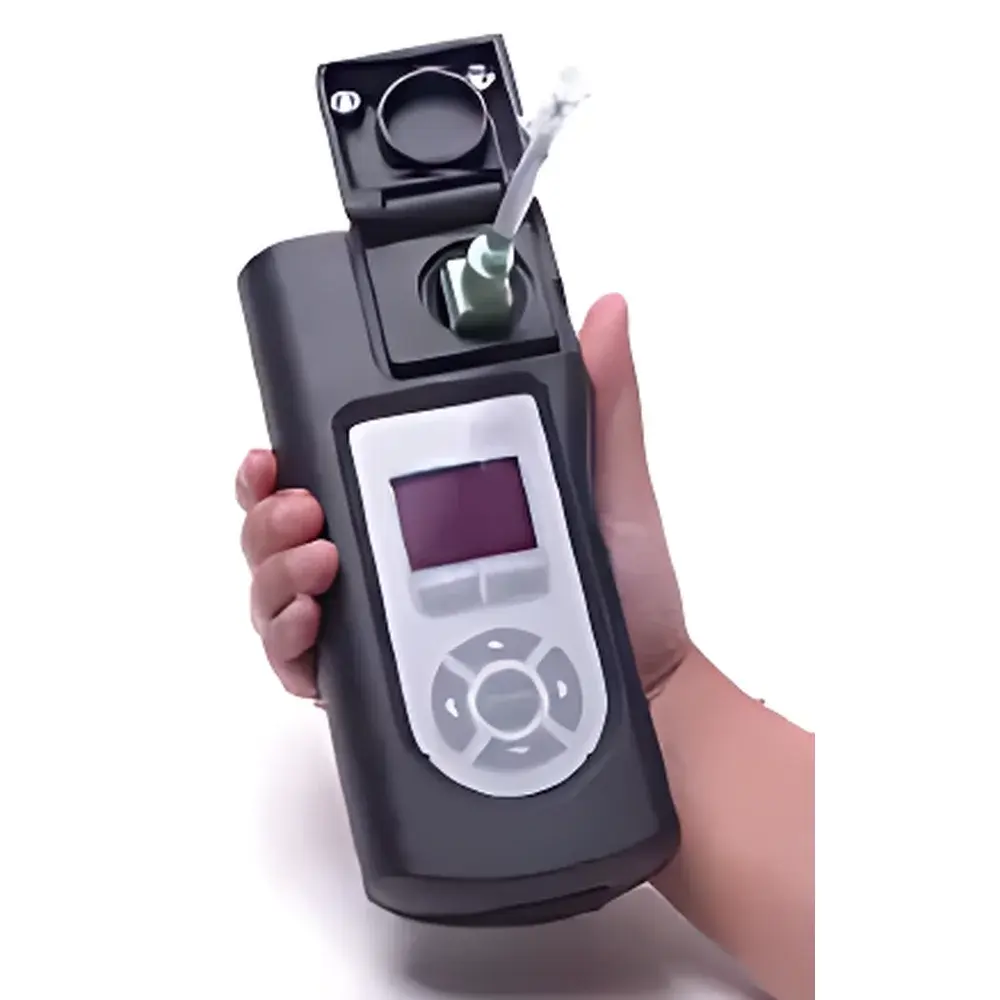
AND1100 Handheld Fluorometric Heavy Metals Analyzer
| Origin | USA |
|---|---|
| Manufacturer Type | Authorized Distributor |
| Origin Category | Imported |
| Model | AND1100 |
| Price Range | USD 14,000–28,000 |
| Instrument Type | Portable |
| Detection Principle | Fluorometric Assay with DNAzyme-Based Biosensors |
| Target Metals | Pb²⁺, Cu⁺/Cu²⁺, UO₂²⁺, Hg²⁺, Zn²⁺, Cd²⁺, Cr(VI), As(III/V) (Multi-Parameter Configurable) |
| Analysis Time | ≤20 seconds per metal |
| Accuracy | ±1% RSD (at mid-range calibration points) |
| Resolution | 0.1 ppb (for Pb²⁺, Hg²⁺, UO₂²⁺) |
Overview
The AND1100 Handheld Fluorometric Heavy Metals Analyzer is an engineered field-deployable instrument designed for rapid, on-site quantification of trace heavy metal ions in aqueous matrices—including drinking water, surface water, groundwater, wastewater effluents, and industrial process streams. Unlike conventional colorimetric or electrochemical sensors, the AND1100 employs a highly selective fluorometric detection platform based on catalytic DNAzyme (deoxyribozyme) biosensors. Each sensor cartridge contains immobilized, metal-specific DNAzymes that undergo conformational activation upon binding to target analytes (e.g., Pb²⁺, Hg²⁺, UO₂²⁺), triggering a measurable fluorescence signal proportional to ion concentration. This bio-recognition mechanism delivers sub-ppb sensitivity without requiring acid digestion, complexing reagents, or laboratory-grade sample preparation—enabling direct analysis of unfiltered, ambient-temperature water samples.
Key Features
- Single-button operation with intuitive graphical interface and real-time on-screen results display—no chemistry expertise required.
- Modular, pre-calibrated sensor cartridges: each color-coded cartridge is dedicated to one or two metals (e.g., blue for Pb²⁺/Hg²⁺; green for Cu²⁺/Zn²⁺; amber for UO₂²⁺/Cd²⁺), eliminating cross-reactivity and user calibration errors.
- Rugged IP54-rated enclosure with chemical-resistant housing, compliant with CE marking for electromagnetic compatibility and safety in field environments.
- Built-in time/date stamping and geotagging (via optional Bluetooth GPS pairing) for audit-ready data capture aligned with ISO/IEC 17025 documentation requirements.
- Integrated rechargeable Li-ion battery supporting >12 hours of continuous operation; USB-C port enables simultaneous data export and charging.
- Firmware-upgradable architecture with over-the-air (OTA) capability via USB-connected PC and free desktop software suite.
Sample Compatibility & Compliance
The AND1100 accepts raw water samples across pH 4.5–9.0 and turbidity ≤100 NTU without filtration or pretreatment. It has been validated per ASTM D5673-18 (Standard Test Method for Determination of Metals in Water by Inductively Coupled Plasma Mass Spectrometry) for method correlation, demonstrating <5% deviation from ICP-MS reference values at concentrations ≥10× LOD. Sensor cartridges meet ISO 15197:2013 biocompatibility criteria and are manufactured under ISO 13485-certified quality systems. The instrument supports GLP-compliant workflows through configurable audit trails, electronic signatures, and 21 CFR Part 11–ready data export (CSV and encrypted .andx binary formats).
Software & Data Management
The companion ANDLink Desktop Software (v3.2+, Windows/macOS) provides full traceability: users can import field-collected datasets, apply batch corrections, generate PDF reports with embedded chromatogram-style fluorescence kinetics plots, and export to LIMS via HL7 or CSV. All measurement metadata—including operator ID, sensor lot number, calibration expiry, environmental temperature, and raw fluorescence intensity (RFU) values—are retained in each record. Firmware updates include enhanced interference correction algorithms for high-ionic-strength matrices (e.g., seawater, brines) and expanded calibration libraries for emerging contaminants such as Cr(VI) and As(III).
Applications
- Regulatory compliance monitoring for EPA Safe Drinking Water Act (SDWA) action levels (e.g., Pb: 15 ppb, Cd: 5 ppb, Hg: 2 ppb).
- Emergency response screening during industrial spills or natural disasters where lab turnaround exceeds 24–48 hours.
- Source water vulnerability assessments in rural or off-grid communities lacking access to centralized analytical labs.
- QA/QC verification of point-of-use (POU) and point-of-entry (POE) treatment systems, including activated carbon, ion exchange, and reverse osmosis units.
- Academic and NGO-led citizen science initiatives requiring standardized, low-barrier instrumentation for longitudinal water quality mapping.
FAQ
What is the limit of detection (LOD) for lead (Pb²⁺)?
The LOD for Pb²⁺ is 2 ppb (S/N ≥ 3) using the standard blue sensor cartridge under ambient lighting conditions.
Can the same sensor be reused for multiple measurements?
No—each sensor cartridge is single-use and factory-calibrated; reuse compromises accuracy due to irreversible DNAzyme saturation and photobleaching.
Does the instrument require annual recalibration?
No; calibration is embedded in each sensor cartridge. Users only verify performance quarterly using NIST-traceable check standards (included in starter kit).
Is validation data available for regulatory submission?
Yes—full method validation packages (precision, recovery, matrix interference, ruggedness) are provided per ISO/IEC 17025 Annex A.2 and are accepted by several state primacy agencies for Tier 2 field screening data.
How is data integrity ensured during USB transfer?
All exported files include SHA-256 checksums and digital signatures tied to instrument serial number and firmware version, satisfying ALCOA+ data governance principles.
Related Products







