
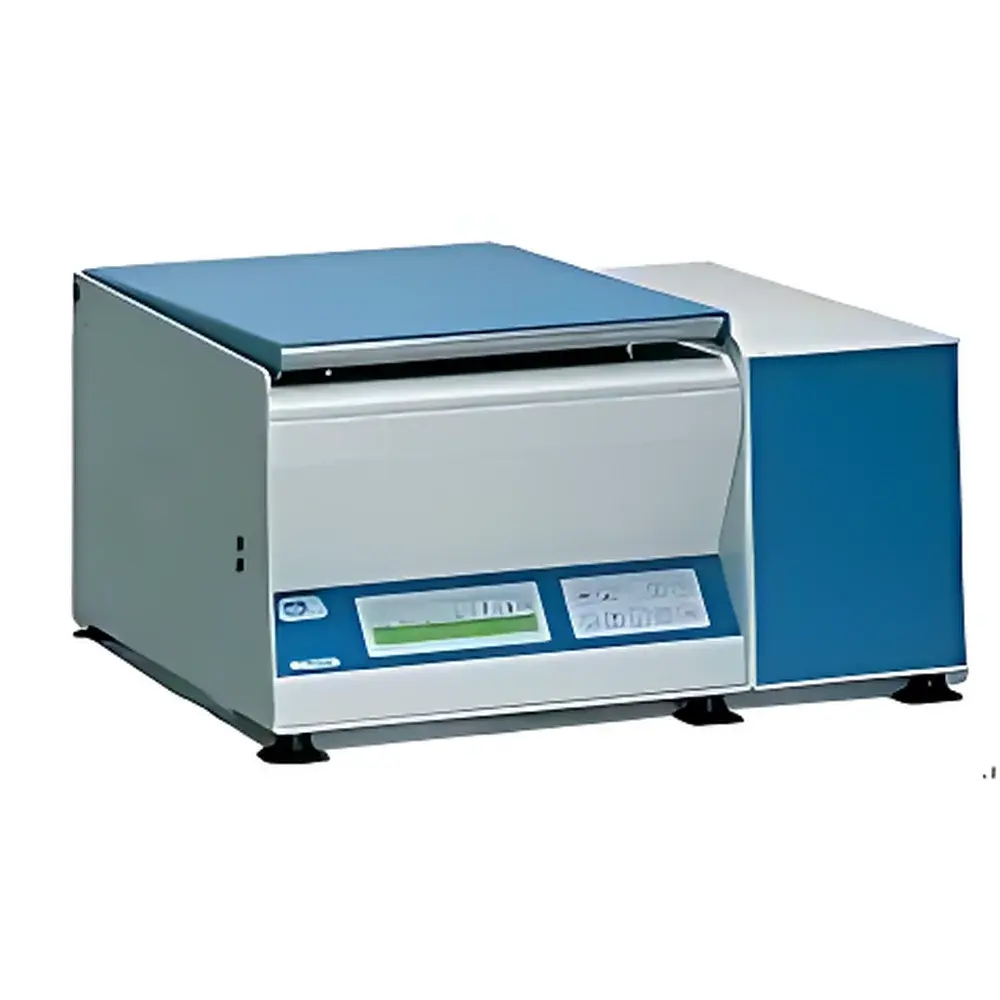
JP Medifriger-BL-S Microprocessor-Controlled Refrigerated Centrifuge
| Brand | JP |
|---|---|
| Origin | Spain |
| Model | Medifriger-BL-S |
| Instrument Type | Benchtop Refrigerated Centrifuge |
| Speed Range | 10,000–30,000 rpm |
| Max RCF | 50,000 × g |
| Max Capacity | 800 mL (4 × 200 mL) |
| Temperature Range | 0–30 °C |
| Noise Level | 50–60 dB(A) |
| Dimensions (H×W×D) | 38 × 68 × 52 cm |
| Weight | 70 kg |
| Power | 1230 W |
| Construction | DUR-Al alloy outer housing, stainless-steel inner bowl and top plate, steel-reinforced safety chamber |
| Drive System | Maintenance-free induction motor |
| Cooling System | Hermetically sealed compressor with rear-exhaust non-recirculating air cooling |
| Control System | Microprocessor-based digital control with rotor auto-identification, 10 programmable protocols, real-time RCF/speed/timer/temperature display, and integrated alarm monitoring |
Overview
The JP Medifriger-BL-S is a high-performance benchtop refrigerated centrifuge engineered for precision separation of biological macromolecules—including proteins, nucleic acids, organelles, and subcellular particles—under tightly controlled thermal and rotational conditions. Designed and manufactured in Spain, it operates on the principle of sedimentation force generation via high-speed rotation, where centrifugal acceleration (expressed as × g) drives differential migration of particles based on size, density, and shape through liquid media. Its microprocessor-controlled architecture ensures stable temperature maintenance (0–30 °C), consistent rotor dynamics, and repeatable run conditions essential for reproducible analytical and preparative workflows in regulated environments such as clinical diagnostics, biopharmaceutical QC labs, and academic research facilities.
Key Features
- Maintenance-free induction motor delivering smooth acceleration/deceleration profiles and extended service life without brush wear or lubrication requirements.
- Robust mechanical construction: outer casing fabricated from corrosion-resistant DUR-Al alloy; inner bowl and top plate made of electropolished stainless steel; reinforced steel safety chamber fully enclosed within the chassis.
- Non-recirculating rear-exhaust air cooling system—air drawn into the cavity is expelled externally after single-pass heat exchange, preventing internal thermal buildup and ensuring stable sample temperature throughout operation.
- Hermetically sealed refrigeration compressor mounted on vibration-damping supports, coupled with an oil-film evaporator coil wrapped around the rotor chamber for uniform thermal distribution.
- Integrated rotor auto-identification system: optical sensor detects laser-engraved identification codes on all rotors, buckets, and adapters upon lid closure—validating compatibility, enforcing speed/RCF limits, and blocking unsafe parameter combinations before run initiation.
- Digital microprocessor interface with real-time display of speed (rpm), relative centrifugal force (× g), elapsed time, remaining time, setpoint temperature, and actual chamber temperature; supports storage of up to 10 user-defined protocols with independent ramp/brake profiles.
Sample Compatibility & Compliance
The Medifriger-BL-S accommodates a wide range of sample formats via interchangeable angular rotors, including standard conical tubes (e.g., 15 mL, 50 mL), microcentrifuge tubes (0.2–2.0 mL), and large-volume bottles (up to 200 mL). Its maximum capacity configuration supports four 200 mL bottles (800 mL total), making it suitable for scalable purification steps in downstream processing. All rotors are certified to ISO 15195:2019 (calibration of centrifuges) and comply with IEC 61010-1:2010 safety standards for laboratory equipment. The system meets GLP and GMP operational prerequisites when configured with audit-trail-enabled software (optional), and its temperature stability profile aligns with USP guidelines for analytical instrument qualification.
Software & Data Management
While the Medifriger-BL-S operates as a standalone unit with embedded firmware, optional PC connectivity (RS-232 or USB) enables integration with laboratory information management systems (LIMS) or custom data acquisition platforms. Exported logs include timestamped run parameters (start/stop time, speed, RCF, temperature setpoint/actual, rotor ID, protocol name), supporting traceability for FDA 21 CFR Part 11–compliant environments when paired with validated third-party software. Firmware updates are performed via secure USB interface, preserving calibration integrity and maintaining version-controlled configuration records.
Applications
- Isolation of plasma membrane vesicles and mitochondrial fractions from tissue homogenates.
- Clarification of bacterial lysates prior to chromatographic purification of recombinant proteins.
- Concentration and pelleting of exosomes and extracellular vesicles from cell culture supernatants.
- Routine preparation of serum, plasma, and PBMCs in clinical laboratories requiring strict temperature control during spin-down.
- High-speed pelleting of virus particles for infectivity assays and structural analysis.
- Preparative separation of polysomes and ribosomal subunits under cold-synchronized conditions.
FAQ
What is the maximum RCF achievable with the Medifriger-BL-S?
The system delivers up to 50,000 × g at its rated maximum speed of 30,000 rpm, depending on rotor radius and tube geometry.
Does the centrifuge support automatic rotor recognition across all accessories?
Yes—every rotor, bucket, and adapter carries a permanent laser-engraved identification code read by an optical sensor upon lid closure, enabling automatic validation of speed and RCF limits.
How does the non-recirculating cooling system improve thermal stability?
By exhausting heated air externally after one pass—rather than recirculating it—the system avoids heat accumulation inside the chamber, maintaining setpoint accuracy within ±1 °C over extended runs.
Is the Medifriger-BL-S compliant with international safety standards?
It conforms to IEC 61010-1:2010 for electrical safety and is designed to meet ISO 15195:2019 requirements for centrifuge calibration traceability.
Can the unit be integrated into a networked lab environment?
Yes—via optional RS-232 or USB interface, allowing remote parameter setting, run logging, and LIMS synchronization when used with validated middleware.



