
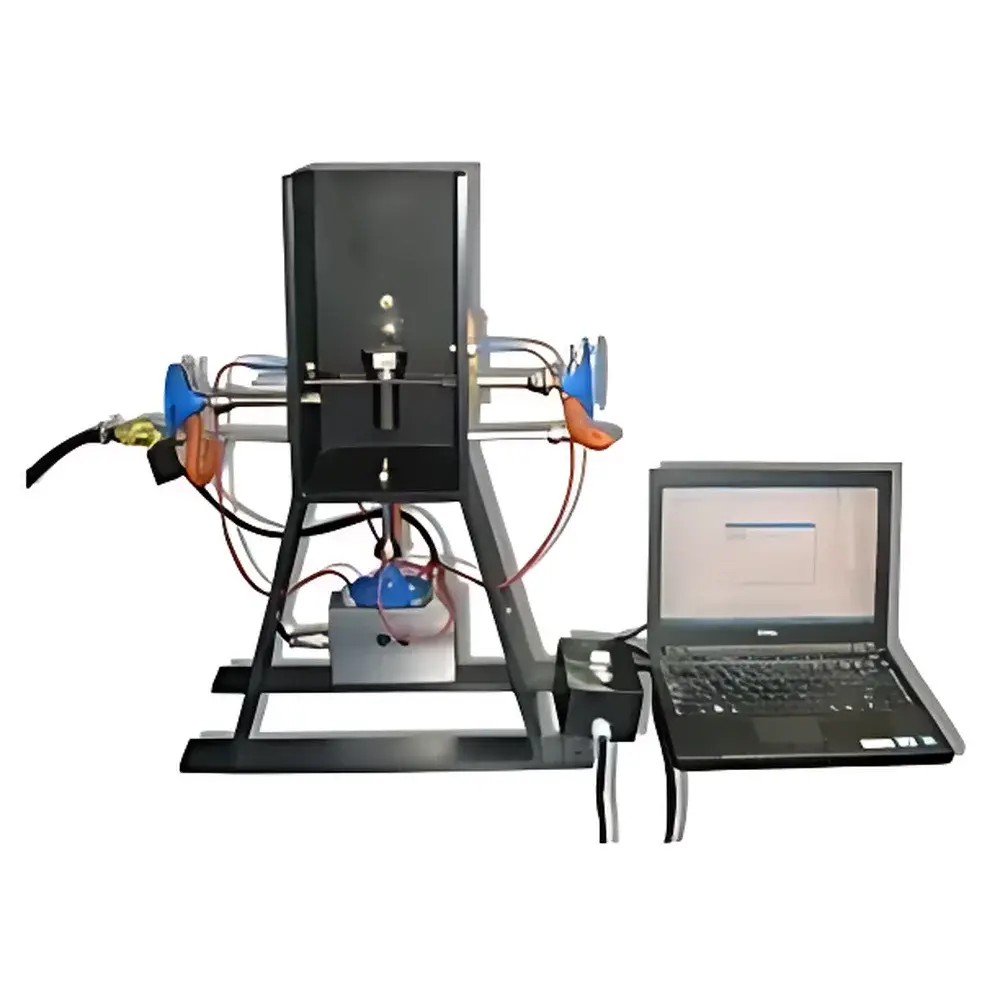
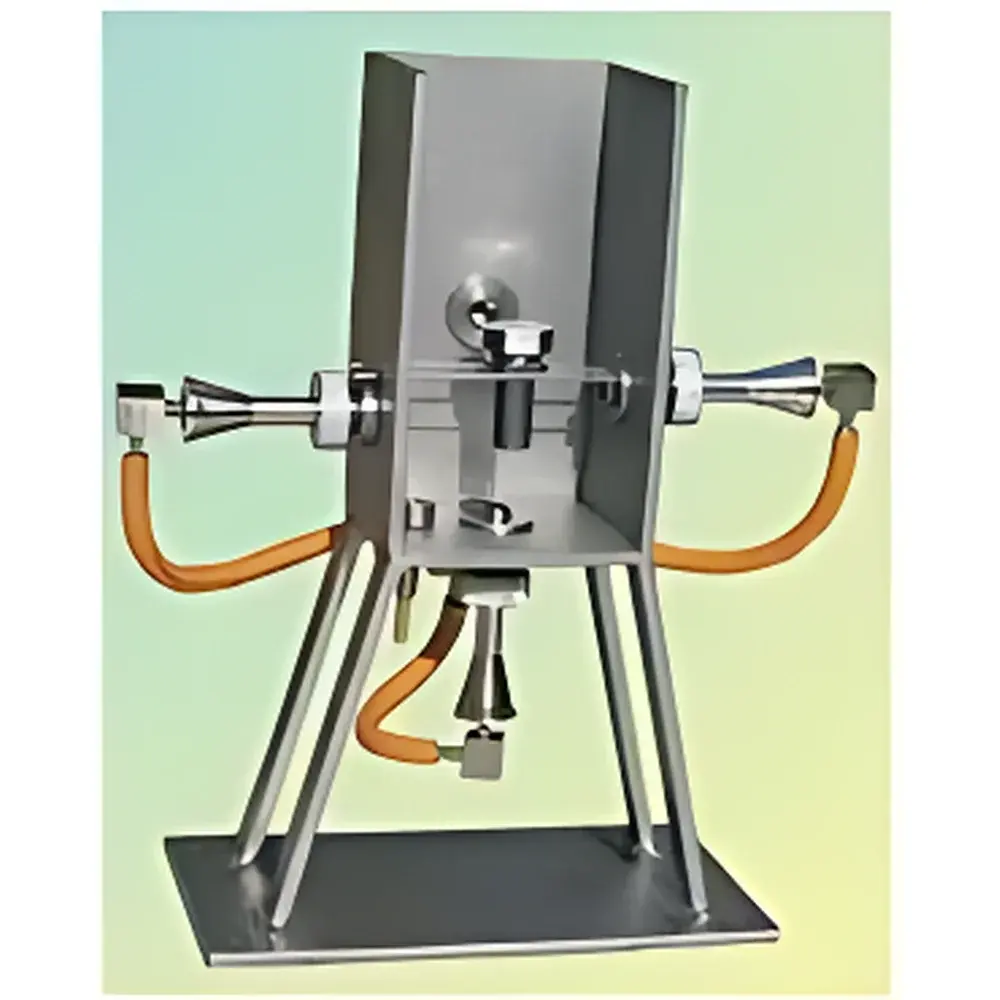
Koenen Test Apparatus by SMS (USA)
| Brand | SMS |
|---|---|
| Origin | USA |
| Manufacturer Type | Authorized Distributor |
| Origin Category | Imported Instrument |
| Model | Koenen |
| Price Range | USD 14,000 – 70,000 |
| Sample Tube Dimensions | 75 mm length × 25 mm OD |
| Sample Tube Mass | 25.5 ± 1.0 g |
| Orifice Diameters | 1.0, 1.5, 2.0, 2.5, 3.0, 5.0, 8.0, 12.0, 20.0 mm |
| Heating Rate | 3.3 ± 0.3 K/s |
| Propane Supply | 500 mbar regulated |
| Ignition System | Remote Electronic Controller |
| Power Supply | 110 V / 60 Hz or 220 V / 50 Hz |
| Compliance | ASTM E681, UN Manual of Tests and Criteria Part I, Section 15, ISO 8767 |
Overview
The Koenen Test Apparatus, supplied by SMS as an authorized distributor for the U.S.-manufactured system, is a standardized thermal sensitivity assessment instrument designed to evaluate the response of solid, liquid, and pasty substances to intense localized heating under highly confined conditions. It implements the principle of controlled pyrolysis and pressure buildup within a sealed steel tube exposed directly to calibrated propane flame impingement — a method grounded in classical thermal hazard classification physics. The apparatus quantifies thermal instability by measuring mechanical deformation (bulging, splitting, or rupture) of the sample containment tube following standardized heating exposure. This deformation serves as a deterministic indicator of rapid exothermic decomposition potential, enabling unambiguous assignment to transport hazard classes per the United Nations Recommendations on the Transport of Dangerous Goods (UN RTDG), particularly under Test Series 1 (Thermal Stability) and Section 15 of the UN Manual of Tests and Criteria.
Key Features
- Four independently regulated propane burners delivering uniform, reproducible flame geometry and heat flux across the sample tube surface — engineered for strict adherence to ASTM E681-defined heating rate tolerance (3.3 ± 0.3 K/s).
- Precision-machined sample tube fabricated from cold-drawn low-carbon steel: 75 mm length, 25 mm outer diameter, mass 25.5 ± 1.0 g, with flanged open end ensuring consistent axial alignment and sealing interface.
- Matched stainless-steel counterbalance tube, identical in dimensions and mass to the sample tube, enabling balanced thermal expansion behavior and eliminating torsional stress artifacts during high-temperature exposure.
- Interchangeable orifice plates manufactured from high-chromium heat-resistant alloy (Cr ≥ 25%), featuring nine standardized orifice diameters (1.0–20.0 mm) traceable to NIST-certified dimensional metrology.
- Hydraulic sample compaction tool applying a repeatable 80 N axial force during specimen loading — critical for eliminating void-dependent variability in decomposition onset and propagation.
- Integrated electronic ignition controller with fail-safe interlock circuitry, enabling remote actuation of all four burners from outside the test chamber — fully compliant with OSHA 1910.120 and NFPA 45 laboratory safety protocols.
- Dual-voltage power architecture (110 V / 60 Hz or 220 V / 50 Hz) with built-in surge suppression and ground-fault circuit interruption (GFCI) for global deployment in accredited testing laboratories.
Sample Compatibility & Compliance
The Koenen apparatus accepts samples in solid (crystalline, granular, powdered), liquid (neat or solution), and semi-solid (paste, slurry, gel) physical states. Sample volume is constrained by the internal geometry of the standard tube (ID ≈ 22.5 mm), requiring representative sub-sampling per ISO/IEC 17025:2017 Clause 7.3.2. Testing follows strictly defined preconditioning protocols: ambient equilibration (23 ± 2 °C, 50 ± 5 % RH), moisture content verification (per ASTM D2297), and exclusion of volatile solvents exceeding 5 % w/w unless explicitly permitted by test protocol. Regulatory alignment includes full conformance with UN Manual of Tests and Criteria, Part I, Section 15 (Koenen Test); ASTM E681-22 (Standard Test Method for Determination of Explosive Sensitivity to Thermal Stimuli); and ISO 8767:2021 (Explosives — Test methods — Koenen test). Data records satisfy FDA 21 CFR Part 11 requirements when paired with validated LIMS integration via RS-232/USB serial output.
Software & Data Management
While the core Koenen test is inherently analog in its pass/fail mechanical endpoint assessment, the SMS-supplied apparatus includes digital instrumentation for real-time monitoring and auditability. A calibrated thermocouple (Type K, ±0.5 °C accuracy) embedded in the burner manifold logs time-temperature profiles synchronized with video capture (120 fps, H.264 encoding) of tube deformation. All raw data — including pressure regulator setpoint (500 mbar), mass flow readings, ignition timestamp, and post-test visual documentation — are timestamped and stored in CSV/JSON format. Optional software modules support GLP-compliant report generation with electronic signature fields, automatic UN classification mapping, and trend analysis across sequential test batches — meeting ISO/IEC 17025 Clause 7.7.2 for result validation and traceability.
Applications
- Hazard classification of energetic materials during R&D phase prior to scale-up synthesis.
- Regulatory submission support for UN transport classification (Class 1 explosives, Class 4.1 self-reactive substances, Class 5.1 oxidizers).
- Quality control screening of batch-to-batch thermal consistency in pharmaceutical intermediates and fine chemical manufacturing.
- Failure mode analysis of thermally degraded battery electrolytes and cathode slurries under abuse conditions.
- Validation of thermal stabilizer efficacy in polymer formulations and propellant binders.
- Forensic analysis of post-incident residues where thermal runaway initiation pathways require reconstruction.
FAQ
What standards does the Koenen Test Apparatus comply with?
ASTM E681, UN Manual of Tests and Criteria Part I Section 15, ISO 8767, and national transpositions including GB/T 21578-2013 (China) and JIS K 7251 (Japan).
Is operator training included with purchase?
Yes — SMS provides a 2-day on-site commissioning and competency assessment program covering safe propane handling, orifice plate selection logic, deformation interpretation per UN criteria, and emergency shutdown procedures.
Can the apparatus be integrated into an existing fume hood exhaust system?
It must be installed in a dedicated, negatively pressured test cell with minimum 1.2 m/s face velocity at the observation window and HEPA-filtered exhaust capable of removing >99.97 % of particulates ≥0.3 µm generated during tube rupture events.
What maintenance intervals are recommended?
Burner nozzles require ultrasonic cleaning every 50 tests; orifice plates must be inspected for erosion using optical profilometry before each use; pressure regulator calibration is required annually per ISO/IEC 17025 Clause 6.4.6.
Does the system support automated pass/fail decision logic?
No — final classification is determined by trained personnel evaluating physical evidence (tube bulge height, crack length, fragmentation pattern) against UN-defined thresholds; automation is prohibited under current regulatory guidance to preserve technical judgment integrity.





