
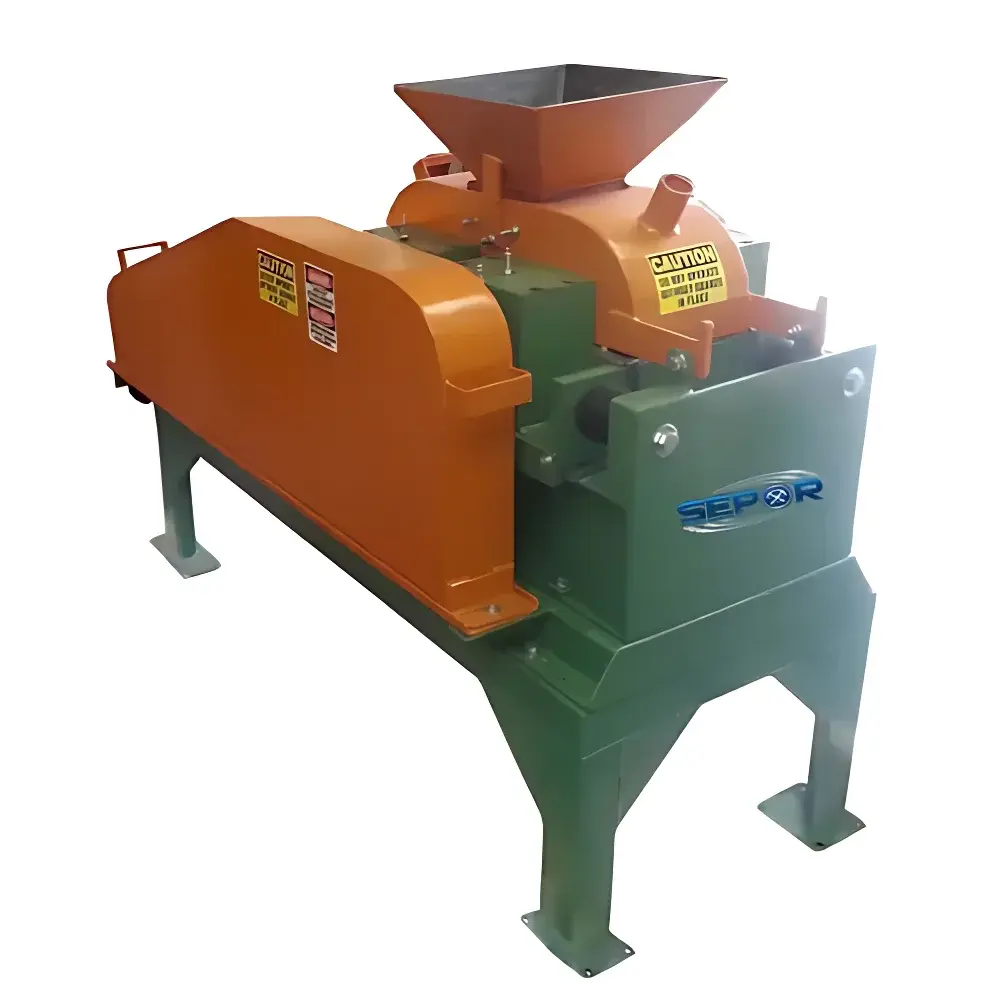
Bico 010C-009 Dual Roll Crusher 10″ × 6″
| Origin | USA |
|---|---|
| Supplier Type | Authorized Distributor |
| Origin Category | Imported |
| Model | 010C-009 |
| Pricing | Available Upon Request |
| Feed Size | 3/8" to 1/2" (9.5–12.7 mm) |
| Output Size | ~−10 mesh |
| Throughput | 3,000 lb/hr (1,364 kg/hr) for medium-hard ore |
| Shipping Weight | 1,400 lb (727 kg) |
| Roller Diameter × Width | 10 in × 6 in (254 mm × 152 mm) |
Overview
The Bico 010C-009 Dual Roll Crusher is a precision-engineered laboratory and pilot-scale size-reduction device designed for controlled, consistent comminution of brittle and semi-brittle materials. Operating on the principle of compression between two counter-rotating rolls—typically driven at differential surface speeds—the unit delivers predictable particle size reduction with minimal overgrinding or fines generation. Its 10-inch diameter × 6-inch width roll configuration provides optimal throughput-to-footprint ratio for benchtop and mobile pilot applications. The crusher is widely deployed in mineral processing laboratories for sample preparation prior to grinding, leaching, assay, or XRF/XRD analysis; it also serves as a secondary crusher in continuous pilot circuits where feed material exhibits moderate hardness (e.g., quartzite, limestone, coal, slag, and ceramic precursors). Structural rigidity, sealed bearing architecture, and modular roller assembly ensure long-term dimensional stability and operational repeatability under repeated loading cycles.
Key Features
- Adjustable roll gap via calibrated handwheel—enabling precise control over product size distribution without tools or disassembly.
- Double-sealed, grease-lubricated roller bearings housed in fully enclosed, rigid cast-iron support brackets—designed for extended service life and resistance to dust ingress.
- Removable roller subassemblies: each roller shaft with shell, core, and bearing block can be extracted as a single unit for inspection, re-coating, or replacement.
- Tapered-core mounting system secures alloy steel roller shells via mechanical interference fit—maintaining concentricity and positional integrity even after significant wear-induced shell thinning.
- Hinged full-width roller guard provides unobstructed access to crushing zone for rapid cleaning between samples—critical for cross-contamination control in multi-sample workflows.
- Integrated elastomeric bumper stops limit axial roll travel during jam events, absorbing impact energy and preventing damage from tramp metal or oversized feed fragments.
- Standard 6-inch-diameter dust extraction port (NPT thread) compatible with laboratory fume hoods or centralized vacuum systems per OSHA 1910.94 and ISO 16000-7 requirements.
- Optional portable support frame enables flexible placement on lab benches, mobile carts, or pilot plant skids—supporting both batch and semi-continuous operation modes.
Sample Compatibility & Compliance
The 010C-009 is validated for use with non-fibrous, non-sticky, low-moisture (30% without enhanced wear protection, nor for ductile metals, polymers, or hygroscopic salts. The unit complies with CE machinery directive 2006/42/EC for safety integration, incorporates IP54-rated electrical enclosures, and meets UL 508A requirements for industrial control panels when equipped with optional motor starter packages. All structural weldments conform to AWS D1.1 standards; roller shell material meets ASTM A278 Grade 65-45-12 specification for high-strength cast iron components.
Software & Data Management
As a mechanically actuated, manually adjusted crushing system, the 010C-009 operates without embedded firmware or digital controls. However, its design supports full integration into GLP-compliant laboratory workflows: roll gap settings are recorded manually in bound logbooks or LIMS-integrated electronic notebooks (e.g., LabWare LIMS, Thermo Fisher SampleManager), and throughput data may be synchronized with mass flow meters or belt weighfeeders in pilot configurations. Optional analog tachometer outputs (0–10 VDC) enable speed monitoring via external DAQ systems for process validation per FDA 21 CFR Part 11 Annex 11 guidelines when used in regulated pharmaceutical or battery-material manufacturing environments.
Applications
- Primary sample splitting and homogenization for geochemical assay (e.g., fire assay, ICP-MS digestion prep).
- Feed conditioning for ball mill or rod mill circuits in metallurgical testwork (ASTM E838, ISO 11267).
- Size reduction of catalyst supports, battery cathode precursors (e.g., NMC, LFP), and refractory raw materials prior to sintering trials.
- Continuous secondary crushing in 1–5 ton/hr pilot plants treating construction & demolition debris or recycled concrete aggregate.
- Controlled fragmentation of geological core segments for thin-section preparation or micro-CT scanning.
FAQ
What is the maximum feed size the 010C-009 can accept?
The unit is rated for feed particles up to 1/2 inch (12.7 mm) in largest dimension. Oversized material must be pre-screened to avoid jamming or uneven load distribution.
Can this crusher handle wet or sticky feed material?
No—it is designed exclusively for dry, free-flowing, non-adhesive feeds. Moisture content above 8% w/w significantly increases plugging risk and reduces crushing efficiency.
Is the roller shell replaceable, and what is its typical service life?
Yes; shells are field-replaceable and fabricated from hardened alloy steel. Service life varies by feed abrasivity but typically exceeds 800 operating hours for medium-hard ores under proper maintenance protocols.
Does the unit include dust suppression features?
It includes a 6-inch NPT dust port and inlet hopper with debris guard, but does not integrate active dust collection—external vacuum or baghouse systems must be connected per local occupational exposure limits (e.g., OSHA PEL for respirable crystalline silica).
What electrical supply is required for standard operation?
Standard configuration uses a 230 VAC, 60 Hz, single-phase, 5 HP TEFC motor (UL-listed). Custom 3-phase or 50 Hz variants are available upon request with engineering review.





