
FRITSCH P-13 Premium Disc Mill
| Brand | FRITSCH |
|---|---|
| Origin | Germany |
| Manufacturer | FRITSCH GmbH |
| Type | Disc Mill |
| Model | P-13 Premium |
| Input Size | ≤ 20 mm |
| Output Size | 0.01–0.5 mm |
| Throughput | 150 kg/h |
| Disc Speed | 440 rpm |
| Power Supply | 400 V / 3~ / 50–60 Hz / 1830 W |
| Dimensions (W×H×D) | 52 × 105 × 63 cm |
| Net Weight | 240 kg |
| Gross Weight | 275 kg |
| Grinding Gap Adjustment Resolution | 0.05 mm |
| Compliance | CE |
Overview
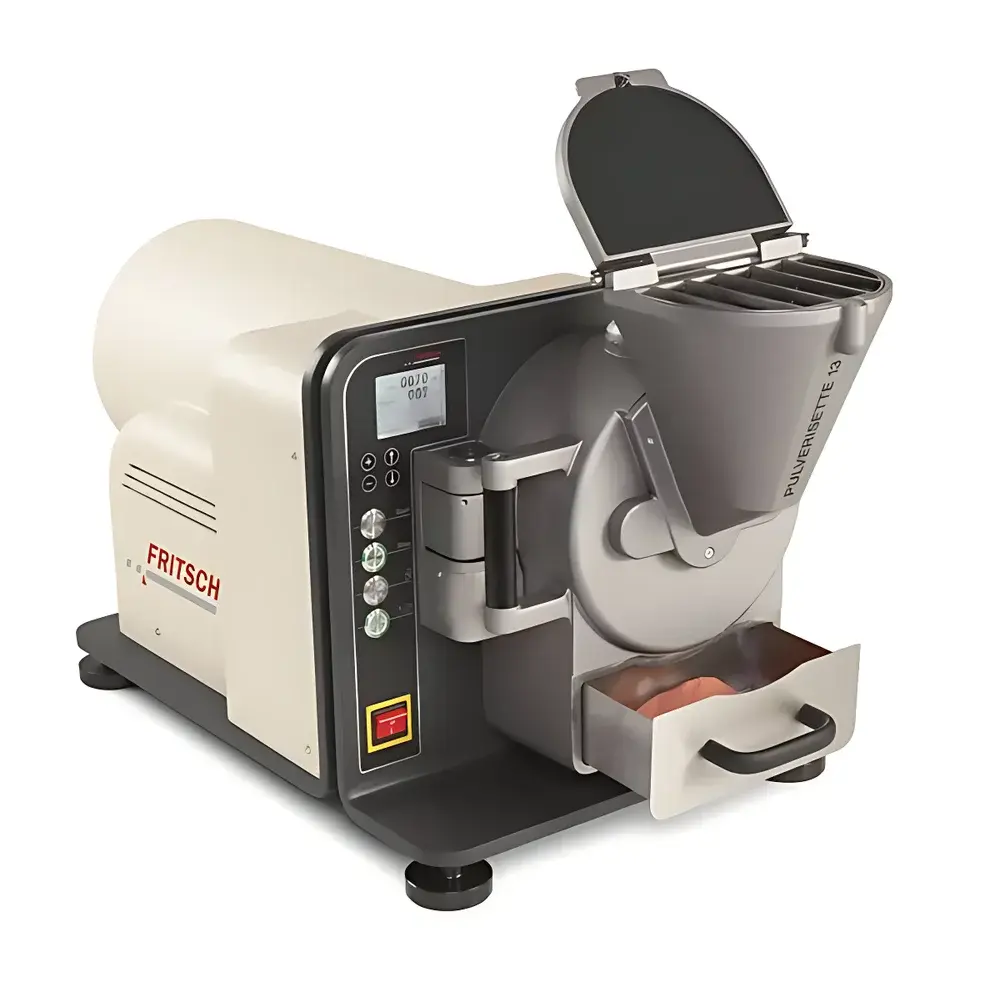
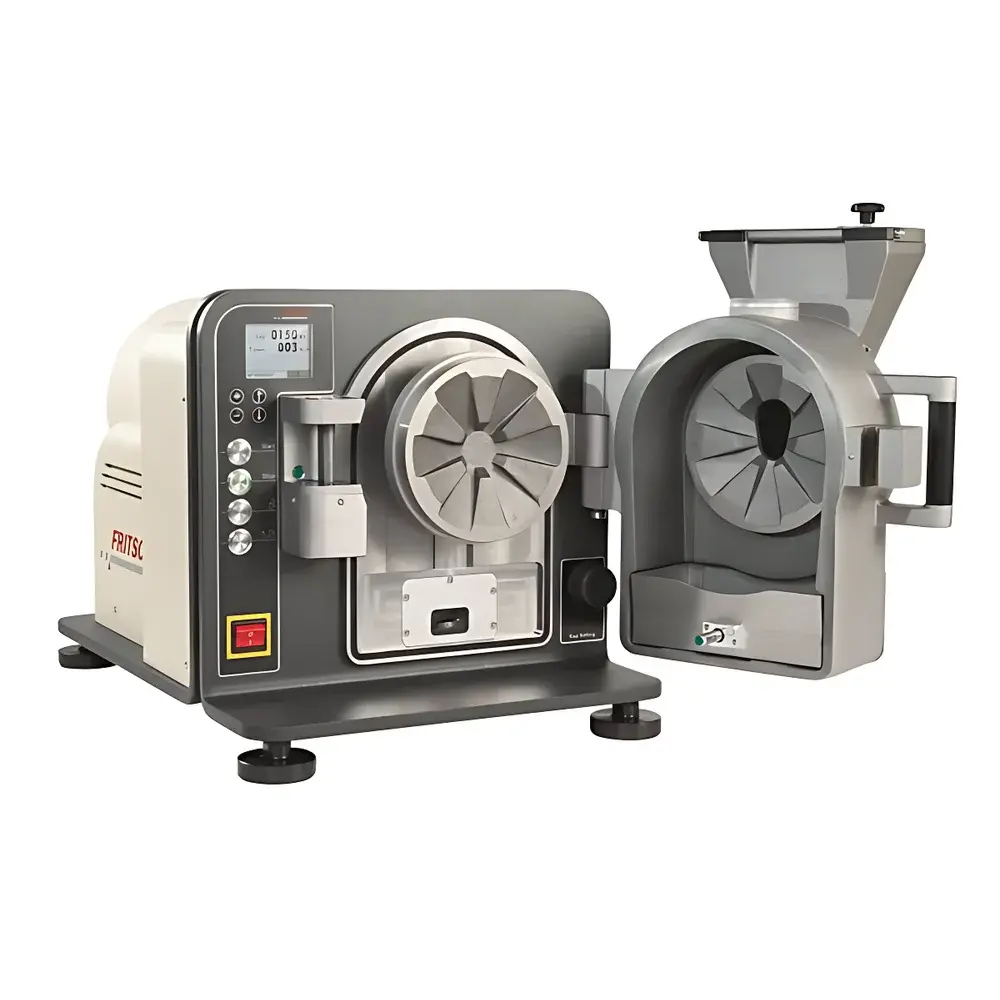
The FRITSCH P-13 Premium Disc Mill is a high-performance, industrial-grade laboratory disc mill engineered for precise, reproducible size reduction of hard and brittle materials. Based on the Couette-type shear principle, it employs two parallel, counter-rotating (or co-rotating) grinding discs — one stationary and one driven at 440 rpm — to generate controlled compressive force and intense surface friction across the sample. This mechanical action enables consistent particle size reduction without excessive heat generation or amorphization, making it especially suitable for applications demanding structural integrity preservation in mineralogical, metallurgical, ceramic, and geochemical samples. Designed and manufactured in Germany, the P-13 Premium complies with stringent EU machinery safety directives and integrates seamlessly into ISO/IEC 17025-accredited laboratories where traceability, repeatability, and process control are mandatory.
Key Features
- High-resolution digital LED interface enabling real-time adjustment and monitoring of grinding gap (0.05 mm resolution) and grinding time — critical for method development and SOP adherence.
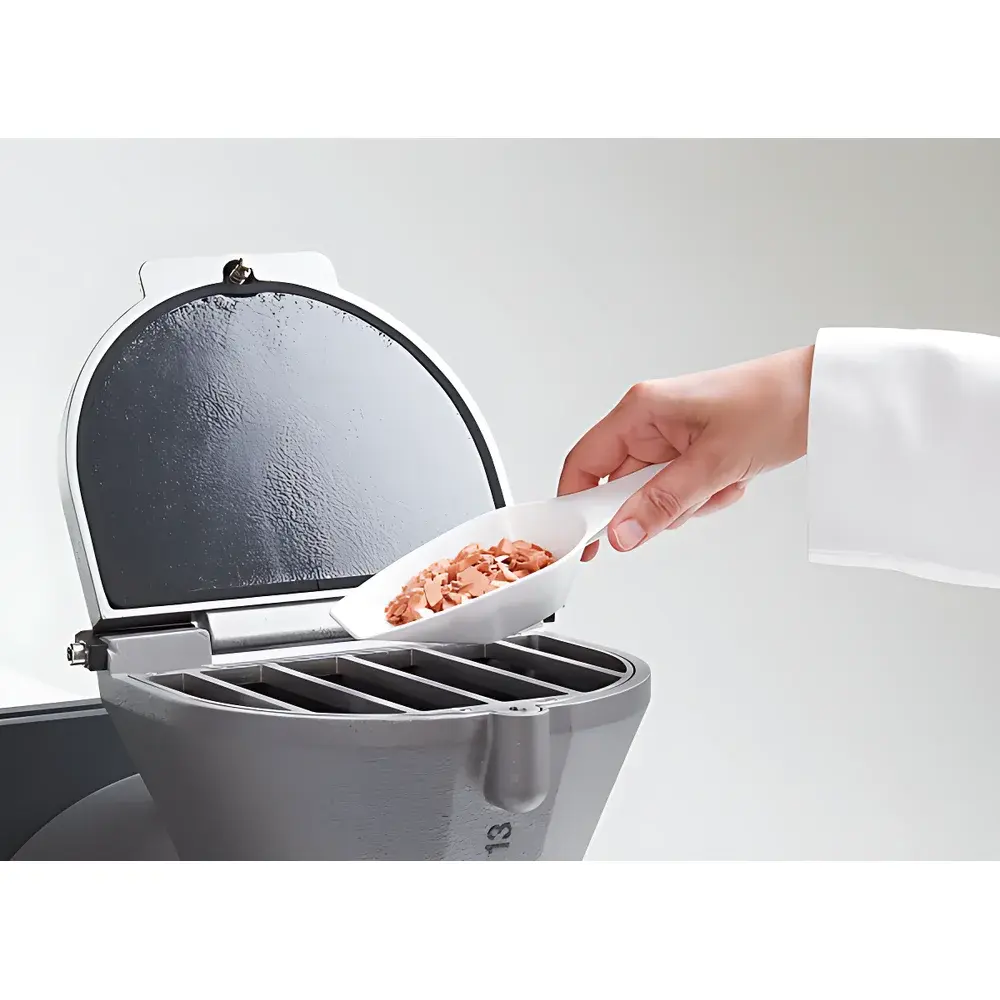
- Large-diameter feed hopper with hinged, splash-proof lid minimizes operator exposure and ensures ergonomic, dust-free material loading — compliant with OSHA and EU Directive 2004/37/EC (carcinogens and mutagens).
- Automatic zero-point calibration system simplifies disc alignment and compensates for thermal expansion or wear-induced drift, ensuring long-term dimensional stability.
- Reversible disc rotation (clockwise/counter-clockwise) extends disc service life by distributing wear evenly — particularly beneficial when processing abrasive materials such as quartz, corundum, or sintered ceramics.
- Tool-free disassembly design allows rapid access to grinding chamber and collection drawer; all wetted parts are accessible for cleaning and verification — supporting GLP/GMP cleaning validation protocols.
- Integrated dust extraction port compatible with centralized lab vacuum systems (e.g., HEPA-filtered cyclonic extractors), coupled with a fully sealed, removable collection drawer that prevents cross-contamination between batches.
- Modular coupling capability with FRITSCH P-1 Jaw Crusher via standardized mounting frame — enabling two-stage comminution workflows from ≥20 mm feed down to ≤0.05 mm final particle size in a single, validated sequence.
- Four interchangeable grinding disc material options: stainless steel (X5CrNi18-10), manganese steel (1.3401), tungsten carbide (WC-Co), and yttria-stabilized zirconia (YSZ) — selected based on hardness, chemical inertness, and contamination sensitivity per application.
Sample Compatibility & Compliance
The P-13 Premium is optimized for dry, brittle, and moderately hard materials including ores, slag, refractory bricks, feldspar, basalt, soil aggregates, and sintered metal powders. It is not recommended for fibrous, elastic, or highly ductile samples (e.g., polymers, rubber, or soft alloys). All configurations meet CE marking requirements under Machinery Directive 2006/42/EC and Electromagnetic Compatibility Directive 2014/30/EU. The instrument supports audit-ready documentation: full operational logs (time-stamped gap settings, runtime, disc direction), optional electronic signature integration for 21 CFR Part 11 compliance, and compatibility with LIMS via RS-232/USB data export.
Software & Data Management
While the P-13 Premium operates as a stand-alone instrument with embedded firmware, its digital interface supports ASCII-formatted log export (via USB stick) containing timestamped parameters: grinding gap value, total operation duration, disc rotation direction, and start/stop events. These logs are directly importable into laboratory information management systems (LIMS) or statistical process control (SPC) platforms. Optional FRITSCH LabSuite software (v3.2+) provides batch-level metadata tagging, trend analysis of gap drift over time, and PDF report generation aligned with ISO 13320 (laser diffraction) and ASTM C136 (sieve analysis) pre-processing requirements.
Applications
- Preparation of representative subsamples for X-ray fluorescence (XRF) and X-ray diffraction (XRD) analysis — minimizing heterogeneity bias through uniform particle size distribution.
- Routine homogenization of geological core samples prior to geochemical assay (ICP-MS/OES), ensuring <5% RSD in elemental recovery across replicate grinds.
- Production of standardized reference materials (SRMs) in certified reference material (CRM) manufacturing facilities, where inter-laboratory comparability depends on identical comminution history.
- Particle size reduction of ceramic raw materials (e.g., alumina, silicon carbide) prior to slip casting or dry pressing — maintaining phase purity and avoiding Fe/Ni contamination via YSZ disc option.
- Comminution of metallurgical slags and fly ash for leaching studies (e.g., TCLP, EN 12457), where liberation efficiency directly influences heavy metal mobility assessment.
FAQ
What is the maximum allowable moisture content for samples processed in the P-13 Premium?
Samples must be air-dried to ≤1.5% moisture by weight to prevent clogging and ensure consistent throughput. For hygroscopic or clay-rich matrices, pre-drying at 105°C for 2 hours is recommended.
Can the P-13 Premium be used for cryogenic grinding?
No — the instrument is not designed for liquid nitrogen cooling or sub-zero ambient operation. For temperature-sensitive or thermolabile materials, FRITSCH’s Planetary Mill PULVERISETTE 5 or Cryomill systems are recommended.
Is the grinding gap calibration traceable to national standards?
Yes — the built-in gap sensor is factory-calibrated using NIST-traceable micrometer standards (certified to ±0.01 mm uncertainty), with recalibration intervals defined in the maintenance manual (typically every 12 months or after 500 operating hours).
How does the P-13 Premium ensure compliance with ISO 17025 clause 6.4.10 (equipment verification)?
The instrument provides documented evidence of performance verification: gap linearity test reports, speed verification logs (using calibrated tachometer), and repeatability testing protocols (RSD ≤2.5% across five consecutive 100 g batches of certified quartz sand).



