
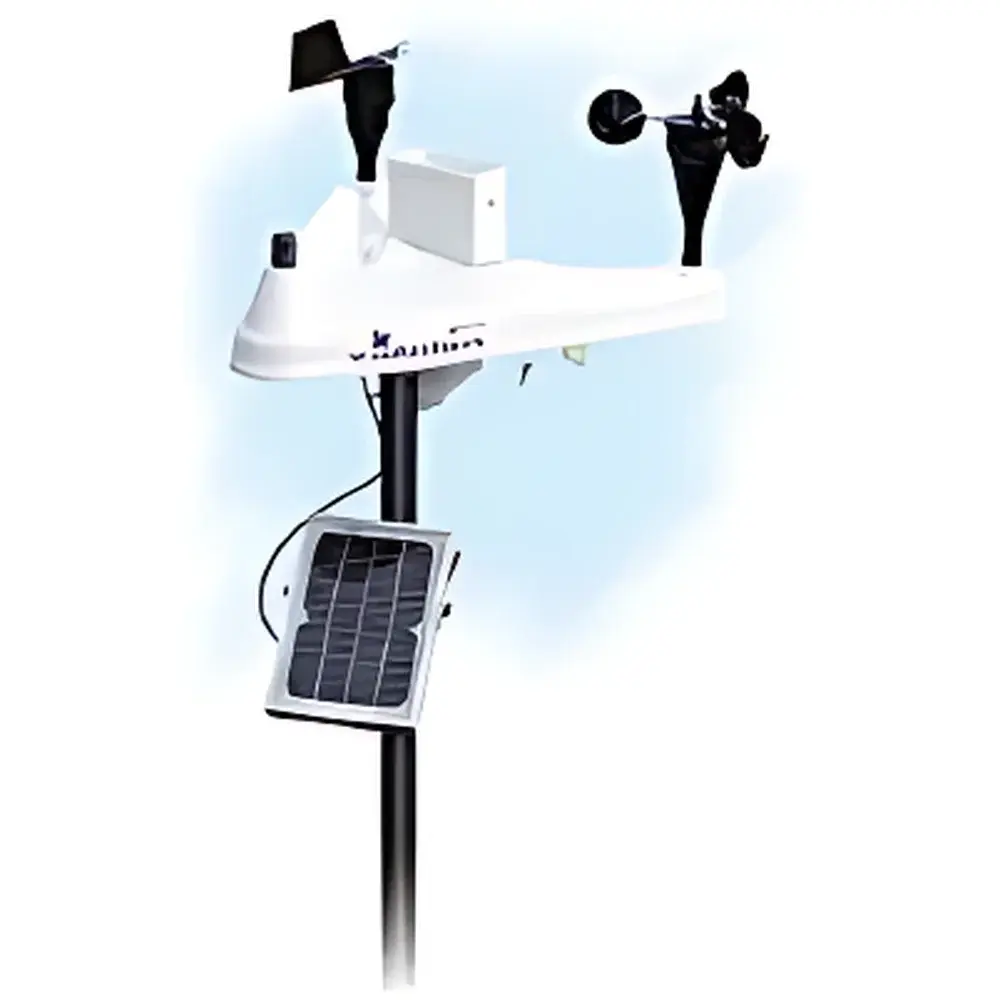
WeatherHawk 232 Portable Weather Station
| Brand | WeatherHawk |
|---|---|
| Origin | USA |
| Model | 232 |
| Instrument Type | Portable Weather Station |
| Communication Interface | RS-232 Serial |
| Power Supply | 16–22 VDC |
| Operating Temperature Range | −40 °C to +50 °C |
| Data Storage | 128 KB Non-Volatile Flash (~32,000 Data Points) |
| Sensor Suite | Anemometer (Cup), Wind Vane (Resistive), Thermistor-based Air Temperature & RH, Capacitive Barometer, Tipping-Bucket Rain Gauge, Silicon Photodiode Pyranometer (300–1100 nm) |
Overview
The WeatherHawk 232 is an industrial-grade portable weather station engineered for long-term environmental monitoring in remote, unattended, or resource-constrained field deployments. Built upon the proven Signature series architecture, it delivers metrologically traceable measurements of seven core meteorological parameters: wind speed and direction, air temperature, relative humidity, barometric pressure, solar radiation, and precipitation. Unlike consumer-grade units, the 232 employs rigorously validated sensor technologies—including a three-cup anemometer with sinusoidal magnetic induction output, a precision resistive wind vane with 352° electrically linear response, and a calibrated tipping-bucket rain gauge with 50 cm² orifice area—ensuring high reproducibility across diverse climatic conditions. Its measurement principle integrates physical transduction (e.g., mechanical displacement → electrical pulse for rainfall; thermal resistance change → voltage for temperature/RH; capacitive diaphragm deflection → pressure reading) with embedded firmware that applies real-time temperature compensation and signal conditioning. Designed for deployment in agricultural research, watershed management, wildfire risk modeling, and infrastructure resilience assessment, the 232 operates without field calibration, eliminating dependency on specialized tools or technician training.
Key Features
- Direct RS-232 serial interface for wired connection to PC, data logger, or SCADA host—no radio module required
- Industrial-grade construction with IP65-rated enclosure and corrosion-resistant aluminum mounting hardware
- Self-draining tipping-bucket rain gauge with 1 mm resolution (0.04″ per tip); optional high-accuracy 0.01″/tip configuration available
- Capacitive barometric sensor with integrated silicon strain gauge and factory temperature compensation (range: 15–115 kPa)
- Thermistor-hygrometer assembly featuring replaceable polymer RH sensing element; temperature accuracy ±0.5 °C, RH accuracy ±3% (10–95% RH)
- Solar radiation sensor compliant with ISO 9060:2018 Class C specifications: spectral response 300–1100 nm, sensitivity ~0.25 mV/(W·m⁻²), max irradiance 2000 W·m⁻²
- Non-volatile flash memory (128 KB) stores up to ~32,000 timestamped records with configurable logging intervals (1 min to 24 h)
Sample Compatibility & Compliance
The WeatherHawk 232 is compatible with standard environmental monitoring workflows governed by ASTM D5098 (Standard Practice for Calibration of Meteorological Sensors), ISO 17025-accredited calibration protocols, and USDA NRCS Field Office Technical Guide requirements for evapotranspiration (ETo) estimation. Its tipping-bucket rain gauge meets WMO Guide to Instruments and Methods of Observation (CIMO Guide) Chapter 12 specifications for precipitation measurement accuracy under wind-induced undercatch mitigation guidelines. The system supports GLP-compliant data integrity through PakBus protocol packet checksums, time-stamped records, and write-once memory architecture. While not FDA 21 CFR Part 11 certified out-of-the-box, its deterministic data structure and audit-ready binary logging enable integration into validated systems when paired with compliant host software and access control policies.
Software & Data Management
All WeatherHawk systems—including the 232—communicate via the proprietary PakBus protocol, a lightweight, low-overhead binary protocol optimized for low-bandwidth, high-latency field networks. A free Software Development Kit (SDK) is provided to third-party developers for integrating the 232 into custom dashboards, IoT platforms, or irrigation control logic engines. Native compatibility includes WeatherHawk’s own WeatherLink Live software suite (v6.0+), Campbell Scientific LoggerNet, and open-source tools such as R packages weatherlink and Python’s pakbus library. Data export formats include CSV, JSON, and NetCDF4, supporting interoperability with GIS platforms (ArcGIS, QGIS) and time-series databases (InfluxDB, TimescaleDB). Firmware updates are performed via serial command-line interface (CLI) with CRC-verified binary loading.
Applications
- Agricultural water management: Real-time ETo calculation using FAO-56 Penman-Monteith inputs from co-located sensors
- Wildfire danger indexing: Integration with NFDRS (National Fire Danger Rating System) fuel moisture models
- Urban microclimate studies: Networked deployment for heat island mapping and ventilation corridor analysis
- Construction site environmental compliance: Dust suppression trigger logic based on wind speed/direction thresholds
- Educational field labs: Modular sensor interchangeability supports hands-on instrumentation pedagogy aligned with AGU and AMS curriculum standards
- Renewable energy siting: Solar irradiance and wind profile validation for photovoltaic yield modeling and small-wind feasibility screening
FAQ
Does the WeatherHawk 232 require periodic recalibration?
No field recalibration is required. All sensors are factory-calibrated with NIST-traceable references. However, the RH polymer sensor should be replaced every 18–24 months (or sooner in chemically aggressive environments) to maintain stated accuracy.
Can the 232 operate autonomously on battery power?
Yes—it draws ≤12 mA at 12 VDC in sleep mode and ≤45 mA during active sampling. When paired with a regulated 12 V sealed lead-acid or lithium iron phosphate battery and solar charge controller, it supports multi-year unattended operation.
Is the tipping-bucket rain gauge heated for winter use?
The standard 232 rain gauge is unheated. For freezing precipitation applications, users must specify the optional heated rain collector (HW-RC-HTR), which maintains basin temperature above 0 °C using PWM-controlled 12 VDC heating elements.
What is the maximum cable length for RS-232 communication?
Up to 15 meters (50 ft) is recommended without signal repeaters. For longer runs, an RS-232-to-RS-485 converter with twisted-pair cabling extends reliable communication to 1,200 meters.
How does the system handle data loss during power interruption?
All measurements are written to non-volatile flash memory before power-down. The onboard real-time clock (RTC) maintains time continuity within ±2 seconds/month drift, ensuring temporal integrity of recovered datasets.







