
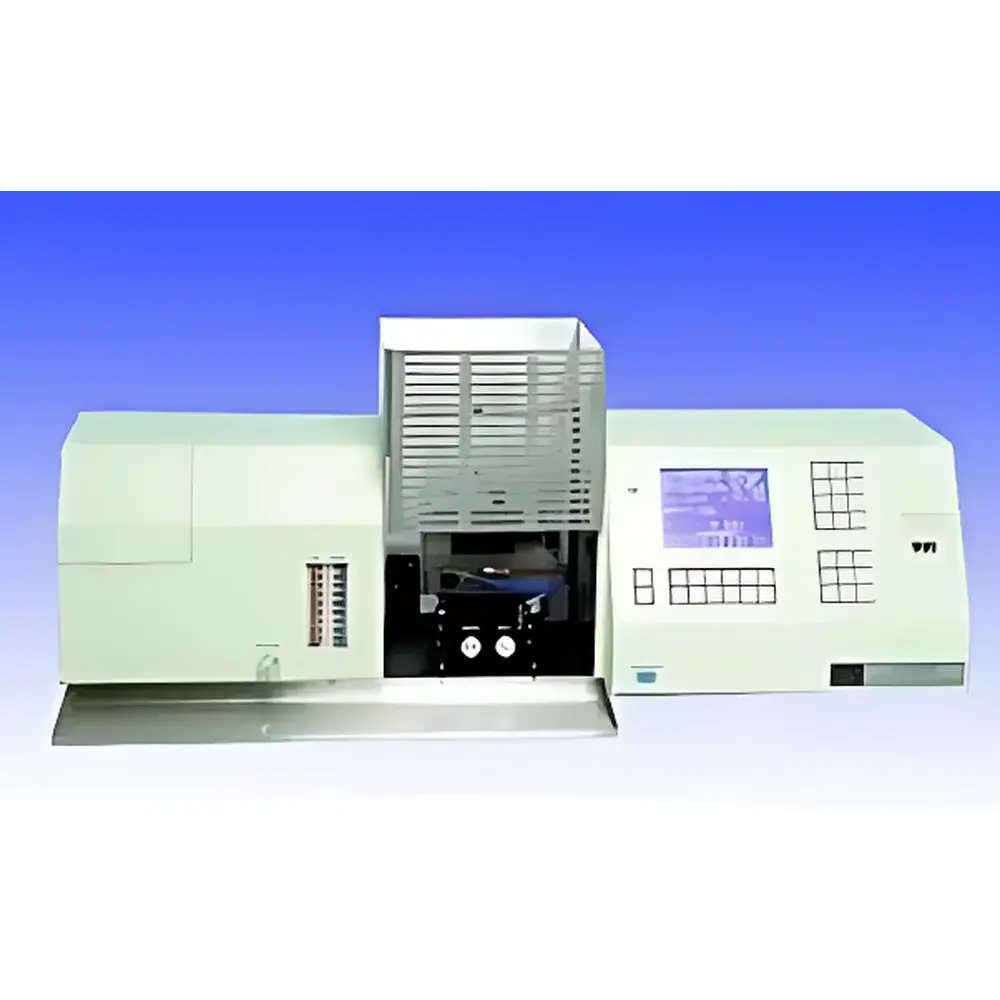
BUCK 210VGP Flame and Graphite Furnace Atomic Absorption Spectrometer
| Brand | BUCK |
|---|---|
| Origin | USA |
| Manufacturer Type | Authorized Distributor |
| Instrument Type | Flame–Graphite Furnace AAS |
| Optical System | Single-beam |
| Monochromator | Ebert-type with selectable slit widths (0.2, 0.7, and 2.0 nm) |
| Detector | Photomultiplier Tube (PMT) |
| Background Correction | Deuterium Lamp (D₂) with pulsed self-reversal mode |
| Spectral Resolution | ≤0.3 nm |
| Detection Limit (Cu) | <0.006 mg/L |
| Sensitivity (Cu) | 5 ppm at 1% absorption |
| Precision (RSD) | <0.3% |
| Wavelength Range | 190–900 nm |
| Slit Width Options | 0.2 nm, 0.7 nm, 2.0 nm |
| Lamp Holders | Triple independent lamp turret with preheat and standby control |
| Flame Burner | High-efficiency slot burner with adjustable gas flows (air/acetylene, N₂O/acetylene) |
| Graphite Furnace | Model 220 GF, integrated design with rapid heating (0–3000 °C in <1 s), programmable multi-step temperature ramping, integrated gas purge (Ar/N₂), and optional integrated graphite furnace autosampler (220AS) |
| Sample Introduction | Pneumatic nebulizer with high-efficiency spray chamber and corrosion-resistant glass bead impactor |
| Software Interface | Onboard microcomputer controller with preloaded method library for >60 elements |
| Dimensions (W×D×H) | 1016 × 305 × 305 mm |
| Compliance | Designed to support GLP/GMP workflows |
Overview
The BUCK 210VGP is a dual-mode atomic absorption spectrometer engineered for precision elemental quantification across diverse sample matrices. It operates on the fundamental principle of atomic absorption spectroscopy—measuring the attenuation of narrow-band radiation from element-specific hollow cathode lamps as ground-state atoms in a flame or graphite furnace absorb light at characteristic wavelengths. The instrument integrates flame atomic absorption (FAAS) and electrothermal atomization (ETAAS) into a single platform, enabling trace-level analysis down to sub-ppb concentrations for elements including Cu, Pb, Zn, Fe, Cr, Ni, Mn, Ca, Mg, Na, K, Ag, Au, and others. Its Ebert-type monochromator—optimized for minimal stray light and high wavelength fidelity—delivers spectral resolution ≤0.3 nm, while the pulsed deuterium lamp background correction system ensures robust compensation for structured molecular absorption and light scattering in complex matrices such as biological digests, environmental waters, and metallurgical extracts.
Key Features
- Integrated flame–graphite furnace architecture with tool-free, rapid head exchange between modes—enabling seamless transition without realignment or recalibration.
- Ebert monochromator with user-selectable slit widths (0.2, 0.7, and 2.0 nm) to balance resolution and signal-to-noise ratio per analytical requirement.
- Triple independent lamp turret with programmable preheat and standby functions—supporting simultaneous optimization of up to three hollow cathode lamps.
- 220 GF graphite furnace featuring ultra-fast resistive heating (0–3000 °C in under one second), precise multi-stage temperature programming, and integrated inert gas purging (Ar/N₂).
- Pulsed deuterium background correction with self-reversal capability—providing accurate, real-time correction for broadband and structured background interference.
- Onboard microcomputer controller with embedded operating system and preconfigured method library for over 60 elements—covering flame, graphite furnace, and hydride generation protocols.
- High-efficiency pneumatic nebulization system with corrosion-resistant glass bead impactor and optimized spray chamber geometry—maximizing transport efficiency and long-term stability.
Sample Compatibility & Compliance
The 210VGP accommodates liquid samples across a broad range of acidities and viscosities, supporting direct analysis of aqueous standards, digested environmental solids (per EPA Method 200.7/200.8), clinical serum/plasma (after dilution or matrix-matched calibration), and industrial process streams. Its graphite furnace configuration meets ISO 8288, ASTM D1688, and USP requirements for heavy metal testing in pharmaceutical excipients. When operated with validated software extensions and audit-trail-enabled data handling, the system supports compliance with GLP and GMP environments—including full traceability of instrument parameters, calibration history, and raw absorbance data. All gas flow controls (oxidant, fuel, purge, and auxiliary) are digitally regulated and logged, satisfying documentation needs for regulatory audits.
Software & Data Management
The embedded microcontroller provides full method development, execution, and reporting without external PC dependency. Users configure lamp current, slit width, burner height, furnace temperature ramps, background correction timing, and integration windows directly via the front-panel interface. Preloaded methods include calibration curve fitting (linear, quadratic, weighted), peak area/height integration, and automatic blank subtraction. Raw absorbance data, time-resolved furnace signals, and diagnostic logs are exportable via RS-232C to LIMS or third-party analytical software. Optional 220AS autosampler integration enables unattended batch processing with sample ID tagging, automated dilution, and carryover minimization—critical for high-throughput environmental or food safety labs.
Applications
- Environmental monitoring: Quantification of Pb, Cd, As, and Hg in drinking water, wastewater, soil digests, and airborne particulate filters.
- Clinical and toxicology labs: Measurement of essential (Fe, Zn, Cu, Mg) and toxic (Pb, Cd) elements in whole blood, urine, and serum.
- Pharmaceutical quality control: Heavy metal testing per ICH Q3D and USP / guidelines in active pharmaceutical ingredients (APIs) and excipients.
- Geological and metallurgical analysis: Determination of base metals (Ni, Co, Cr) and precious metals (Au, Ag) in ore concentrates and refinery intermediates.
- Food and agricultural testing: Screening for mineral nutrients and contaminants in fortified foods, infant formula, and plant tissue digests.
FAQ
Does the 210VGP require an external computer for routine operation?
No—the instrument includes a fully functional onboard microcomputer with dedicated firmware for method setup, data acquisition, calibration, and report generation.
Can the graphite furnace and flame systems be used interchangeably during the same analytical session?
Yes—tool-free mechanical switching between flame and graphite furnace heads allows immediate mode transition without optical realignment.
Is the deuterium background correction capable of handling high-background matrices like seawater or digested sludge?
The pulsed D₂ lamp system, combined with optimized temporal gating, effectively corrects both continuous and structured background up to optical densities of 2.5.
What level of regulatory compliance does the 210VGP support out-of-the-box?
Hardware-level compliance with ISO/IEC 17025 technical requirements is inherent; full 21 CFR Part 11 compliance requires deployment of validated third-party data management software with electronic signature and audit trail functionality.
Are consumables such as graphite tubes and hollow cathode lamps proprietary to BUCK?
BUCK hollow cathode lamps and graphite components are manufacturer-specified for optimal performance and thermal stability—but standard dimensions allow compatibility with select third-party alternatives meeting OEM thermal and dimensional tolerances.
Related Products



