
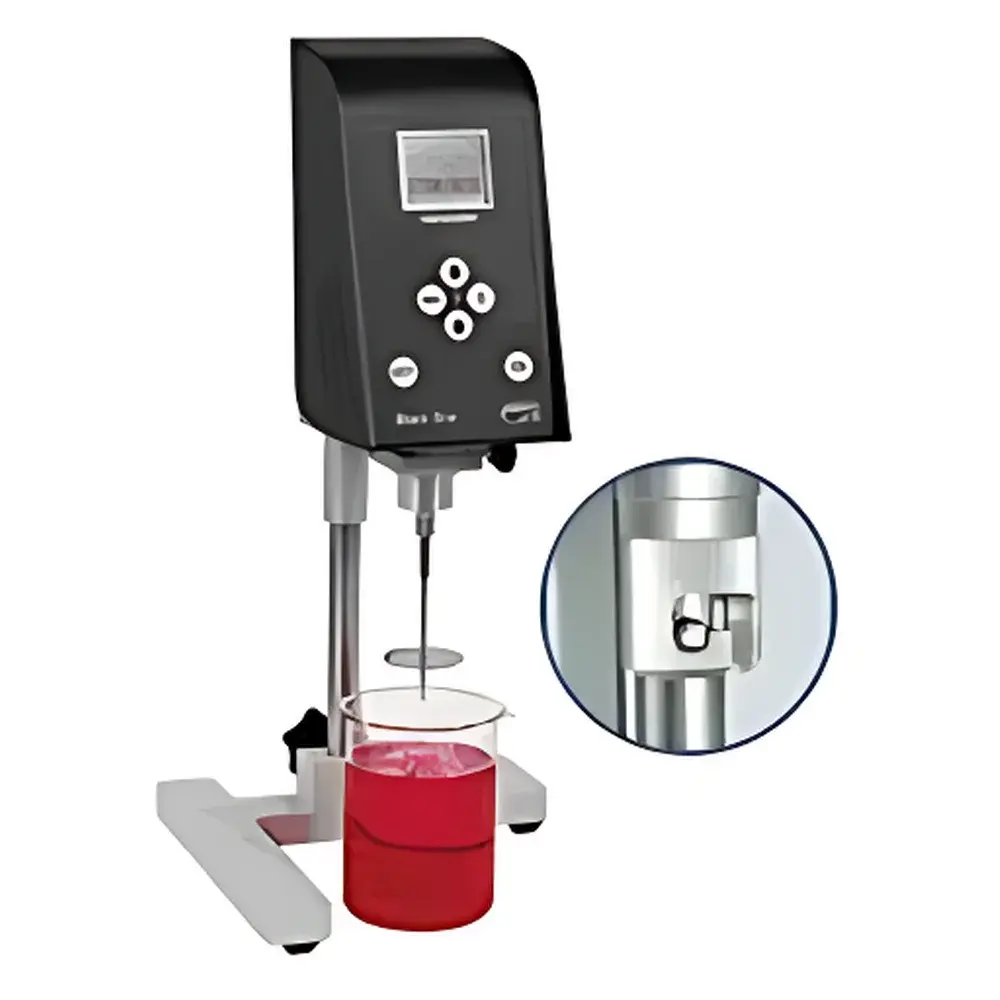
Lamyrheology BLACK ONE Basic Direct-Drive Rotational Viscometer
| Brand | Lamyrheology |
|---|---|
| Origin | France |
| Model | BLACK ONE Basic |
| Instrument Type | Fixed Rotational Viscometer |
| Drive System | Direct-Drive Motor (Spring-Free) |
| Operating Environment | Ambient Temperature |
| Viscosity Range | 20 – 180 × 10⁶ mPa·s (20 – 180 M mPa·s) |
| Speed Range | 0.3 – 250 rpm (21 discrete speeds) |
| Torque Range | 0.05 – 10 mN·m |
| Accuracy | ±1% of full scale |
| Repeatability | ±0.2% |
| Digital Output | Real-time speed, torque, viscosity, and time-stamped data via RS-232/USB |
| Power Supply | 90–240 VAC, 50/60 Hz |
| Dimensions (W×L×H) | 122 × 130 × 660 mm |
| Weight | 6 kg |
| Spindle Interface | Bayonet-type quick-connect |
| Compliance | ASTM D2196, ASTM D1084, ISO 2555, ISO 3219 |
Overview
The Lamyrheology BLACK ONE Basic is a precision-engineered, spring-free direct-drive rotational viscometer designed for reliable, maintenance-light viscosity characterization of Newtonian and non-Newtonian fluids under ambient laboratory conditions. Unlike traditional spring-and-dashpot viscometers, the BLACK ONE Basic employs a brushless DC motor coupled directly to the spindle shaft—eliminating mechanical hysteresis, wear-prone springs, and calibration drift associated with torsion wire systems. Its measurement principle follows the fundamental Couette flow geometry: torque required to rotate a defined geometry (spindle) at a controlled angular velocity within a fluid is directly proportional to the fluid’s dynamic viscosity, as standardized in ASTM D2196 and ISO 3219. The instrument delivers high reproducibility across its broad operational range—from low-viscosity solvents (20 mPa·s) to highly structured polymer melts and pastes (up to 180 × 10⁶ mPa·s)—without speed sag or torque saturation, enabled by its high-torque motor and real-time closed-loop speed control.
Key Features
- Direct-drive motor architecture eliminates mechanical springs, removing annual recalibration requirements and eliminating sensitivity to instrument leveling—operation is stable even on non-perfectly horizontal surfaces.
- 21 precisely calibrated rotational speeds (0.3–250 rpm), including low-shear options critical for thixotropic or shear-thinning material assessment.
- Bayonet-style spindle interface enables tool-free, repeatable spindle mounting with sub-millimeter axial positioning accuracy—ensuring consistent immersion depth and gap geometry per test.
- Integrated digital output supports time-synchronized acquisition of speed, torque, viscosity, and elapsed time via RS-232 or USB, compatible with third-party data logging and LIMS environments.
- Rugged aluminum chassis and compact vertical footprint (122 × 130 × 660 mm) optimize benchtop space in QC labs while maintaining thermal stability and vibration damping.
- Configurable timed shear protocols allow automated “shake-and-measure” sequences—essential for evaluating structural recovery kinetics in gels, suspensions, and yield-stress fluids.
Sample Compatibility & Compliance
The BLACK ONE Basic accommodates standard DIN, ASTM, and ISO-compliant spindles (e.g., LV, RV, HA, HB geometries), enabling viscosity determination across diverse sample classes: aqueous food emulsions, cosmetic creams, pharmaceutical suspensions, solvent-borne coatings, ink formulations, and industrial lubricants. Its torque resolution and speed stability meet the repeatability thresholds specified in USP for viscosity testing of semisolid dosage forms and align with GLP documentation requirements when paired with audit-trail-enabled software. While not intrinsically compliant with FDA 21 CFR Part 11, the instrument’s deterministic digital output and timestamped data streams support integration into validated workflows where electronic records are governed by Part 11-compliant data acquisition platforms.
Software & Data Management
The viscometer operates standalone with front-panel LCD navigation or integrates seamlessly with Lamyrheology’s optional ViscoLab Basic software (Windows-based). This application provides real-time viscosity vs. time and viscosity vs. shear rate plotting, automatic calculation of apparent viscosity at user-defined shear rates, and export of CSV-formatted datasets with metadata (operator ID, date/time stamp, spindle ID, temperature annotation field). Raw torque and speed values are retained at 10 Hz sampling, supporting post-hoc analysis of transient behavior such as yield point estimation via controlled stress ramping (when used with optional add-on firmware). All data files include embedded instrument configuration parameters, satisfying traceability requirements for ISO/IEC 17025-accredited laboratories.
Applications
- Quality control of batch-to-batch consistency in edible oils, sauces, and dairy products per ISO 11357-6.
- Routine viscosity screening of topical pharmaceutical gels and ointments during formulation development and release testing.
- Shear-thinning evaluation of water-based architectural paints and automotive refinish coatings under simulated application shear rates.
- Stability assessment of colloidal dispersions and nanoparticle suspensions through time-dependent viscosity profiling.
- Teaching laboratories requiring robust, low-maintenance instrumentation for undergraduate rheology experiments aligned with ASTM D1200 curriculum modules.
FAQ
Does the BLACK ONE Basic require periodic spring replacement or annual recalibration?
No. Its spring-free direct-drive design eliminates mechanical springs entirely—removing both wear-related drift and scheduled maintenance intervals.
Can it measure yield stress or viscoelastic properties?
Not natively. As a steady-state rotational viscometer, it reports apparent viscosity under controlled shear. For yield stress or storage/loss moduli, a controlled-stress rotational rheometer (e.g., BLACK ONE Advanced with oscillatory module) is required.
Is temperature control integrated?
No. The BLACK ONE Basic is designed for ambient-temperature operation. For temperature-dependent measurements, it is compatible with external Peltier or water-jacketed sample holders (sold separately) and requires manual temperature monitoring.
What spindle geometries are supported out-of-the-box?
Standard cylindrical spindles (LV-1 to LV-4, RV-1 to RV-7) and disk-type spindles per DIN 53019-1 are supported via the bayonet interface; custom geometries may be adapted with mechanical alignment fixtures.
How is compliance with ISO/IEC 17025 addressed?
The instrument’s ±0.2% repeatability, traceable torque/speed calibration certificates (available upon request), and deterministic digital output provide foundational metrological evidence—final accreditation depends on lab-specific validation protocols and uncertainty budgeting per ISO/IEC 17025:2017 Clause 6.4.



