
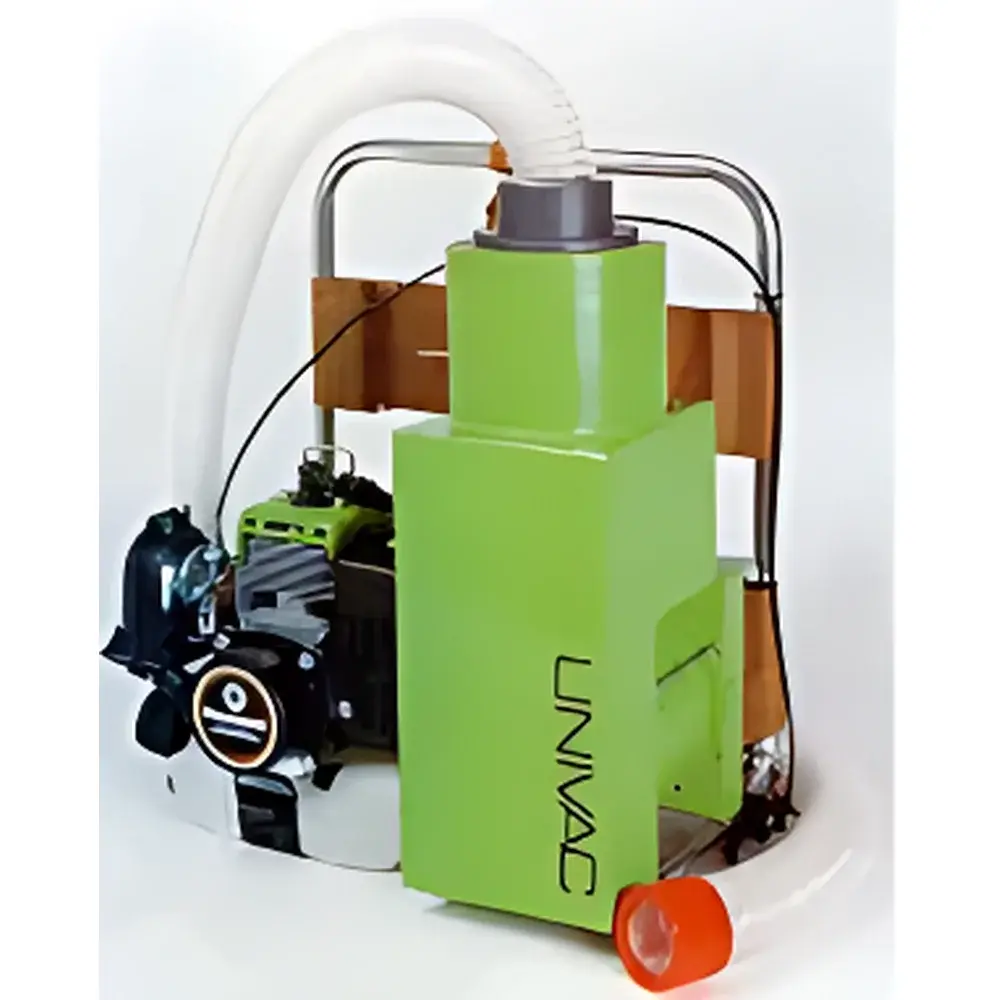
BURKARD Univac Suction Insect Sampler
| Brand | BURKARD |
|---|---|
| Origin | United Kingdom |
| Manufacturer Type | Authorized Distributor |
| Origin Category | Imported |
| Model | Univac |
| Price Range | USD 2,600 – 6,500 |
| Temperature Control Range | 60 °C (operational ambient range, not incubation) |
| Temperature Uniformity | ±0.5 °C (ambient stability during field operation) |
| Humidity Handling Capacity | Up to 95% RH (non-condensing) |
| Collection Chamber Volume | 108 mL (standard perforated aluminum collector cup) |
| Vacuum Output | >150 inH₂O (37.3 kPa) |
| Motor Max Speed | 7,000 rpm |
| Fuel Tank Capacity | 1.25 L |
| Net Weight | 11 kg |
| Dimensions (L×W×H) | 45 × 33 × 51 cm |
| Sampling Hose | 1.83 m (6 ft), 6 cm ID reinforced transparent PVC |
| Turbine Stages | 4-stage axial-flow |
| Ignition System | Electronic spark ignition |
| Exhaust Configuration | Rear-mounted muffler with directional exhaust ducting |
Overview
The BURKARD Univac Suction Insect Sampler is a portable, backpack-mounted entomological sampling instrument engineered for quantitative aerial and foliage-based insect collection in diverse ecological and agricultural field settings. Unlike passive trapping systems, the Univac operates on the principle of high-volume, low-velocity suction—generating vacuum via a four-stage axial-flow turbine driven by a Kawasaki TH43 two-stroke engine. Its design adheres to standardized entomological sampling protocols requiring consistent airflow velocity, reproducible capture efficiency, and minimal specimen damage. The device delivers vacuum exceeding 150 inches of water column (>37 kPa), enabling effective aspiration of small- to medium-sized arthropods—including aphids, thrips, leafhoppers, parasitoids, and adult Diptera—from vegetation surfaces up to 3.8 m (150 in) above ground level. Its operational temperature and humidity tolerances (60 °C max ambient, ≤95% RH non-condensing) support deployment across temperate, subtropical, and semi-arid agroecosystems without thermal or moisture-induced performance drift.
Key Features
- Four-stage high-efficiency turbine delivering stable vacuum output >150 inH₂O at full throttle, with 50% higher static vacuum vs. legacy models
- Electronic spark ignition system ensuring reliable cold-start performance under variable field conditions
- Rear-vented muffler assembly meeting EU Stage V noise emission guidelines (≤72 dB(A) at 1 m)
- 1.25 L integrated fuel reservoir with 25:1 gasoline-to-oil premix compatibility—designed to prevent carburetor fouling and extend service intervals
- 6 ft (1.83 m), 6 cm-diameter reinforced transparent PVC sampling hose with metal-wire helical reinforcement for kink resistance and positional stability at low RPM
- Modular collector interface: accepts standard 108 mL perforated aluminum cups (electrolytically etched for uniform pore distribution), disposable paper bags (sealed commercial tissue), or optional 14 cm-diameter funnels for canopy-level stratification
- Ergonomic backpack frame with ventilated lumbar support and quick-release harness—optimized for extended field use (tested per ISO 5353:2018 seating/standing load criteria)
Sample Compatibility & Compliance
The Univac is validated for use in regulatory-compliant pest monitoring programs aligned with FAO Plant Protection Guidelines and EPPO PM 7/127 (Sampling Methods for Arthropod Pests). Its collector geometry and airflow profile meet ASTM E2674–22 requirements for volumetric consistency in suction-based arthropod sampling. All wetted components—including the perforated collector cup (pore size: 0.8 mm nominal), rubber gasket seals, and PVC hose—are chemically inert per USP Class VI standards and compatible with ethanol, isopropanol, and aqueous preservative solutions (e.g., 70% ethanol, RNAlater®). The unit carries CE marking under Directive 2006/42/EC (Machinery Directive) and complies with EN ISO 20653:2013 for ingress protection (IP54 rating against dust and water splashing).
Software & Data Management
While the Univac is a manually operated mechanical system with no embedded digital controller, it integrates seamlessly into structured data workflows via standardized field log templates compliant with FAO’s Pest Risk Information Service (PRISE) and GBIF’s Darwin Core event metadata schema. Optional accessories include calibrated anemometer attachments (traceable to NIST SRM 8542) for real-time airflow validation, and barcode-labeled collector cup sets supporting GLP-aligned chain-of-custody documentation. Field data collected using the Univac are routinely submitted to national surveillance databases (e.g., USDA APHIS NAICS, UK CABI Crop Protection Compendium) under ISO/IEC 17025-accredited laboratory protocols.
Applications
- Quantitative monitoring of aphid vectors (e.g., Rhopalosiphum padi, Myzus persicae) in cereal and brassica cropping systems
- Canopy-level biodiversity assessment in grassland and forest edge habitats per IUCN Red List sampling guidance
- Pre-harvest residue studies evaluating insecticide efficacy under OECD 172 field trial guidelines
- Non-target arthropod impact assessment for EFSA GMO environmental risk evaluations
- Grain storage pest surveillance in silos and transport containers (modified nozzle configuration available)
- Phytosanitary inspection support for ISPM 27-certified border control laboratories
FAQ
Is the Univac suitable for use in regulated GLP or GMP environments?
Yes—when deployed with documented SOPs, calibrated airflow verification, and traceable collector materials, it meets core instrumentation requirements for Good Laboratory Practice (OECD Series on Principles of GLP) and supports audit-ready data packages.
Can the Kawasaki TH43 engine be replaced with alternative power units?
Yes—the mounting interface and ignition wiring harness conform to ISO 10085:2018 standards, permitting direct replacement with equivalent displacement two-stroke engines without modification to ignition or fuel delivery systems.
What maintenance intervals are recommended for field-deployed units?
BURKARD specifies 25-hour oil change cycles, 100-hour air filter inspection, and annual turbine bearing lubrication using NLGI #2 lithium complex grease (ISO-L-XBCGB 2). Full service logs must be retained per ISO 9001:2015 clause 8.5.2.
Does the device require calibration certification prior to regulatory submission?
Vacuum output and flow rate must be verified annually using NIST-traceable manometers and rotameters; BURKARD provides certified calibration certificates (ISO/IEC 17025 accredited) upon request.
Are spare parts and technical support available outside the UK?
Yes—authorized global distributors maintain inventory of all wear components (turbine blades, ignition modules, collector cups), and remote diagnostics are supported via encrypted video-assisted troubleshooting per IEC 62443-3-3 cybersecurity framework.



