
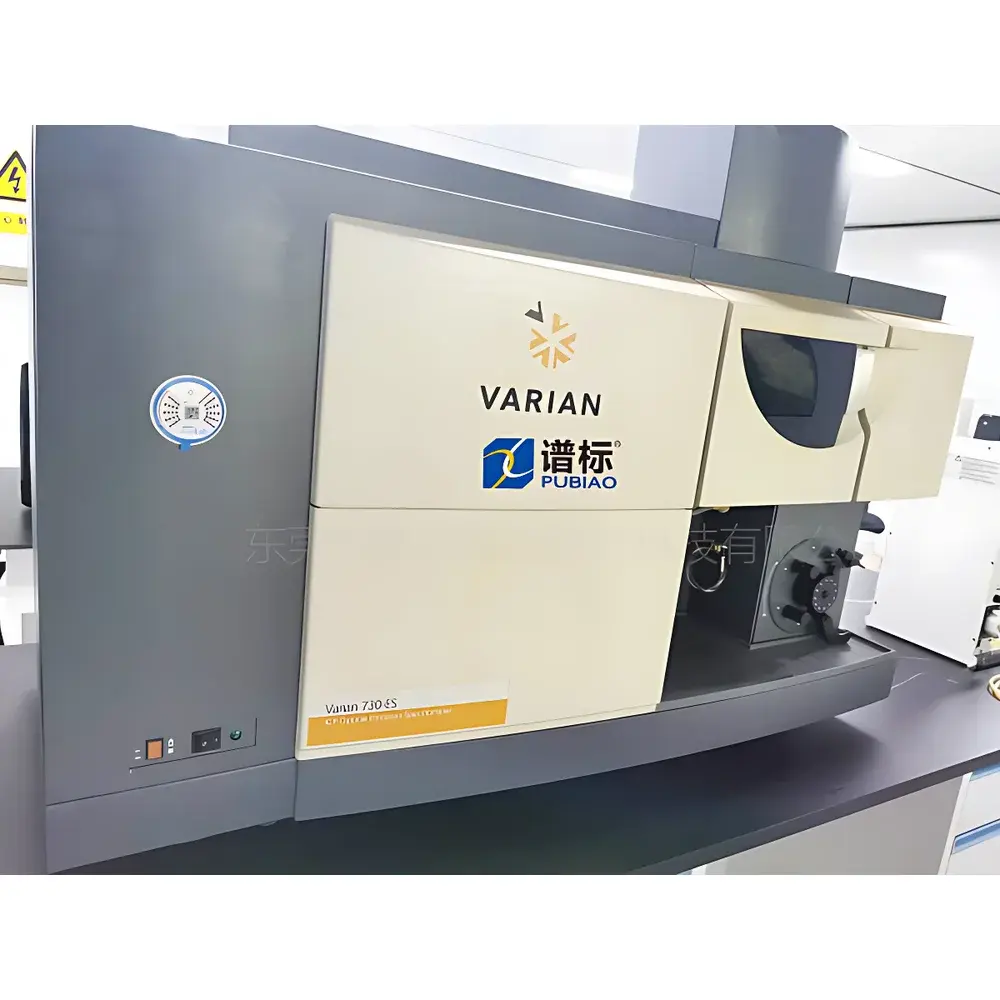
Agilent 730-ES ICP-OES Spectrometer (Refurbished)
| Brand | Agilent Technologies |
|---|---|
| Origin | USA |
| Model | 730-ES |
| Instrument Type | Full-Spectrum Direct-Reading ICP-OES |
| Detection Limit | Application-Dependent |
| Repeatability | Application-Dependent |
| Stability | <0.1% RSD (8 h, no internal standard) |
| Wavelength Range | 167–785 nm |
| Optical Resolution (FWHM) | <7 nm at 188.980 nm (As) |
Overview
The Agilent 730-ES is a refurbished, full-spectrum direct-reading inductively coupled plasma optical emission spectrometer (ICP-OES) engineered for high-precision multielement analysis in regulated and research laboratories. Based on robust axial-view plasma observation geometry, the system employs a 40 MHz air-cooled solid-state RF generator (700–1500 W, 50 W increments), delivering stable plasma excitation with >75% coupling efficiency and automatic ignition/extinction via user-defined protocols. Its core optical architecture features a 400-mm focal length echelle spectrometer with CaF₂ prism cross-disperser and 94.74 lines/mm echelle grating, thermally stabilized at 35 °C to ensure long-term wavelength fidelity and signal reproducibility. Light detection is performed by a custom-designed, triple-stage Peltier-cooled CCD detector operating at –35 °C, enabling low dark current, high dynamic range, and simultaneous acquisition across the full 167–785 nm spectral window. The integrated image-mapping (I-MAP) technology ensures uniform pixel-to-wavelength registration without mechanical scanning—eliminating moving parts and enhancing measurement robustness.
Key Features
- Axial-view plasma configuration with Cold Cone Interface (CCI) for enhanced sensitivity (3–12× lower detection limits vs. radial view) and improved tolerance to high total dissolved solids (TDS)
- Computer-controlled plasma observation position (X/Y axis) and optimized plasma gas flow regulation (plasma, auxiliary, nebulizer gases) using mass flow controllers (MFCs) with 0.01 L/min resolution
- Full-spectrum acquisition in ~0.8 s per readout via 1 MHz clock-speed bidirectional CCD readout with overflow protection on every pixel
- Adaptive Integration Time (AIT) algorithm enabling concurrent high-SNR measurement of both intense major-element lines and trace-level analyte signals within a single exposure
- Automated sample introduction with SVS-1 fast rinse valve system, programmable per-sample rinse duration (SmartRinse), and 3–4 channel peristaltic pump (0–50 rpm, software-controlled)
- Thermally stabilized echelle optics with active purge (Ar or N₂; 0.75 L/min standard, 3 L/min for <185 nm lines) and sealed optical path to minimize moisture/contamination effects
Sample Compatibility & Compliance
The Agilent 730-ES supports diverse sample matrices—including aqueous standards, digested geological/metallurgical samples, environmental waters, and high-TDS brines—through configurable sample introduction options: SeaSpray or Conikal nebulizers paired with single-channel glass cyclonic spray chambers (axial-only), or inert dual-channel configurations for specialized applications. Its CCI design mitigates tail-flame interference and extends linear dynamic range up to 6 orders of magnitude. The system meets foundational requirements for regulatory compliance workflows: built-in US EPA method templates, editable Quality Control Protocols (QCP), multi-point calibration with slope revalidation (Re-Cal Slope), and support for standard addition and external calibration. When deployed with optional 21 CFR Part 11-compliant software modules, it provides full audit trail logging, electronic signature enforcement, role-based access control, and secure data archiving via Microsoft SQL Server 2005 Express.
Software & Data Management
ICP Expert II is a network-integrated, Windows-based platform designed for method development, instrument control, and compliant data handling. Its workflow-driven interface includes guided method setup wizards, FACT (Fast Automatic Curve Fitting) for real-time spectral deconvolution, and AutoMax for automated parameter optimization (e.g., RF power, viewing height, gas flows). Background correction options span fixed-point interpolation to advanced polynomial fitting. Time-resolved signal (TRS) acquisition enables seamless hyphenation with HPLC or other separation techniques. All analytical sequences support weight/volume/dilution factor application, customizable sample labeling (batch, user-defined IDs), and flexible reporting—including PDF, CSV, and LIMS-export formats. Post-run retrospective data editing is permitted under full audit trail recording, satisfying GLP and GMP documentation expectations.
Applications
The Agilent 730-ES delivers reliable performance across environmental monitoring (EPA Methods 200.7, 200.8, 6010D), geochemical analysis (rock, soil, sediment digests), metallurgical QC (alloy composition, trace impurities), clinical/toxicology screening (blood, urine metals), and pharmaceutical elemental impurity testing (ICH Q3D). Its axial-view CCI configuration is particularly suited for ultra-trace analysis of As, Pb, Cd, and Cr in drinking water or semiconductor-grade reagents, where sub-ppt detection limits and minimal polyatomic interference are critical. Routine precision—<0.1% RSD stability over 8 hours without internal standardization—and rapid warm-up (<10 min plasma stabilization from standby)—support high-throughput laboratory operations.
FAQ
Is this instrument factory-refurbished or third-party refurbished?
This Agilent 730-ES system has undergone certified refurbishment by an Agilent-authorized service partner, including full optical alignment verification, RF generator recalibration, detector dark-current characterization, and comprehensive performance validation against ASTM D1976 and ISO 11885 reference protocols.
What consumables and accessories are included with the system?
The base configuration includes a standard quartz torch, SeaSpray nebulizer, single-channel glass cyclonic spray chamber, peristaltic pump tubing set, and argon purge kit. Optional accessories (e.g., inert spray chamber, Conikal nebulizer, autosampler integration) are available upon request.
Does the system support regulatory data integrity requirements?
Yes—when equipped with the optional ICP Expert II 21 CFR Part 11 module, the system provides electronic signatures, immutable audit trails, user authentication, and secure database encryption compliant with FDA, EMA, and PMDA expectations.
What is the typical detection limit for arsenic at 188.980 nm?
Under optimized axial-view conditions with standard sample introduction, typical 3σ detection limits for As are ≤0.008 µg/L in 2% HNO₃ matrix, verified per EPA Method 200.7 protocol.
Can the instrument be upgraded to support newer software versions or hardware modules?
Yes—Agilent maintains backward compatibility for firmware updates and offers field-installable upgrades including advanced background correction algorithms, expanded spectral libraries, and enhanced autosampler communication protocols.






