
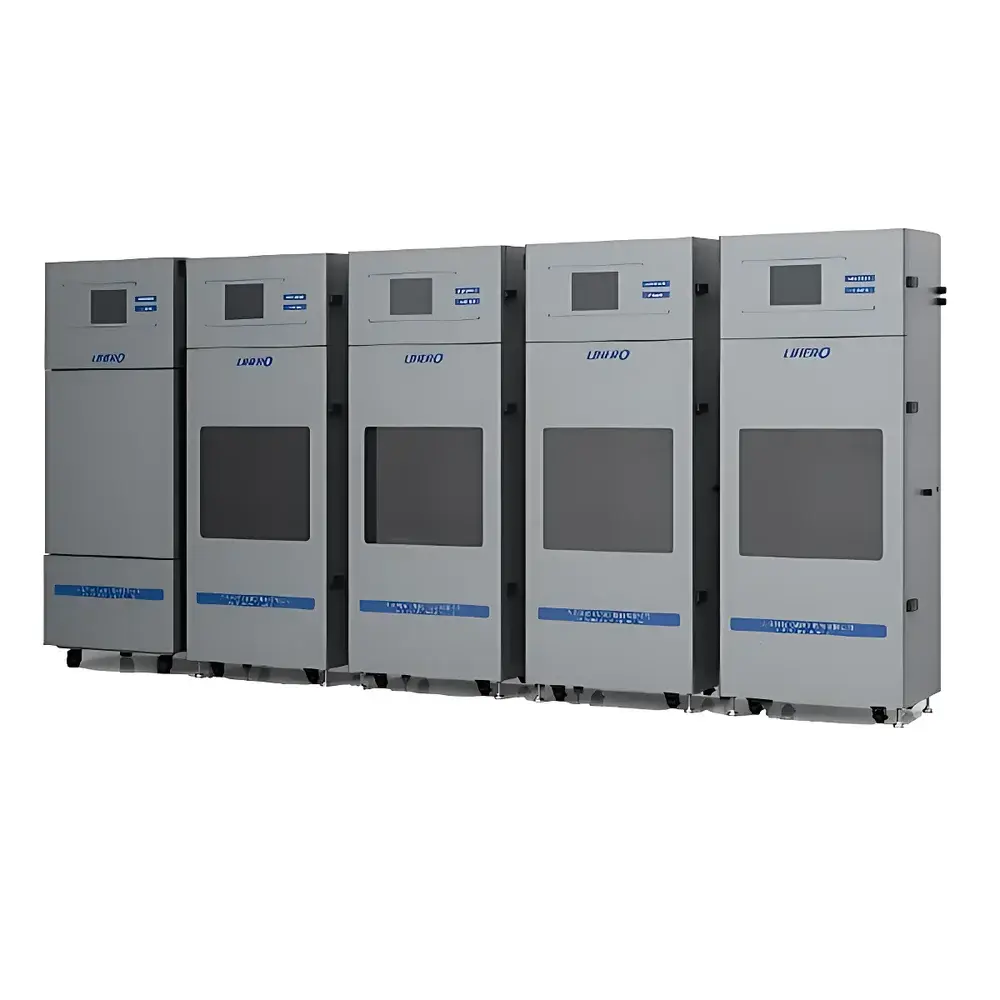
Lihero Wastewater Effluent Online Monitoring System
| Brand | Lihero |
|---|---|
| Origin | Hunan, China |
| Manufacturer Type | Authorized Distributor |
| Product Origin | Domestic (China) |
| Model | Wastewater Effluent Online Monitoring System |
| Pricing | Available Upon Request |
Overview
The Lihero Wastewater Effluent Online Monitoring System is an integrated, regulatory-compliant environmental monitoring platform engineered for continuous, unattended measurement of key water quality parameters at industrial and municipal discharge points. Built upon a modular architecture grounded in Couette-flow sampling dynamics, spectrophotometric oxidation (for CODCr), ion-selective electrode and colorimetric detection (for NH3-N), molybdenum blue spectrophotometry (for TP), and high-temperature catalytic digestion with UV-Vis detection (for TN), the system delivers real-time, traceable analytical data aligned with statutory environmental reporting obligations. Its design adheres strictly to the technical specifications promulgated by China’s Ministry of Ecology and Environment (MEE) in 2019—specifically HJ 353–356—and integrates hardware-level compliance with HJ 212–2017 for standardized data packet structure, metadata tagging, and bidirectional communication protocols.
Key Features
- Modular subsystem integration: Independent yet interoperable Data Control Unit (DCU), Automatic Water Sampling Unit (ASU), Analytical Module (supporting simultaneous CODCr, NH3-N, TP, and TN quantification), and Quality Control Unit (QCU) with automated standard addition and calibration verification.
- Regulatory-grade data integrity: Embedded audit trail functionality logs all instrument events—including calibration timestamps, reagent lot numbers, maintenance interventions, and alarm triggers—with immutable timestamping and user authentication.
- Adaptive sampling logic: Supports time-proportional, flow-proportional, and composite sampling modes; configurable via DCU interface to align with discharge permit conditions and local regulatory requirements.
- Automated quality assurance: Integrated auto-spiking, blank subtraction, duplicate analysis, and standard recovery validation per HJ 355–2019; full traceability of reference material certificates and calibration curves.
- Remote supervisory control: Compliant with HJ 212–2017’s command-response protocol, enabling centralized platform-initiated instrument diagnostics, parameter adjustment, sample triggering, and firmware updates without on-site intervention.
- Robust environmental enclosure: IP65-rated cabinet housing with temperature/humidity stabilization, anti-corrosion internal plumbing, and redundant power supply options for uninterrupted operation in outdoor or semi-industrial settings.
Sample Compatibility & Compliance
The system is validated for use with wastewater effluents exhibiting turbidity ≤ 400 NTU, suspended solids ≤ 150 mg/L, chloride ≤ 2000 mg/L, and pH 2–12. It accommodates inlet tubing diameters of 6–12 mm and supports sample intake from depths up to 5 m via submersible pump configuration. All analytical modules meet the performance criteria defined in HJ 353–2019 (installation), HJ 354–2019 (acceptance testing), HJ 355–2019 (operation & QA/QC), and HJ 356–2019 (data validity assessment). Data transmission conforms to HJ 212–2017’s XML-based frame structure, including mandatory fields for device ID, measurement time, parameter code, value, status flag, and digital signature. The system supports GLP-aligned documentation export for regulatory audits and third-party verification.
Software & Data Management
The embedded DCU runs a Linux-based real-time OS with deterministic scheduling for sensor polling and actuator control. Local data storage retains ≥ 180 days of raw sensor outputs, processed results, QC records, and event logs in SQLite format with SHA-256 hash integrity checks. Cloud synchronization occurs via TLS 1.2-encrypted MQTT or HTTP(S) endpoints, supporting configurable retention policies and role-based access control (RBAC). Software features include automated report generation (daily/weekly/monthly), deviation alerting (email/SMS/webhook), and historical trend visualization with statistical process control (SPC) charts (X-bar/R, CUSUM). Audit trails comply with principles equivalent to FDA 21 CFR Part 11 for electronic records and signatures, including operator login tracking, electronic signature capture for critical actions, and write-once-read-many (WORM) archival mode.
Applications
- Continuous compliance monitoring for industrial dischargers under national emission permits (e.g., textile, pharmaceutical, chemical, food processing sectors).
- Real-time early warning for abnormal effluent events—such as accidental spills, treatment failure, or process upsets—enabling rapid mitigation response.
- Supporting environmental inspection agencies in remote supervision, cross-validation against manual grab samples, and enforcement decision-making.
- Integration into enterprise-level environmental management information systems (EMIS) or regional ecological cloud platforms via standardized API interfaces.
- Long-term trend analysis for wastewater treatment optimization, load forecasting, and regulatory reporting (e.g., MEE’s National Discharge Permit Management Information Platform).
FAQ
Does the system support remote firmware updates?
Yes—updates are delivered over secure TLS channels and require dual-operator authorization before execution to ensure operational continuity and version traceability.
How is data authenticity ensured during transmission?
Each data packet includes a digitally signed checksum, device-specific cryptographic key binding, and sequence-numbered payload to prevent replay or tampering.
Can the system operate without internet connectivity?
Yes—the DCU maintains full autonomous operation with local data logging, QC execution, and alarm activation; cloud sync resumes automatically upon network restoration.
Is third-party calibration verification supported?
Yes—the system exports calibration logs, raw spectra (where applicable), and QC result sets in CSV and PDF formats compatible with external accreditation bodies (e.g., CNAS-accredited labs).
What maintenance intervals are recommended?
Reagent replacement every 30 days (typical), tubing inspection every 90 days, and full system verification per HJ 355–2019 quarterly or after any major component service.







