
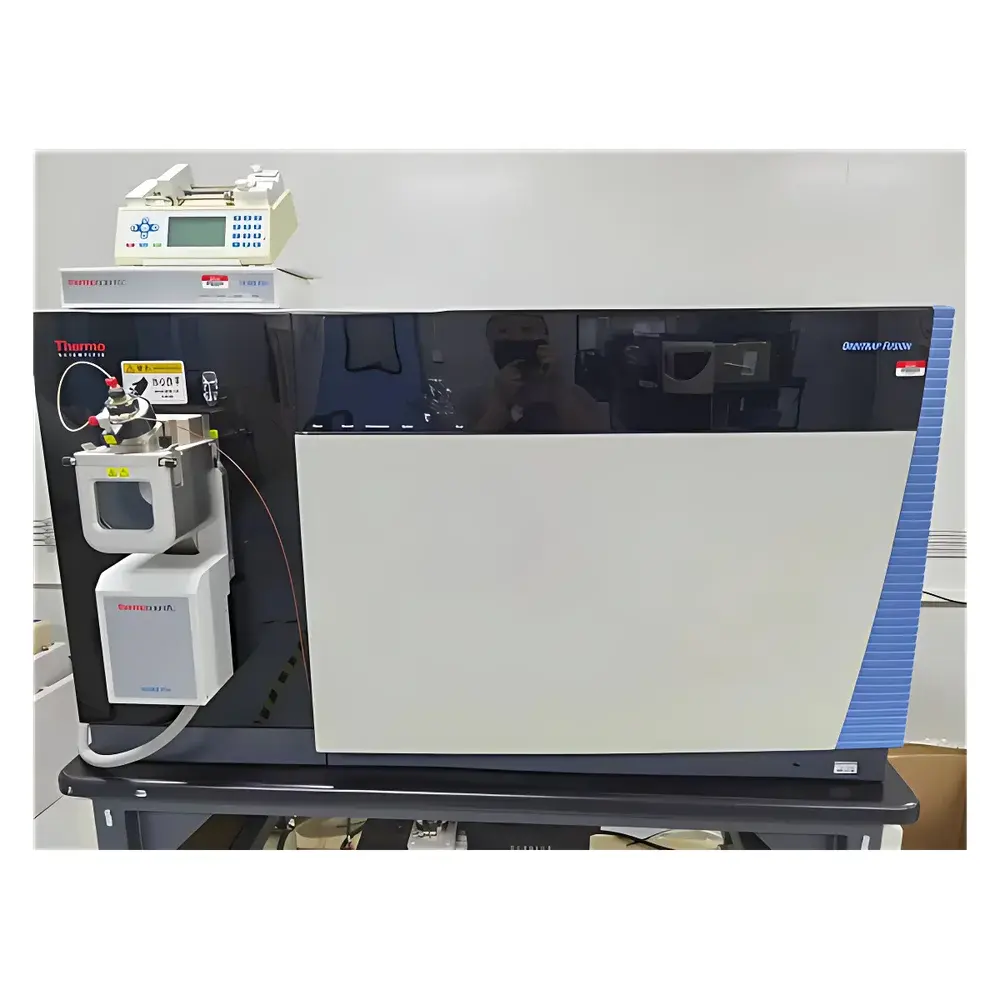
Thermo Scientific Orbitrap Fusion Tribrid Mass Spectrometer
| Brand | Thermo Fisher |
|---|---|
| Origin | USA |
| Manufacturer Type | Authorized Distributor |
| Origin Category | Imported |
| Model | Orbitrap Fusion |
| Instrument Type | Orbitrap-based Hybrid Mass Spectrometer |
| Application Scope | Universal |
| Mass Range | 10–4,000 m/z |
| Sensitivity | 100:1 (S/N for 100 fmol BSA digest, full-scan MS) |
| Resolution | Up to 500,000 FWHM @ m/z 200 |
| Mass Accuracy | < 1 ppm RMS (internal calibration), < 3 ppm (external calibration) |
| Operating Pressure Range | 1×10⁻¹⁰ to 1×10⁻⁷ Torr (Orbitrap vacuum) |
Overview
The Thermo Scientific Orbitrap Fusion Tribrid Mass Spectrometer is a high-performance hybrid mass spectrometer engineered for next-generation proteomics, metabolomics, and structural biology applications. It integrates three complementary mass analyzers—quadrupole (Q), electrostatic field orbitrap (Orbitrap), and dual-pressure linear ion trap (LIT)—into a single, synchronized platform governed by a unified acquisition architecture. This tribrid design enables simultaneous or sequential use of multiple mass analysis and fragmentation modalities within a single LC-MS/MS run. The instrument operates on the principle of Fourier-transform ion cyclotron resonance (FT-ICR)-inspired orbital trapping: ions are electrostatically trapped in a spindle-shaped orbit around a central electrode, where their axial oscillation frequencies—directly proportional to the square root of m/z—are detected as image currents and converted into high-resolution mass spectra via fast Fourier transform (FFT). Unlike detector-dependent systems, the Orbitrap functions as both mass analyzer and transducer, eliminating signal loss from secondary electron multipliers and ensuring long-term stability without consumable replacement.
Key Features
- Ultra-High-Field Orbitrap Analyzer: Features a compact, high-voltage Orbitrap with enhanced electric field geometry, delivering up to 500,000 resolution at m/z 200 and sub-ppm mass accuracy with internal calibration—critical for confident identification of post-translational modifications (PTMs) and isobaric species.
- Dual-Pressure Linear Ion Trap: Comprises separate high-pressure (1.5 mTorr) and low-pressure (0.5 mTorr) helium compartments optimized respectively for rapid ion accumulation/fragmentation (CID) and high-fidelity scanning—enabling >20 Hz MS/MS cycle rates without sacrificing sensitivity or resolution.
- Intelligent Ion Source Platform: Ships standard with the Easy-Source NG, integrating heated electrospray ionization (HESI) and atmospheric pressure chemical ionization (APCI) in a single modular interface; source type is auto-recognized by the instrument firmware upon installation.
- S-Lens Ion Optics & Curved Quadrupole Ion Guide: Replaces legacy tube lenses with multipole S-lens assemblies for >5× improved ion transmission efficiency; curved quadrupole geometry filters neutral species prior to detection, reducing chemical noise and enhancing signal-to-noise ratio.
- Universal Fragmentation Capabilities: Supports collision-induced dissociation (CID) in the ion trap, higher-energy C-trap dissociation (HCD) in the C-trap collision cell, and optional electron-transfer dissociation (ETD) using fluoranthene anion chemistry—enabling backbone cleavage while preserving labile PTMs such as phosphorylation and glycosylation.
Sample Compatibility & Compliance
The Orbitrap Fusion accommodates diverse sample introduction methods—including nanospray, microspray, and standard ESI—with interchangeable sources (e.g., Nanospray Flex Ion Source NG, Easy-Spray o-ESI NG) supporting flow rates from 50 nL/min to 1 mL/min. Its hardware and software architecture comply with Good Laboratory Practice (GLP) and Good Manufacturing Practice (GMP) requirements: audit trails, electronic signatures, and secure user access controls are fully implemented per FDA 21 CFR Part 11. Data integrity is maintained through time-stamped raw file generation, immutable metadata embedding, and support for ISO/IEC 17025-compliant calibration workflows. All mass calibration protocols align with ASTM E2916-20 standards for mass spectrometric performance verification.
Software & Data Management
Controlled via Thermo Scientific Compound Discoverer and Proteome Discoverer 3.0 software suites, the system supports real-time method optimization, automated peak detection, and integrated spectral library searching (NIST, UniProt, SpectraST). Raw data files (.raw) are natively compatible with open-source platforms including Skyline, MaxQuant, and FragPipe. The instrument firmware enforces traceable data lineage: every scan event logs instrument parameters, calibration status, and environmental conditions (vacuum level, temperature, gas flows). All acquisitions support retention time alignment, label-free quantitation (LFQ), and TMT/iTRAQ multiplexing workflows with built-in interference correction algorithms. Data export formats include mzML, mzXML, and vendor-neutral .mgf for cross-platform reproducibility.
Applications
- Deep Proteomics: Enables comprehensive identification and quantification of >10,000 proteins per run in complex biological matrices (e.g., human plasma, tissue lysates) using data-dependent acquisition (DDA) and data-independent acquisition (DIA) strategies.
- Top-Down Proteomics: Delivers intact protein characterization with high mass accuracy and resolution, facilitating direct analysis of proteoforms and combinatorial PTM mapping without enzymatic digestion.
- Metabolite Identification: Supports untargeted metabolite profiling with accurate mass filtering, isotopic pattern recognition, and in silico fragmentation prediction (CFM-ID, MetFrag).
- Structural Biology Support: Provides hydrogen-deuterium exchange mass spectrometry (HDX-MS) compatibility via rapid duty-cycle control and deuterium retention monitoring across pH/temperature gradients.
- Clinical Biomarker Discovery: Validated for translational workflows under CLIA and CAP guidelines when deployed with certified reference materials and QC protocols aligned with ISO 15189.
FAQ
What distinguishes the Orbitrap Fusion from earlier Orbitrap instruments like the Q Exactive?
The Fusion introduces a true tribrid architecture—combining quadrupole, Orbitrap, and dual-pressure ion trap—with independent control over each analyzer and fragmentation pathway. Unlike Q Exactive’s quadrupole-Orbitrap design, the Fusion permits concurrent MS and MS/MS acquisition, parallelizable HCD/CID/ETD events, and real-time decision-making based on dynamic exclusion and intensity thresholds.
Is ETD available as a factory-installed option or field-upgradable?
ETD is offered as a factory-configured module with dedicated electron transfer reagent delivery, fluoranthene reservoir, and optimized RF/DC settings; field upgrade requires certified service engineer installation and full system recalibration.
Does the system support scheduled MRM transitions for targeted quantitation?
While primarily optimized for discovery workflows, the Fusion supports scheduled parallel reaction monitoring (sPRM) with retention time windows, achieving comparable precision and sensitivity to triple-quadrupole platforms for targeted assays.
What vacuum specifications are required for stable Orbitrap operation?
The Orbitrap chamber maintains ultra-high vacuum (UHV) at ≤1×10⁻¹⁰ Torr via turbomolecular pumping; system interlocks prevent acquisition if vacuum integrity falls below 5×10⁻⁹ Torr, ensuring measurement fidelity and detector longevity.
Can raw data files be processed offline without instrument connectivity?
Yes—Thermo’s .raw files contain all necessary metadata, calibration coefficients, and acquisition parameters; processing can be performed on any workstation running compatible versions of Proteome Discoverer or open-source tools without live instrument connection.





