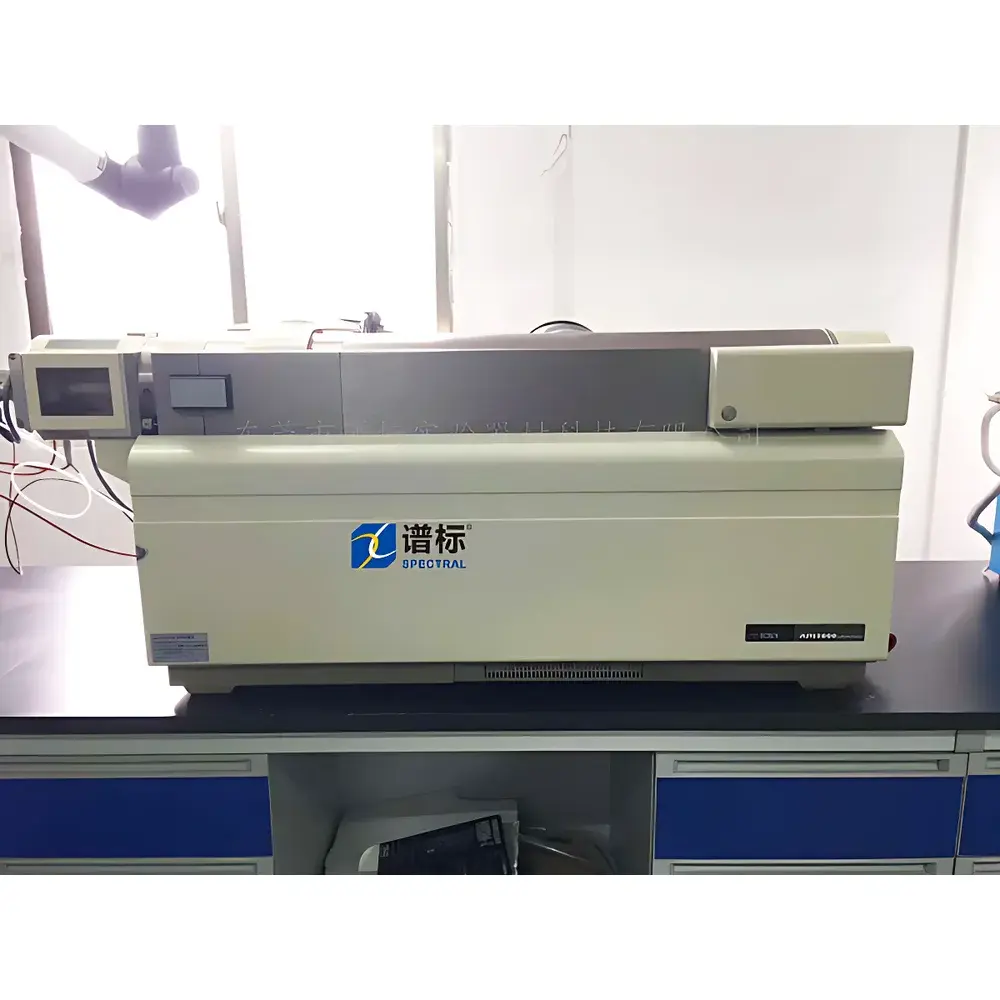
AB Sciex API 3000 Used Triple Quadrupole Liquid Chromatography-Tandem Mass Spectrometer
| Brand | SCIEX |
|---|---|
| Origin | USA |
| Model | API 3000 |
| Instrument Type | Triple Quadrupole LC-MS/MS |
| Usage Duration | 3–5 years |
| Warranty | 1 year |
| Detection Principle | Electrospray Ionization (ESI) and Atmospheric Pressure Chemical Ionization (APCI) coupled with tandem mass spectrometry |
| Dynamic Range | 1–4 × 10⁶ cps |
| Vacuum System | Dual-stage air-cooled turbo molecular pumps |
| Ion Source Flow Ranges | TurboIonSpray: 2–1000 µL/min |
| APCI | 0.2–2.0 mL/min |
| Collision Cell Technology | Linear Accelerator (LINAC) high-pressure RF-only quadrupole (Q0) with collision-induced dissociation (CID) |
| Detector | Pulse-counting electron multiplier with polarity-switching capability (< 100 ms) |
| Scan Speed | Up to 5,000 Da/sec in MRM mode |
| Software Platform | Analyst® 1.4.2 or later (FDA 21 CFR Part 11 compliant configuration available) |
Overview
The AB Sciex API 3000 is a robust, high-performance triple quadrupole liquid chromatography-tandem mass spectrometer (LC-MS/MS) originally engineered for quantitative bioanalysis, pharmaceutical metabolism studies, and clinical toxicology applications. Designed around a proven ion-optics architecture and vacuum-stable quadrupole mass filtering system, the API 3000 employs electrospray ionization (ESI) and atmospheric pressure chemical ionization (APCI) sources—both integrated into a single platform—to deliver consistent sensitivity, selectivity, and inter-day reproducibility. Its core measurement principle relies on precursor ion selection in Q1, collision-induced dissociation (CID) in a pressurized LINAC collision cell (Q2), and product ion detection in Q3—enabling highly specific multiple reaction monitoring (MRM) quantification with sub-pg/mL limits of detection in biological matrices. The instrument’s mechanical and electronic architecture reflects mid-2000s industrial design standards for reliability in regulated laboratories, including GLP and GMP environments.
Key Features
- Triple quadrupole mass analyzer with independently controlled RF/DC voltages for precise mass resolution and transmission efficiency
- Linear Accelerator (LINAC) collision cell technology: eliminates carryover and memory effects during rapid MRM transitions while maintaining high ion transmission and signal-to-noise ratio
- Dual ionization capability: TurboIonSpray® source optimized for low-flow LC (2–1000 µL/min); APCI source compatible with higher flow rates (0.2–2.0 mL/min) and less polar compounds
- Pulse-counting electron multiplier detector supporting fast polarity switching (<100 ms) and wide dynamic range (1–4 × 10⁶ cps)
- Dual-stage air-cooled turbo molecular pump system ensuring stable high-vacuum operation without liquid nitrogen or external chillers
- Integrated Q0 collision focusing quadrupole that enhances ion beam collimation prior to CID, improving duty cycle and quantitative precision
- Hardware-accelerated scanning modes: simultaneous MS and MS/MS acquisition via hybrid scan functions within Analyst® software
Sample Compatibility & Compliance
The API 3000 accommodates a broad range of sample types—including plasma, serum, urine, tissue homogenates, and formulated drug products—when coupled with standard reversed-phase, HILIC, or mixed-mode LC separations. It supports regulatory-compliant workflows aligned with ICH M10, USP , and FDA Bioanalytical Method Validation Guidance. When configured with audit-trail-enabled Analyst® software (v1.4.2+), the system meets data integrity requirements under 21 CFR Part 11 for electronic records and signatures. Routine calibration verification follows ASTM E2065-18 (Standard Practice for Calibration of Mass Spectrometers) and internal mass calibration protocols using polypropylene glycol or tuning mix standards.
Software & Data Management
Data acquisition and processing are managed through Sciex Analyst® software—a Windows-based platform offering real-time peak integration, automated method optimization (e.g., compound-dependent DP, CE, CXP settings), and batch processing for high-throughput labs. Analyst supports raw data export in .WIFF format, compatible with third-party quantitation tools (e.g., MultiQuant™, ISCOPE). All acquisitions include embedded metadata (instrument parameters, timestamps, user IDs), enabling traceability per ISO/IEC 17025:2017 clause 7.5.2. Backup and archiving are facilitated via network-mapped drives or LTO tape systems; no proprietary cloud dependency is required.
Applications
- Quantitative pharmacokinetic (PK) and toxicokinetic (TK) analysis of small-molecule drugs and metabolites in biological fluids
- Endogenous biomarker quantification (e.g., steroids, vitamins, neurotransmitters) using stable isotope-labeled internal standards
- Residue analysis in food safety testing (veterinary drugs, pesticides, mycotoxins) per EU Commission Decision 2002/657/EC
- Impurity profiling and degradation product identification in stability-indicating assays
- Supporting method development for LC-MS/MS validation per FDA Guidance for Industry (May 2018)
FAQ
Is the API 3000 compatible with modern UHPLC systems?
Yes—the instrument accepts analog and digital trigger signals from major UHPLC platforms (e.g., Waters Acquity, Thermo UltiMate 3000, Agilent 1290) via TTL or RS-232 interfaces.
Does this unit include validated installation qualification (IQ) and operational qualification (OQ) documentation?
A full IQ/OQ protocol package—including vacuum leak test logs, mass calibration reports, and sensitivity verification results—is provided upon request and can be executed by certified field service engineers.
Can the system be upgraded to support newer software versions or hardware modules?
While the API 3000 hardware does not support post-2010 firmware revisions, it remains fully functional with Analyst® 1.6.3 (last officially supported version); no hardware retrofits are required for continued compliance.
What maintenance intervals are recommended for optimal performance?
Routine maintenance includes quarterly ion source cleaning, biannual turbomolecular pump oil inspection, and annual mass calibration—aligned with Sciex’s original maintenance schedule recommendations.