
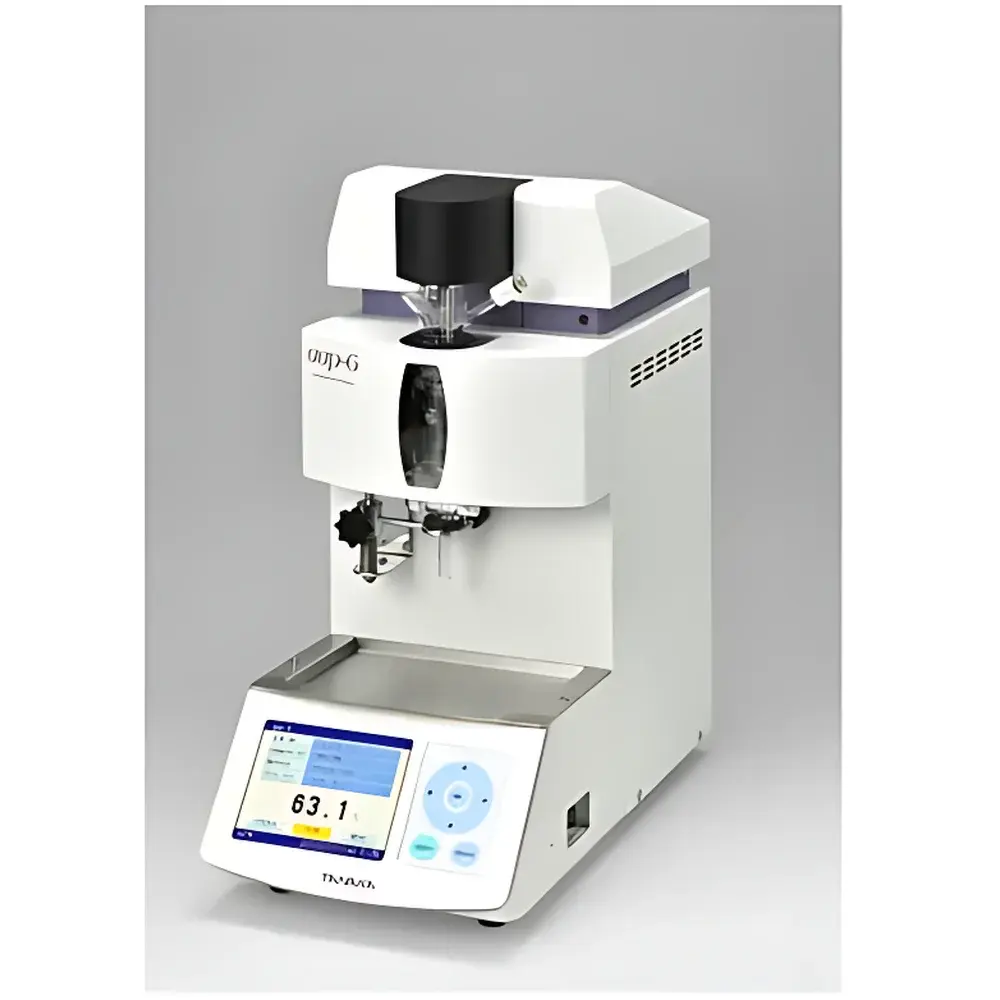
Tanaka AAP-6 Automatic Aniline Point Tester
| Brand | Tanaka |
|---|---|
| Origin | Japan |
| Model | AAP-6 |
| Standards Compliance | GB/T 262, JIS K2256, ISO 2977, ASTM D611 |
| Temperature Range | 20°C above ambient to 160°C (extended low-temp operation requires optional chiller system) |
| Control System | Microprocessor-based programmable controller |
| Display | 5.7-inch color LCD, temperature resolution 0.1°C |
| Sensor | PT100 platinum resistance thermometer (100 Ω at 0°C) |
| Detection Method | Infrared LED emitter + phototransistor optical detection circuit |
| Sample Cell | Dual-section U-shaped vacuum-jacketed tube with detachable lower section for weighing |
| Heating Element | Stainless steel micro-heater (20 W) |
| Stirring Mechanism | DC motor-driven impeller via gear-belt coupling |
| Ramp Profile | 10°C/min until 10°C below setpoint, then 2°C/min |
| Safety Protections | Overheat cutoff at setpoint +10°C or 170°C ceiling |
| Data Storage | Auto-log of latest 200 test records (sample ID, result, timestamp) |
| I/O Interfaces | USB, RS-232C, LAN |
| Dimensions | 230 × 470 × 490 mm (W×D×H) |
| Weight | 14 kg |
| Power Supply | AC 100–240 V, 50/60 Hz, 125 W |
| Operating Environment | 10–40°C, ≤90% RH non-condensing |
Overview
The Tanaka AAP-6 Automatic Aniline Point Tester is a precision-engineered instrument designed for the standardized determination of aniline point in petroleum products—primarily lubricating oils, distillates, and hydrocarbon solvents—according to internationally recognized test methods including ASTM D611, ISO 2977, JIS K2256, and GB/T 262. The aniline point serves as a critical empirical indicator of aromatic content and polarity in hydrocarbon mixtures; lower aniline points correlate with higher aromaticity and poorer solvency for elastomers, while higher values suggest greater paraffinic character and improved oxidative stability. The AAP-6 employs a validated optical phase-transition detection principle: as the heated mixture of sample and aniline reaches mutual solubility, the previously turbid or heterogeneous liquid becomes optically homogeneous. This transition is captured in real time by an infrared LED–phototransistor pair positioned across the U-shaped vacuum-jacketed cell, eliminating subjective visual interpretation and ensuring high inter-laboratory reproducibility.
Key Features
- Automated dual-stage heating profile: 10°C/min ramp to within 10°C of user-defined expected aniline point, followed by precise 2°C/min fine control—minimizing thermal overshoot and optimizing measurement accuracy.
- Modular U-tube sample cell with separable upper and lower sections enables direct gravimetric sampling without transfer errors; the lower segment can be removed, tared, and reinstalled without disturbing calibration or alignment.
- Integrated optical detection system uses infrared emission and phototransistor reception to detect phase homogenization objectively—immune to operator bias and insensitive to sample color or opacity.
- Robust safety architecture includes dual overtemperature cutoffs (at setpoint +10°C or absolute 170°C), real-time PT100 continuity monitoring, and automated diagnostics for optical path failure or internal power anomalies.
- Compact vertical stack design (control unit atop measurement module) reduces footprint to 230 × 470 mm—ideal for space-constrained QC laboratories.
- Full microprocessor control with 5.7-inch color LCD interface supports intuitive navigation, on-screen temperature calibration via four-way keypad, and immediate access to system status and error logs.
Sample Compatibility & Compliance
The AAP-6 accommodates both transparent and opaque petroleum samples—including waxy or semi-solid materials at ambient temperature—without pre-melting or dilution. Solid-phase samples are weighed directly in the detachable lower cell section, then assembled into the vacuum-jacketed U-tube for controlled heating. The instrument meets full regulatory traceability requirements for routine quality control: all temperature measurements are referenced to a certified PT100 sensor with NIST-traceable calibration documentation available upon request. Data integrity complies with GLP principles through automatic timestamped logging of 200 most recent tests (including sample ID, result, date/time, and operator flag if configured). Optional integration with LIMS via RS-232C or LAN enables audit-ready electronic records aligned with FDA 21 CFR Part 11 expectations when paired with validated software protocols.
Software & Data Management
The embedded firmware implements deterministic real-time control logic with no external PC dependency. All test parameters—including expected aniline point, ramp rates, and alarm thresholds—are configurable via the front-panel interface. Results are stored internally with full metadata (sample name, temperature result, start/finish timestamps, and system diagnostic flags). Export is supported via USB mass storage (CSV format), RS-232C serial dump, or TCP/IP network transfer for centralized database ingestion. Firmware updates are performed via USB stick with cryptographic signature verification to maintain configuration integrity. No proprietary drivers or cloud dependencies are required—ensuring long-term operational continuity and IT security compliance in regulated environments.
Applications
- Quality assurance of base oils and finished lubricants per ASTM D611 specification limits.
- Refinery process monitoring of solvent extraction efficiency and aromatic saturation levels.
- Research and development of bio-derived hydrocarbons and synthetic esters where polarity profiling informs compatibility with seals and additives.
- Contract testing laboratories requiring ISO/IEC 17025-compliant instrumentation with documented uncertainty budgets and interlaboratory validation data.
- Regulatory submission support for fuel and lubricant registration dossiers under REACH or EPA Tier 3 reporting frameworks.
FAQ
Does the AAP-6 require external cooling for sub-ambient aniline point measurements?
Yes. For samples with expected aniline points below ambient +20°C, an optional chiller system—including insulated coolant circulation tubing, cryogenic bath vessel, and temperature-stabilized cold block—is required. The standard unit operates from ambient +20°C to 160°C.
Can the instrument validate method compliance for ISO 2977 certification audits?
Yes. The AAP-6 implements the exact heating rate profile, optical detection threshold, and reporting granularity specified in ISO 2977:2021. Full calibration certificates, maintenance logs, and firmware version traceability support audit readiness.
Is the optical detection system susceptible to fouling from heavy fuel residues?
No. The infrared LED and phototransistor are mounted externally on polished quartz windows sealed to the vacuum jacket. Routine cleaning requires only isopropanol wipe-down; no disassembly or optical recalibration is needed between tests.
What level of temperature accuracy is maintained across the operating range?
The PT100 sensor provides ±0.1°C repeatability and ±0.3°C absolute accuracy (traceable to NIST SRM 1750) over the full 20–160°C range, verified annually using calibrated reference thermometers per ASTM E77.
How is data integrity ensured during power interruption?
Non-volatile memory retains all 200 test records and system configuration settings. Upon restart, the instrument resumes normal operation without data loss or parameter reset.
Related Products





