Brabender ELATEST Pneumatic Density Meter
| Brand | Brabender |
|---|---|
| Origin | Germany |
| Model | ELATEST |
| Power Supply | 230 V, 50/60 Hz, 1 A |
| Density Range (Standard) | 0.8–2.6 g/cm³ |
| Sample Volume | 40–120 cm³ |
| Integrated Precision Balance | 0–300 g |
| Repeatability | ±0.03% |
| Absolute Accuracy | ±0.0008 g/cm³ |
| Compressed Air Supply | 6–8 bar |
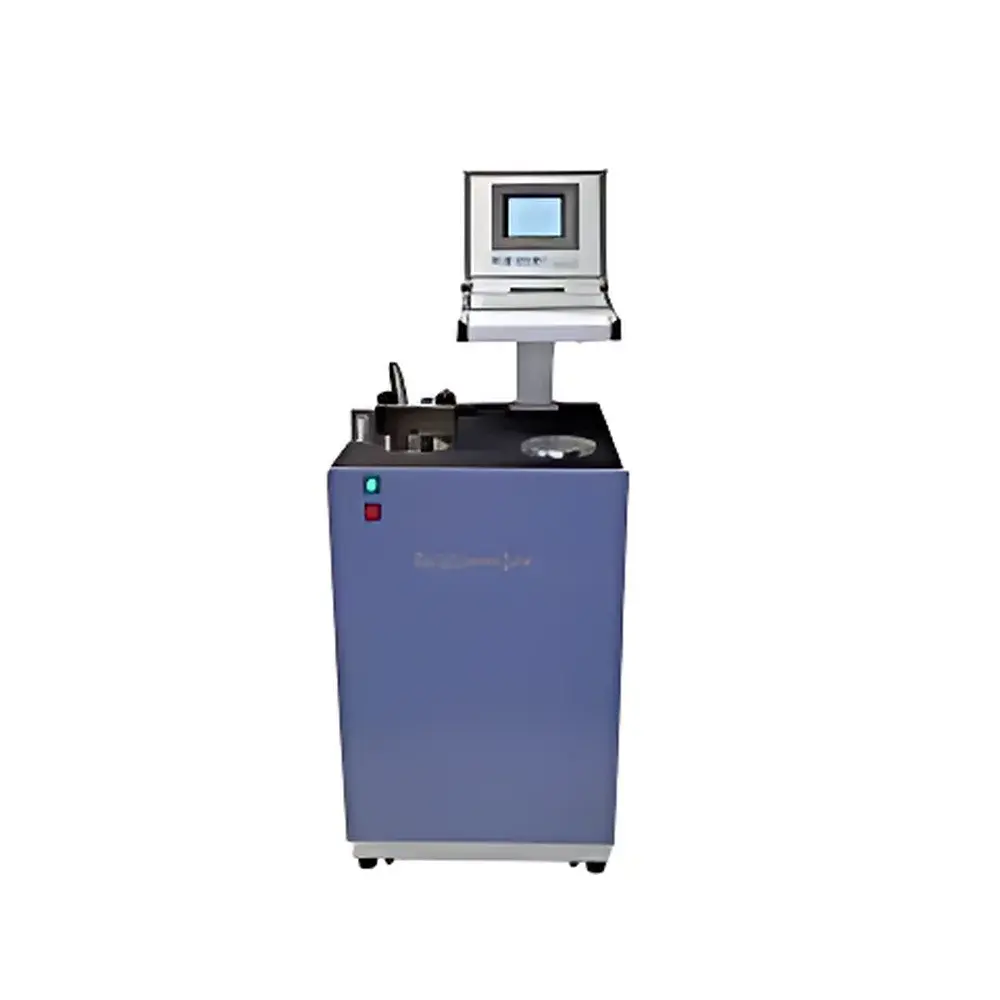
| Dimensions (W×H×D) | 510 × 1400 × 510 mm |
| Weight | ~130 kg |
Overview
The Brabender ELATEST Pneumatic Density Meter is a precision-engineered instrument designed specifically for the accurate and rapid determination of bulk density in uncured rubber compounds, elastomers, and polymer blends. It operates on the principle of pneumatic compression under controlled pressure—applying a defined gas force to compact a known volume of sample within a sealed chamber. As air is displaced from interstitial voids during compression, the final stabilized piston position is measured via high-resolution linear displacement transduction. Coupled with real-time mass measurement from the integrated analytical balance, the system computes true density (ρ = m/V) using rigorously calibrated volumetric geometry and pressure-compensated algorithms. This method eliminates operator-dependent variables inherent in liquid displacement or buoyancy techniques—particularly critical for low-density, porous, or air-entrapment-prone rubber formulations. The ELATEST meets the metrological demands of both R&D laboratories optimizing compound formulation and production QA/QC environments requiring traceable, high-throughput density verification aligned with ISO 2781, ASTM D792, and DIN 53479 standards.
Key Features
- Fully automated pneumatic compression cycle with programmable pressure setpoints (6–8 bar) and dwell time control
- Integrated high-precision electronic balance (0–300 g, readability ≤0.001 g) co-located within the measurement chamber to eliminate weighing transfer errors
- Non-contact linear position sensor with sub-micron resolution for piston displacement tracking during compression stabilization
- Capacitive touchscreen HMI with embedded Windows-based software enabling intuitive method setup, real-time curve visualization (force vs. displacement), and automatic density calculation
- Modular sample cup design accommodating volumes from 40 cm³ to 120 cm³—optimized for standard rubber test slugs and industrial batch samples
- Robust stainless-steel frame and pneumatic actuation architecture engineered for continuous operation in industrial laboratory settings
- Compliance-ready data handling: audit-trail enabled logging, user access levels, electronic signatures, and export formats compatible with LIMS and ERP integration (CSV, XML)
Sample Compatibility & Compliance
The ELATEST is validated for heterogeneous, viscoelastic, and aerated rubber matrices—including natural rubber (NR), styrene-butadiene rubber (SBR), ethylene propylene diene monomer (EPDM), nitrile rubber (NBR), and thermoplastic elastomers (TPEs). Its compression-based methodology avoids solvent interaction, surface tension artifacts, or thermal drift associated with hydrostatic methods—making it especially suitable for carbon-black-filled compounds, oil-extended grades, and masterbatches where conventional pycnometry yields inconsistent results. The system supports GLP and GMP workflows through configurable electronic records per 21 CFR Part 11 requirements, including timestamped raw sensor outputs, calibration history, and user action logs. All mechanical and electrical components conform to CE, EMC Directive 2014/30/EU, and Low Voltage Directive 2014/35/EU.
Software & Data Management
The embedded software platform provides full lifecycle management of density analysis—from method creation (pressure ramp profiles, hold times, auto-zero sequences) to statistical reporting (mean, SD, CV%, trend charts across batches). Raw displacement and mass data are stored in native binary format with metadata tagging (operator ID, sample ID, environmental conditions). Export functions support automated FTP/SFTP upload, OPC UA server connectivity, and direct SQL database insertion. Calibration routines include balance linearity verification, pressure transducer validation, and geometric volume certification using NIST-traceable reference standards. Software updates are delivered via secure HTTPS channel with version-controlled release notes and change impact assessments.
Applications
- Rubber formulation development: Quantifying filler dispersion efficiency and compound homogeneity via density deviation mapping
- Process validation: Monitoring consistency of extruded or calendered sheets prior to vulcanization
- Raw material acceptance testing: Verifying supplier-specified density tolerances for synthetic elastomers and reclaim rubber
- Quality deviation root cause analysis: Correlating density anomalies with mixing parameters (rotor speed, temperature, time)
- Regulatory submission support: Generating auditable density datasets for ISO/TS 16949, IATF 16949, and FDA device component documentation
- Research into polymer morphology: Supporting studies on phase separation kinetics in thermoplastic vulcanizates (TPVs)
FAQ
What sample preparation is required prior to measurement?
Minimal preparation is needed: Samples must be cut to fit the selected cup volume, free of surface contaminants, and at ambient temperature (18–25°C). No drying or degassing is necessary—the pneumatic compression inherently removes entrapped air.
Can the ELATEST measure cured rubber specimens?
It is optimized for uncured compounds; cured elastomers exhibit insufficient compressibility under 8 bar pressure, leading to unreliable displacement signals and reduced accuracy. For vulcanized materials, alternative methods such as helium pycnometry are recommended.
Is external compressed air supply mandatory?
Yes—a clean, oil-free, desiccated air source delivering stable 6–8 bar pressure is required. An integrated air dryer and filter manifold is available as an optional accessory kit.
How often does the system require recalibration?
Balance calibration is recommended daily before first use; pressure sensor verification every 3 months; full geometric volume certification annually using certified reference cylinders.
Does the software support multi-language interfaces?
English and German UI languages are pre-installed; additional language packs (French, Spanish, Chinese) can be deployed via firmware update upon request.