
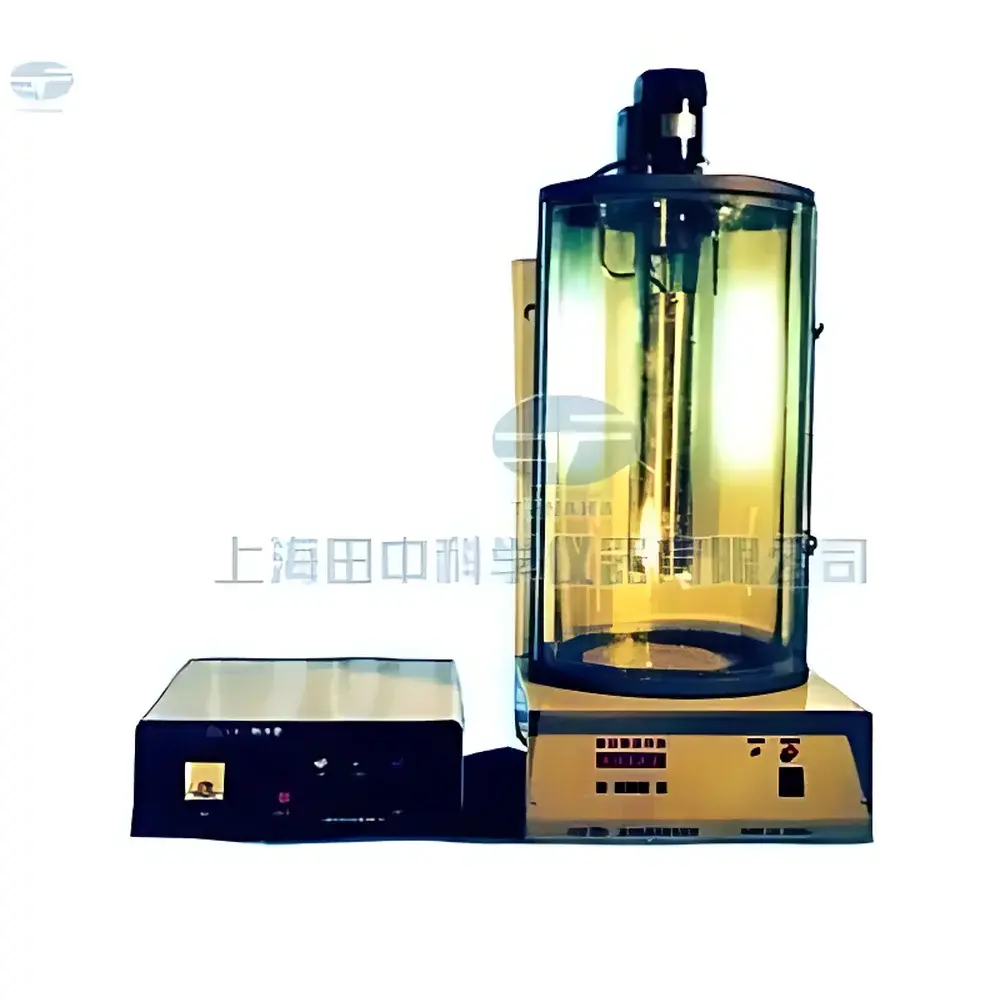
Tanaka KV-5B Standard Viscosity Calibration Bath
| Brand | Tanaka |
|---|---|
| Origin | Japan |
| Manufacturer Type | Authorized Distributor |
| Product Origin | Imported |
| Model | KV-5B |
| Pricing | Available Upon Request |
| Temperature Control Accuracy | ±0.01 °C |
| Temperature Range | 15–135 °C (standard preset points: 20, 40, 50, 80, 100 °C) |
| Bath Dimensions | Ø300 mm × H600 mm (borosilicate glass cylinder) |
| Heating Power | 1.5 kW (220 V) |
| Cooling | Optional Peltier-based chiller (1.0 kW, separate unit) |
| Illumination | Integrated rear-side fluorescent lighting |
| Display Resolution | 0.01 °C (digital PID controller) |
| Power Supply | AC 220 V, 50/60 Hz, max. 1.7 kW |
| Overall Dimensions | 400 × 450 × 880 mm |
| Net Weight | 33 kg (bath unit) |
| Chiller | ~17 kg |
| Sample Capacity | Up to 4 capillary viscometers simultaneously via interchangeable holder fixtures |
| Compliance | ISO 3104, ASTM D445, IP 71, GB/T 265 |
Overview
The Tanaka KV-5B Standard Viscosity Calibration Bath is a precision-engineered thermal immersion system designed exclusively for the calibration and verification of capillary kinematic viscometers and certified reference viscosity standards. It operates on the fundamental principle of maintaining a thermally homogeneous, ultra-stable bath environment—critical for achieving traceable kinematic viscosity measurements per international standard methodologies. Unlike general-purpose constant-temperature baths, the KV-5B integrates metrologically validated temperature control architecture specifically optimized for viscometry applications where thermal uniformity across the full 600 mm immersion depth must be preserved within ±0.01 °C. Its borosilicate glass cylindrical bath (Ø300 × H600 mm) ensures optical clarity, chemical resistance to hydrocarbon solvents, and minimal thermal mass gradient—enabling rapid stabilization and long-term drift suppression. The system supports dual operational modes: as a primary calibration station for laboratory-accredited viscosity instrument verification, and as a compliant kinematic viscosity testing platform meeting all procedural requirements of ISO 3104 and ASTM D445.
Key Features
- Ultra-high stability temperature control with ±0.01 °C accuracy across full 600 mm bath height—achieved via Japanese-sourced PID controller, high-resolution digital display (0.01 °C resolution), and integrated thermal compensation circuitry.
- Four independent viscometer ports with modular, user-selectable holder fixtures—compatible with Ubbelohde, Cannon-Fenske, Ostwald, and suspended-level capillary types (holders supplied per customer-specified viscometer geometry).
- Dedicated Peltier-based auxiliary chiller (optional, 1.0 kW) enabling rapid cooling from 100 °C to 40 °C in under 12 minutes—eliminating reliance on external coolant loops or ice-water baths.
- Rear-mounted fluorescent illumination system providing glare-free, shadow-minimized visual inspection of meniscus movement during timing intervals—critical for manual stopwatch-based kinematic viscosity determination.
- Pre-programmed temperature setpoints at 20, 40, 50, 80, and 100 °C; extended range available from 15–135 °C in 5 °C increments upon request—fully configurable without firmware modification.
- Integrated safety architecture including over-temperature cut-off, dry-run protection, ground-fault interruption, and thermal fuse redundancy—certified to IEC 61010-1 for laboratory use.
Sample Compatibility & Compliance
The KV-5B is engineered for direct compatibility with all capillary viscometers referenced in ISO 3104 (petroleum products), ASTM D445 (transparent and opaque liquids), IP 71 (fuel oils), and GB/T 265 (Chinese national standard for petroleum products). Its bath geometry satisfies minimum immersion depth requirements (≥150 mm below upper timing mark) for all standard viscometer types when mounted vertically in designated holders. The system supports calibration of both primary reference standards (e.g., NIST-traceable silicone oils) and secondary working standards used in internal quality control laboratories. All thermal performance data—including axial/radial temperature gradients, time-to-stabilization, and long-term drift—are documented per ISO/IEC 17025 Annex A.2 guidelines, enabling direct integration into GLP/GMP validation protocols and audit-ready calibration records.
Software & Data Management
While the KV-5B operates as a standalone analog-digital hybrid instrument, its PID controller provides RS-232 serial output (optional USB adapter available) for real-time temperature logging and remote setpoint adjustment via third-party SCADA or LIMS platforms. Logged data includes timestamped bath temperature, setpoint deviation, heater/chiller duty cycle, and alarm status flags—all exportable as CSV for trend analysis. For regulated environments, the system supports 21 CFR Part 11-compliant electronic record generation when paired with validated data acquisition software (e.g., LabArchives or Thermo Fisher SampleManager), including user authentication, audit trail, and electronic signature capability. Calibration certificates issued by Tanaka’s authorized service centers include uncertainty budgets calculated per GUM (JCGM 100:2008) and are recognized by national metrology institutes in Japan (NMIJ), the UK (NPL), and Germany (PTB).
Applications
- Primary calibration of capillary viscometers in metrology labs and national standards bodies.
- In-house verification of certified viscosity reference materials (CRM) prior to QC usage in refinery and petrochemical QA/QC departments.
- Validation of kinematic viscosity test procedures under ISO/IEC 17025 accreditation requirements.
- Supporting ASTM D445 method transfer studies between laboratories or instruments.
- Temperature uniformity mapping for ISO 17025 internal audits of viscosity testing facilities.
- Calibration interval extension justification through documented thermal stability metrics.
FAQ
Does the KV-5B meet ISO/IEC 17025 requirements for calibration laboratories?
Yes—the bath’s thermal performance specifications, traceable calibration documentation, and uncertainty budgeting methodology comply fully with Clause 6.4 (Equipment) and Appendix A.2 (Verification of Equipment) of ISO/IEC 17025:2017.
Can the unit operate continuously at 100 °C for extended periods?
Yes—thermal management architecture and borosilicate glass construction support uninterrupted operation at 100 °C for >72 hours, with typical drift <±0.005 °C/hour after initial 30-minute stabilization.
Is the Peltier chiller required for ASTM D445 compliance?
Not required—but strongly recommended for labs performing multi-point viscosity tests (e.g., 40 °C and 100 °C on same sample), as it eliminates cross-contamination risk from external coolant baths and reduces turnaround time by >40%.
What viscometer holder configurations are available?
Standard holders accommodate Ubbelohde (0.4–1.2 mm capillary), Cannon-Fenske (Ostwald-type), and suspended-level designs. Custom holders for DIN 51562 or JIS K 2283 geometries can be supplied upon technical drawing submission.
How is temperature uniformity verified across the 600 mm bath height?
Tanaka provides a factory-verified temperature gradient report (per ISO 17025 Annex A.2), measured using four calibrated Pt100 probes at 100 mm intervals from top to bottom—demonstrating ≤±0.008 °C variation at all standard setpoints.
Related Products




