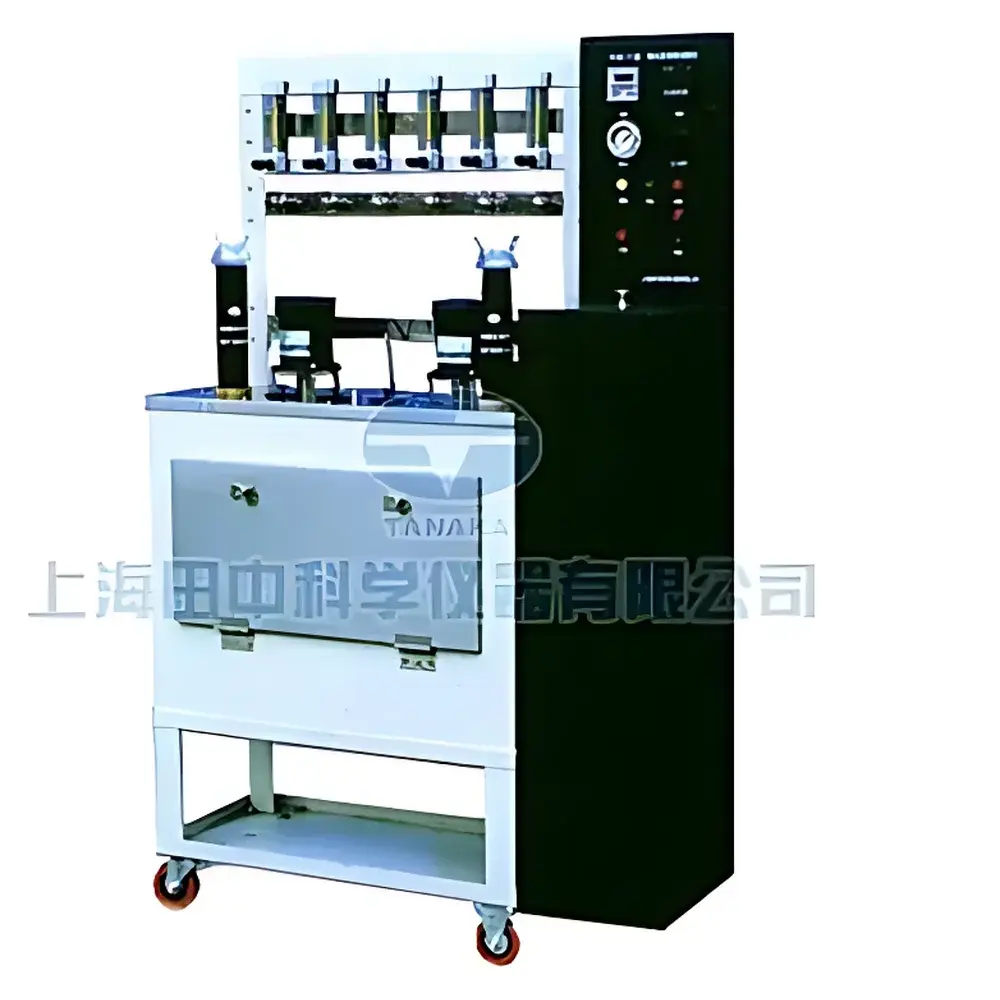
Tanaka FOS-1 Distillate Fuel Oxidation Stability Tester
| Brand | Tanaka |
|---|---|
| Origin | Japan |
| Manufacturer Type | Authorized Distributor |
| Origin Category | Imported |
| Model | FOS-1 |
| Pricing | Upon Request |
| Oxidation Tube Capacity | 6 positions (customizable) |
| Operating Temperature Range | Ambient to 100 °C (temperature control accuracy ±0.2 °C) |
| Temperature Sensor | Platinum resistance thermometer (Pt100) |
| Control Method | PID-based digital temperature controller, display resolution 0.1 °C |
| Preheating Power | 1.2 kW + 1.8 kW |
| Precision Temperature Maintenance Power | 1.8 kW |
| Electrical Supply | AC 220 V, 50/60 Hz, 3.3 kW total |
| Dimensions (W×D×H) | 890 × 350 × 1400 mm |
| Net Weight | ~65 kg |
| Construction | Full stainless-steel chassis with integrated light-shielded oxidation tube cooling enclosure |
Overview
The Tanaka FOS-1 Distillate Fuel Oxidation Stability Tester is a precision-engineered laboratory instrument designed for the accelerated oxidative aging assessment of middle-distillate petroleum fuels—primarily diesel, heating oil, and jet fuel fractions—according to internationally recognized standard test methods SH/T 0175 (Chinese National Standard) and ASTM D2274 (Standard Test Method for Oxidation Stability of Distillate Fuel Oil by Accelerated Oxidation). The instrument operates on the principle of controlled thermal oxidation under pressurized oxygen flow: fuel samples are placed in sealed copper oxidation tubes, heated to a precisely maintained temperature (typically 95 °C or 100 °C), and exposed to flowing oxygen at regulated pressure and flow rate. Following the prescribed exposure duration, the oxidized sample is cooled, filtered, and analyzed for insoluble gum content—a quantitative indicator of oxidative degradation propensity. This gravimetric measurement directly correlates with real-world storage stability, engine deposit formation risk, and filter plugging tendency.
Key Features
- Robust all-stainless-steel construction ensures long-term corrosion resistance against aggressive hydrocarbon-oxygen mixtures and cleaning solvents.
- Six-position oxidation tube holder accommodates parallel testing for improved throughput and statistical reproducibility; modular design supports optional expansion to 12 or 18 positions upon request.
- PID-controlled temperature regulation using Pt100 platinum resistance sensors delivers exceptional thermal uniformity (<±0.2 °C) across all test zones, critical for method compliance and inter-laboratory data comparability.
- Dual-stage heating architecture: high-power preheating elements (1.2 kW + 1.8 kW) rapidly bring the bath to setpoint; low-wattage maintenance heaters (1.8 kW) sustain stable thermal conditions with minimal overshoot.
- Integrated safety system includes automatic shutdown triggers for power interruption, oxygen supply failure, coolant flow cessation, and temperature excursion beyond 105 °C—fully compliant with IEC 61000-6-2 EMC and IEC 61010-1 safety directives.
- Light-tight cooling enclosure minimizes photochemical side reactions during post-oxidation sample handling, preserving analytical integrity per ASTM D2274 Section 8.2 requirements.
Sample Compatibility & Compliance
The FOS-1 is validated for use with distillate fuels meeting ASTM D975 (diesel), ASTM D3699 (kerosene), and ASTM D1655 (jet fuel) specifications. It fully satisfies the apparatus requirements defined in Clause 6 of ASTM D2274 and Section 4 of SH/T 0175—including dimensional tolerances for oxidation tubes, oxygen delivery flow control (50 ± 5 mL/min), pressure regulation (690 ± 14 kPa gauge), and thermal mass characteristics of the bath medium. The instrument’s design facilitates routine verification per ASTM D4057 (standard practice for manual sampling of petroleum products) and supports GLP-compliant operation when paired with auditable logbooks and calibration records traceable to NIST or JCSS standards.
Software & Data Management
While the FOS-1 operates as a stand-alone benchtop unit with analog/digital hybrid controls, its temperature controller outputs RS-485 Modbus RTU signals compatible with third-party SCADA or LIMS platforms (e.g., LabWare LIMS, Thermo Fisher SampleManager). Optional firmware upgrade enables time-stamped temperature logging at 1-second intervals, with data export to CSV for trending analysis. All operational parameters—including start time, setpoint, actual bath temperature, and alarm events—are retained in non-volatile memory for minimum 30-day audit trail retention, supporting FDA 21 CFR Part 11 readiness when used in regulated quality control environments.
Applications
- Quality assurance laboratories evaluating batch-to-batch consistency of refinery-produced diesel fuels.
- Fuel additive development labs quantifying antioxidant efficacy (e.g., hindered phenols, aromatic amines) via comparative gum yield reduction.
- Contract testing facilities performing certified ASTM D2274 analyses for regulatory submission or specification conformance (e.g., EN 590, GB 19147).
- Research institutions investigating oxidation kinetics under variable temperature-oxygen partial pressure regimes.
- Storage terminal operators conducting shelf-life prediction studies for long-term fuel inventory management.
FAQ
What standards does the FOS-1 comply with?
The instrument is engineered to meet the physical and operational requirements of ASTM D2274 and SH/T 0175, including temperature uniformity, oxygen flow control, and mechanical configuration of the oxidation bath.
Is calibration certification included with shipment?
Each unit ships with a factory calibration report referencing NIST-traceable temperature standards; ISO/IEC 17025-accredited calibration services are available separately.
Can the FOS-1 be used for biodiesel blends (e.g., B5, B20)?
Yes—provided the blend meets distillate fuel specifications and the oxidation protocol is adjusted per ASTM D7462 (oxidation stability of biodiesel) where applicable; method validation is recommended prior to routine use.
What maintenance intervals are recommended?
Daily visual inspection of O-rings and tubing; quarterly verification of temperature sensor accuracy and oxygen flowmeter calibration; annual full system performance qualification per ASTM D2274 Annex A1.
Is remote monitoring supported?
Native Ethernet or Wi-Fi connectivity is not built-in, but the RS-485 interface allows integration into existing facility-wide monitoring networks via industrial gateways.