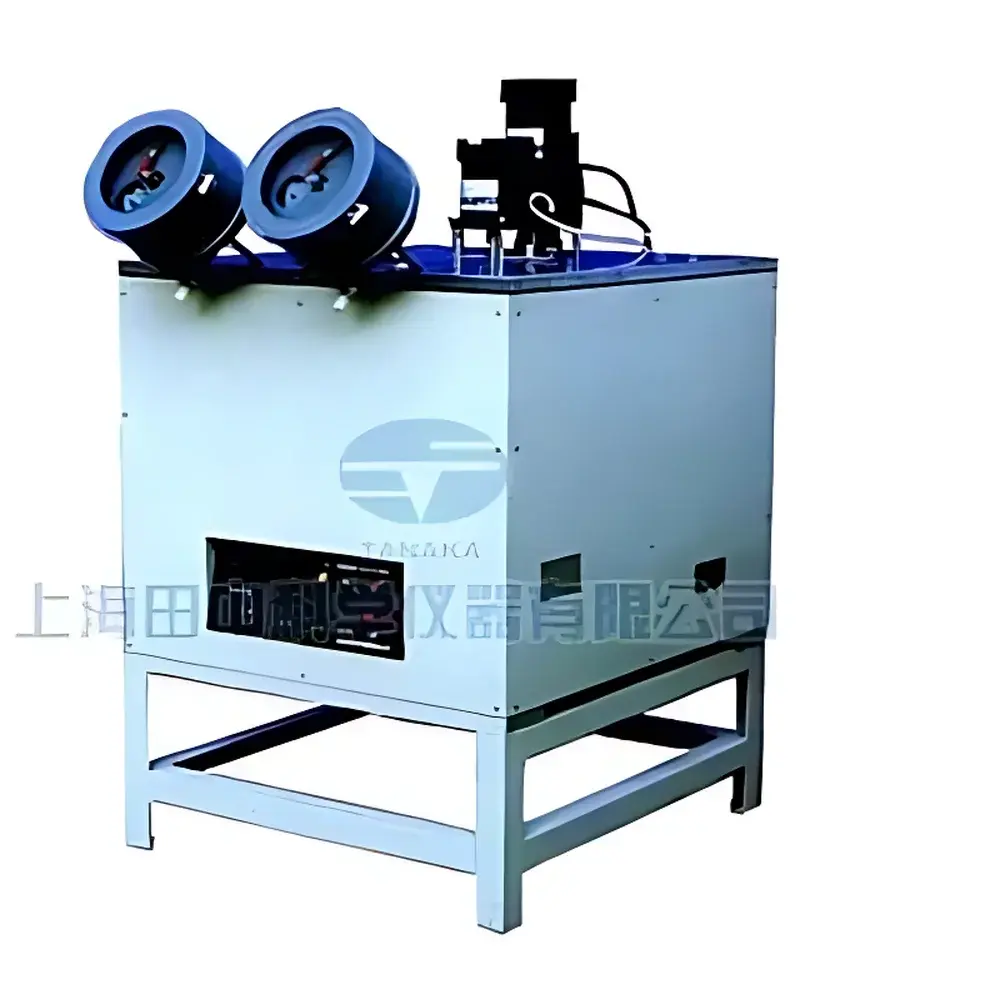
Tanaka LOS-1 Rotating Bomb Oxidation Stability Tester (RBOST)
| Brand | Tanaka |
|---|---|
| Origin | Japan |
| Manufacturer Type | Authorized Distributor |
| Origin Category | Imported |
| Model | LOS-1 |
| Price | Upon Request |
| Bath Temperature Control Accuracy | ≤ ±0.1 °C |
| Operating Bath Temperatures | 140 °C or 150 °C (for turbine oils) |
| Rotational Speed | 100 ± 5 rpm |
| Bomb Tilt Angle | 30° from horizontal |
| Number of Bomb Stations | 2 |
| Bath Capacity | 60 L |
| Heating Power | 2 × 1.2 kW = 2.4 kW |
| Power Supply | AC 220 V, 50/60 Hz |
| Dimensions (W×D×H) | 580 × 620 × 1026 mm |
| Weight | 85 kg |
Overview
The Tanaka LOS-1 Rotating Bomb Oxidation Stability Tester (RBOST) is a precision-engineered instrument designed for quantitative assessment of oxidation resistance in petroleum-based lubricants and insulating oils under accelerated, high-pressure oxygen environments. It operates on the rotating bomb principle—based on controlled autoxidation kinetics—where test specimens are sealed with pure oxygen inside stainless-steel pressure vessels (oxygen bombs), immersed in a thermostatically regulated oil bath, and rotated at a defined angular velocity and tilt angle. This configuration promotes uniform heat transfer, turbulent mixing, and consistent oxidative stress across the sample surface, enabling reproducible induction period measurements critical for predicting long-term in-service stability.
Key Features
- High-stability thermostatic oil bath with dual 1.2 kW heating elements and PID-controlled temperature regulation—achieving ≤ ±0.1 °C accuracy at operational setpoints of 140 °C (for inhibited mineral insulating oils per ASTM D2112) or 150 °C (for turbine oils per ASTM D2272 and SH/T 0193).
- Dual independent bomb rotation stations, each configured with a fixed 30° tilt relative to horizontal plane—ensuring hydrodynamic consistency and eliminating sedimentation bias during extended oxidation cycles.
- Low-noise, gear-driven rotational mechanism delivering precise 100 ± 5 rpm synchronous motion—engineered for continuous operation over multi-day test durations without drift or mechanical fatigue.
- Corrosion-resistant construction: stainless-steel bath tank and outer enclosure provide long-term integrity in high-temperature, high-humidity laboratory environments.
- Integrated safety design including pressure-rated oxygen bomb housings, thermal cut-off protection, and fail-safe electrical isolation compliant with IEC 61010-1 for laboratory equipment.
Sample Compatibility & Compliance
The LOS-1 is validated for use with new and in-service turbine oils sharing identical base oil–additive formulations, as well as 2,6-di-tert-butyl-p-cresol (DBPC)-inhibited mineral insulating oils. Its methodology conforms to internationally recognized standard test methods including ASTM D2272 (Standard Test Method for Oxidation Stability of Steam Turbine Oils by Rotating Bomb), ASTM D2112 (Standard Test Method for Oxidation Stability of Inhibited Mineral Insulating Oils), JIS K 2514, and SH/T 0193 (Chinese national standard equivalent to ASTM D2272). All operational parameters—including bath temperature tolerance, rotational speed, bomb geometry, and oxygen partial pressure—are calibrated and verified traceable to NIST-traceable references. The system supports GLP-compliant documentation workflows when paired with external lab notebooks or LIMS-integrated data capture.
Software & Data Management
The LOS-1 operates as a stand-alone hardware platform requiring manual time–pressure recording via analog pressure gauge and chart recorder (included). While it does not incorporate embedded digital control or real-time data logging, its mechanical and thermal architecture is fully compatible with third-party acquisition systems. Users may integrate digital pressure transducers, thermocouple arrays, and PC-based DAQ platforms to automate induction time detection (e.g., onset of rapid pressure drop >10 psi/min) and generate ASTM-compliant oxidation curves. For regulated environments, such externally augmented configurations can be validated to meet FDA 21 CFR Part 11 requirements for electronic records and signatures when coupled with audit-trail-enabled software and user access controls.
Applications
- Quality assurance of new turbine oils prior to commissioning in power generation facilities.
- Condition monitoring of in-service lubricants to determine remaining useful life and schedule proactive oil changes.
- Formulation development and additive package screening for oxidation inhibitors (e.g., hindered phenols, aromatic amines).
- Comparative stability ranking of base stocks (Group I–III, PAOs, esters) under standardized oxidative stress.
- Regulatory compliance testing for transformer and switchgear manufacturers adhering to IEEE C57.106 and IEC 60296 specifications.
FAQ
What standards does the LOS-1 comply with?
The instrument meets the mechanical, thermal, and geometric requirements of ASTM D2272, ASTM D2112, JIS K 2514, and SH/T 0193 for rotating bomb oxidation testing.
Can the LOS-1 test synthetic lubricants?
Yes—provided the synthetic formulation exhibits comparable volatility and thermal stability at 140–150 °C; validation per ASTM D2272 Annex A1 is recommended for non-mineral base stocks.
Is automated data logging built-in?
No—the LOS-1 is a manually monitored platform. However, its analog outputs and mechanical repeatability support seamless integration with external digital data acquisition systems.
What maintenance is required for long-term reliability?
Routine inspection of O-rings (supplied as P55 specification), catalytic copper wire integrity, oxygen bomb sealing surfaces, and calibration of the bath temperature sensor annually against a certified reference thermometer is advised.
Does the system include oxygen handling accessories?
The standard configuration includes oxygen bomb clamps, dedicated wrenches, coil winders, and catalytic copper wire—but users must supply certified high-purity oxygen (≥99.995%), regulated gas manifolds, and appropriate pressure-rated hoses compliant with local industrial gas safety codes.