
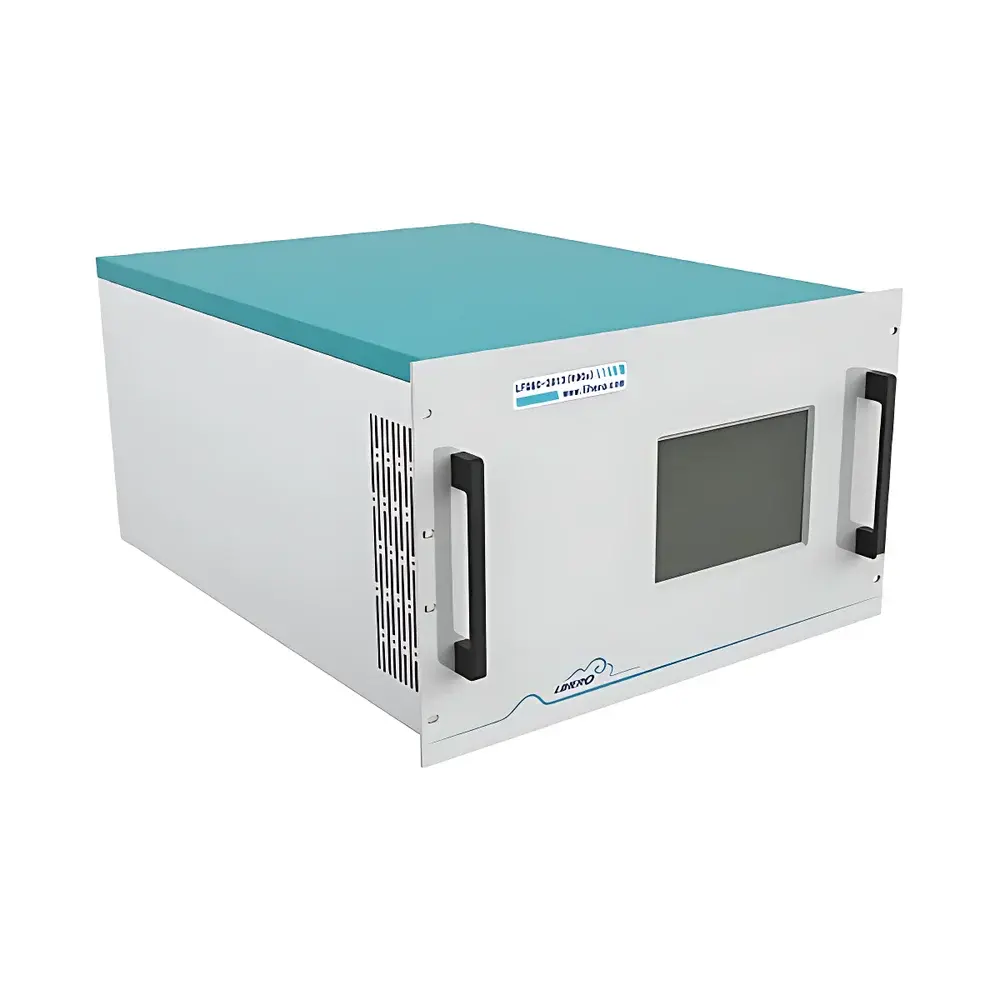
Lihero LFGGC-2013 Continuous Ambient Air VOC Monitoring System via Gas Chromatography
| Brand | Lihero |
|---|---|
| Model | LFGGC-2013 |
| Detection Principle | Flame Ionization Detection (FID) coupled with Preconcentration and Capillary GC Separation |
| Target Analytes | PAMS (57 compounds), Methane, Non-Methane Hydrocarbons (NMHC) |
| Sampling | Automated cryogenic trapping followed by thermal desorption |
| Data Resolution | Real-time chromatographic data acquisition with full-spectrum retention |
| Compliance Framework | Designed for compliance with China’s HJ 1010–2018, HJ 644–2013 |
| Flow Control | Mass Flow Controller (MFC) with ±1% accuracy |
| Data Traceability | Full chromatogram archiving with timestamped metadata and instrument status logging |
| System Architecture | Integrated sampling pretreatment (particulate filtration + Nafion®-based moisture removal), analytical module, and embedded data acquisition & reporting engine |
| Software | Proprietary Lihero VOC-View v3.x with audit trail, user role management, and GLP-compliant data handling |
Overview
The Lihero LFGGC-2013 Continuous Ambient Air VOC Monitoring System is an integrated, field-deployable gas chromatography–flame ionization detection (GC-FID) platform engineered for unattended, long-term quantification of volatile organic compounds (VOCs) in ambient air. It operates on a validated two-stage preconcentration workflow: ambient air is drawn through a particulate filter and Nafion® membrane dryer to remove aerosols and water vapor, then cryogenically trapped at –30 °C on multi-bed sorbent cartridges (e.g., Tenax TA, Carbopack B, Carbopack C). Following automated thermal desorption at >250 °C, analytes are separated on fused-silica capillary columns (e.g., DB-1 or equivalent 60 m × 0.32 mm × 1.0 µm) under precise temperature-programmed conditions and detected via high-stability hydrogen flame ionization. The system is calibrated per HJ 644–2013 and aligned with the analytical scope of the U.S. EPA’s TO-14A and TO-15 protocols—supporting quantitative measurement of the PAMS (Photochemical Assessment Monitoring Stations) suite of 57 priority VOCs, as well as speciated methane and non-methane hydrocarbon (NMHC) mass concentrations.
Key Features
- Fully automated cycle control: real-time synchronization of sampling, cryotrapping, desorption, GC separation, and FID detection—no manual intervention required between cycles.
- Mass flow controller (MFC)-regulated sampling at 0.1–1.0 L/min, enabling programmable sample volumes (e.g., 10–100 L) and adjustable trap durations for optimized sensitivity across low-concentration ambient matrices.
- Embedded chromatogram archival: every analysis generates a time-stamped, digitally signed GC-FID chromatogram stored locally with full metadata—including column head pressure, oven ramp profile, detector gain, and system diagnostic flags.
- Comprehensive instrument health monitoring: continuous logging of critical parameters (trap temperature, desorption heater status, carrier gas pressure, FID flame stability, detector baseline noise) with configurable alarm thresholds and remote notification support.
- Proprietary firmware with deterministic real-time OS ensures cycle repeatability and eliminates timing drift across 30-day+ unattended operation—validated per HJ 1010–2018 stability requirements.
- Seven granted Chinese patents cover core innovations including dual-stage moisture compensation, self-diagnosing trap integrity verification, and adaptive peak integration algorithms resistant to baseline drift.
Sample Compatibility & Compliance
The LFGGC-2013 is validated for ambient air matrices across urban, suburban, industrial fence-line, and background monitoring sites. Its pretreatment architecture removes particulates ≤0.3 µm and reduces relative humidity to <10% RH prior to trapping—minimizing co-desorption artifacts and column contamination. The system meets the performance criteria outlined in HJ 1010–2018 (Technical Specification for Ambient Air VOCs Online Monitoring Systems) for method detection limits (MDLs) ≤50 pptv for benzene and toluene, precision ≤8% RSD, and recovery ≥90% across the PAMS compound list. While not certified to ISO/IEC 17025 or EPA EQCM standards out-of-box, its data structure and audit trail functionality support integration into GLP- and GMP-aligned environmental data management systems compliant with 21 CFR Part 11 when deployed with supplementary validation documentation.
Software & Data Management
VOC-View v3.x is a Windows-based, embedded application providing local configuration, real-time chromatogram visualization, automated calibration scheduling, and report generation (daily summary, QA/QC logs, maintenance alerts). All raw chromatograms and processed results are stored in HDF5 format with SHA-256 checksums. The software implements role-based access control (RBAC), electronic signatures for calibration edits, and immutable audit trails that record user actions, parameter changes, and system events with nanosecond-resolution timestamps. Export options include CSV (for third-party statistical analysis), XML (for national environmental data platforms), and PDF reports conforming to China’s Ministry of Ecology and Environment (MEE) formatting guidelines.
Applications
- Continuous regulatory monitoring at national ambient air quality monitoring stations (NAQMS) and provincial ecological environment bureaus.
- Source attribution studies for ozone and secondary organic aerosol (SOA) precursors in photochemical smog investigations.
- Industrial emission verification near petrochemical complexes, coating facilities, and solvent-use operations.
- Long-term trend analysis of aromatic and aliphatic VOCs in climate-relevant atmospheric chemistry research.
- Calibration transfer and method validation support for laboratory GC-MS systems using field-collected reference data.
FAQ
What VOC compounds does the LFGGC-2013 quantify?
It quantifies all 57 PAMS compounds defined in U.S. EPA Protocol TO-15 and China’s HJ 644–2013, including BTEX (benzene, toluene, ethylbenzene, xylenes), C2–C5 alkanes, isoprene, and carbonyls such as formaldehyde (via derivatization-compatible inlet option). Methane and NMHC are reported as carbon-equivalent mass concentrations.
Is the system suitable for unattended operation in remote locations?
Yes—designed for 30-day autonomous operation with onboard UPS support, environmental enclosure (IP55-rated), and cellular/WiFi telemetry for remote diagnostics and data retrieval.
How is calibration performed and how often is it required?
Calibration uses certified permeation tubes or dynamic dilution of standard gas mixtures. Initial calibration is performed pre-deployment; subsequent checks are recommended every 7 days, with full recalibration every 30 days or after maintenance—per HJ 1010–2018 QA/QC protocols.
Can raw chromatographic data be exported for independent reprocessing?
Yes—full-resolution chromatograms (.h5 files) and peak tables (.csv) are exportable without proprietary codec restrictions, enabling third-party reintegration using OpenChrom, Chromeleon, or custom Python-based processing pipelines.
Does the system support remote firmware updates and configuration changes?
Firmware updates require authenticated SSH access and cryptographic signature verification; configuration changes are permitted only by Level-3 administrators and logged with full traceability in the audit trail.







