
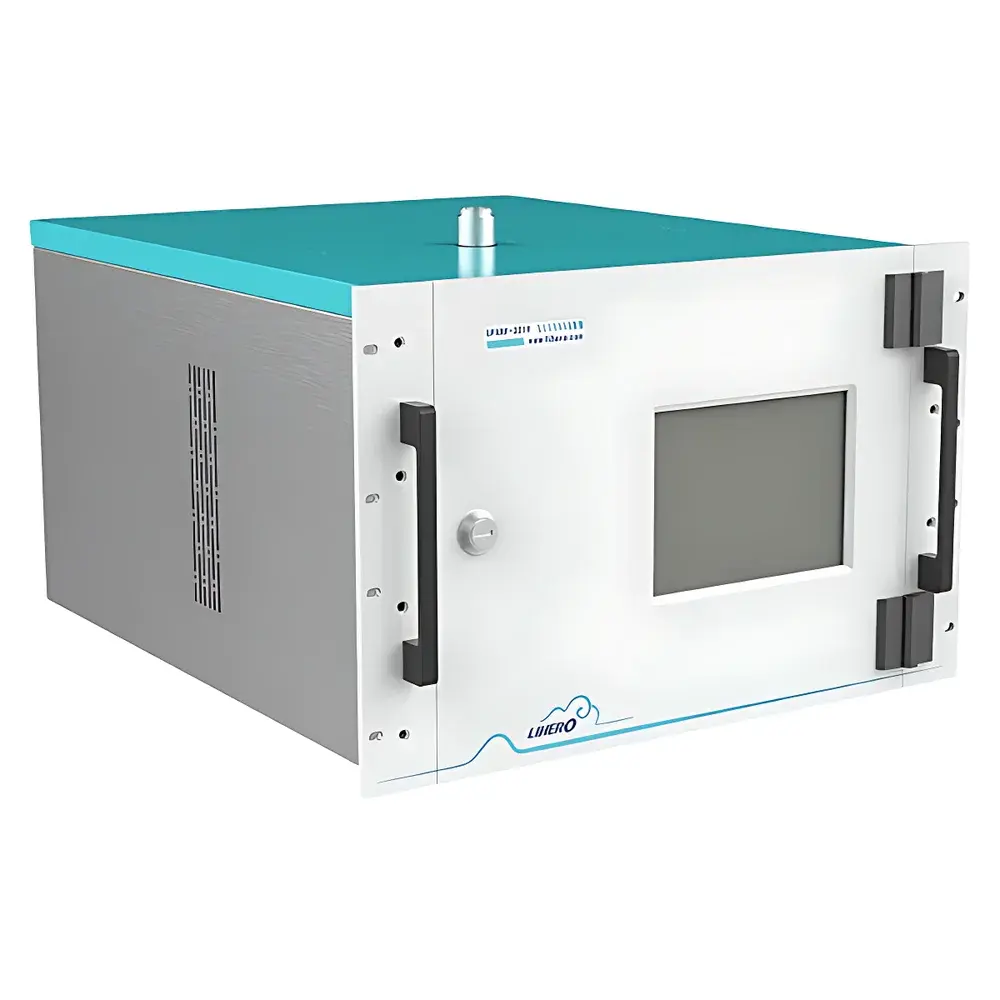
Lihero LFXRF-2019 Online X-ray Fluorescence Elemental Analyzer for Ambient Air Particulate Matter
| Brand | Lihero |
|---|---|
| Model | LFXRF-2019 |
| Measurement Principle | Energy-Dispersive X-ray Fluorescence (ED-XRF) |
| Sample Matrix | PM₂.₅ collected on quartz or Teflon filters |
| Detection Elements | ≥30 elements including Pb, Cr, Cd, As, Cu, Zn, Ni, Mn, Fe, Ca, K, S, Cl, Si, Al, Ti, V, Co, Mo, Sn, Sr, Ba, Rb, Zr, Y, Nb, La, Ce, Nd, Sm |
| Light Element Enhancement | He-purged measurement atmosphere |
| Radiation Safety | Dual-layer lead shielding + interlocked X-ray tube shutdown on door opening |
| Filter Options | 6-position automatic filter wheel |
| Consumables Monitoring | Integrated lifecycle tracking for X-ray tube, detector, and filter tapes |
| Compliance | Meets GB/T 35218–2017, EN 14902:2005, and design-aligned with EPA IO-3.3 and ISO 8778 requirements |
| Power Supply | 220 VAC ±10%, 50/60 Hz |
| Operating Environment | 5–35 °C, 30–80% RH (non-condensing) |
Overview
The Lihero LFXRF-2019 Online X-ray Fluorescence Elemental Analyzer is an automated, field-deployable instrument engineered for real-time, non-destructive quantification of elemental composition in ambient airborne particulate matter (PM₂.₅). Utilizing energy-dispersive X-ray fluorescence (ED-XRF) spectroscopy, the system continuously collects aerosol samples onto a rotating filter tape, performs in situ excitation with a low-power X-ray tube, and acquires high-resolution spectral data to determine mass concentrations of over 30 elements—including regulated toxic metals such as Pb, Cd, As, Cr(VI)-proxy elements (Cr), and transition metals (Cu, Zn, Ni, Mn)—with sub-nanogram per cubic meter detection capability for key analytes. Unlike offline lab-based XRF or ICP-MS workflows, the LFXRF-2019 integrates sampling, conditioning, excitation, detection, and calibration into a single compact platform, enabling unattended operation for up to 30 days with minimal manual intervention. Its measurement principle adheres to fundamental XRF physics: incident X-rays eject inner-shell electrons from target atoms; characteristic fluorescent X-rays emitted during electron relaxation are energy-resolved by a silicon drift detector (SDD), allowing simultaneous multi-element identification and quantification without chemical digestion or reagent consumption.
Key Features
- Helium-purged sample chamber: Eliminates atmospheric absorption of low-energy X-rays (<2 keV), significantly enhancing sensitivity for light elements (e.g., S, Cl, K, Ca, Ti) critical in source apportionment studies.
- Interlocked radiation safety architecture: Dual-layer lead shielding fully encloses the measurement zone; X-ray tube high voltage is automatically terminated within <100 ms upon front-panel door actuation, accompanied by visual and audible alerts compliant with IEC 61010-1 and national radiation safety regulations.
- Programmable 6-position filter wheel: Optimizes excitation conditions across elemental groups—e.g., Al–Ca filters for light elements, Cu–Mo for mid-Z elements, and Ag–Sn for heavy metals—improving peak-to-background ratios and minimizing spectral overlaps.
- Automated filter tape handling: Precision-driven tape advancement synchronized with gravimetric sampling intervals (typically 1–2 h); each analysis spot is uniquely indexed and timestamped for traceability.
- Embedded consumables management: Monitors operational hours of X-ray tube and detector, tracks filter tape usage, and triggers configurable alerts via local display and remote SNMP/Modbus interface when thresholds approach manufacturer-recommended service limits.
Sample Compatibility & Compliance
The LFXRF-2019 is validated for use with standard 47-mm quartz fiber or polytetrafluoroethylene (PTFE) filters, compatible with widely adopted ambient air monitoring protocols including U.S. EPA Method IO-3.3 and European Standard EN 14902:2005. It supports both PM₂.₅ and total suspended particulates (TSP) inlet configurations, with optional integrated cyclone or impactor modules. Data output conforms to netCDF-4 and CSV formats aligned with ACTRIS and EMEP metadata conventions. Instrument design satisfies electromagnetic compatibility (EMC) per EN 61326-1 and environmental robustness per IP54 enclosure rating. While not certified under FDA 21 CFR Part 11, its audit trail functionality—including user login logs, method version stamps, and raw spectrum archival—supports GLP-compliant data governance in regulatory monitoring networks.
Software & Data Management
The embedded Linux-based control software provides real-time spectral visualization, automatic peak deconvolution using fundamental parameter (FP) algorithms, and dynamic background subtraction. Calibration is performed using NIST-traceable thin-film standards (e.g., Micromatter MTF-1 series) and matrix-matched reference materials (e.g., NIST SRM 2783). Data are stored locally on industrial-grade SSD with 12-month buffer capacity and transmitted via Ethernet or optional 4G LTE to centralized platforms (e.g., AirNow, AQICN, or custom SCADA systems) using HTTPS/FTP(S) protocols. Remote diagnostics, firmware updates, and method configuration are accessible through secure web interface with role-based authentication (admin/operator/viewer).
Applications
- Continuous source apportionment in urban and industrial zones, supporting receptor modeling (e.g., PMF, CMB) with high-temporal-resolution elemental time series.
- Compliance monitoring of national ambient air quality standards (e.g., China’s GB 3095–2012, EU Directive 2008/50/EC) for heavy metal pollutants.
- Emergency response deployment during smog episodes or industrial incidents involving metal fume release.
- Long-term trend analysis in background stations, including transboundary transport assessment of crustal vs. anthropogenic elements.
- Co-location validation of optical particle counters and beta attenuation monitors (BAM) through elemental mass closure calculations.
FAQ
What sample volume is required for reliable detection of trace elements like arsenic or cadmium?
Typical minimum detectable masses are 0.5–2 ng per element per analysis spot, achievable with 24-h integrated PM₂.₅ loading at urban background sites (~5 µg/m³ average concentration). Shorter averaging intervals (e.g., 1 h) may be used at elevated concentration sites.
Does the system require external calibration gases or liquid standards?
No. Quantification relies exclusively on solid thin-film standards and FP modeling; no gaseous or wet-chemistry standards are needed.
Can the analyzer operate unattended in remote outdoor enclosures?
Yes. Rated for 5–35 °C and 30–80% RH, it includes internal temperature stabilization and optional heater-cooler modules for extended climatic range.
How is spectral interference between overlapping peaks (e.g., S Kα and Pb Mα) resolved?
The system applies iterative least-squares fitting with physically constrained peak shape models and library-based interference correction coefficients derived from pure-element spectra.
Is raw spectrum data export supported for third-party spectral processing?
Yes. Full-resolution .spe files (WinXRF format) and processed .csv reports are exportable via USB or network transfer, preserving all acquisition parameters and calibration metadata.
Related Products







