
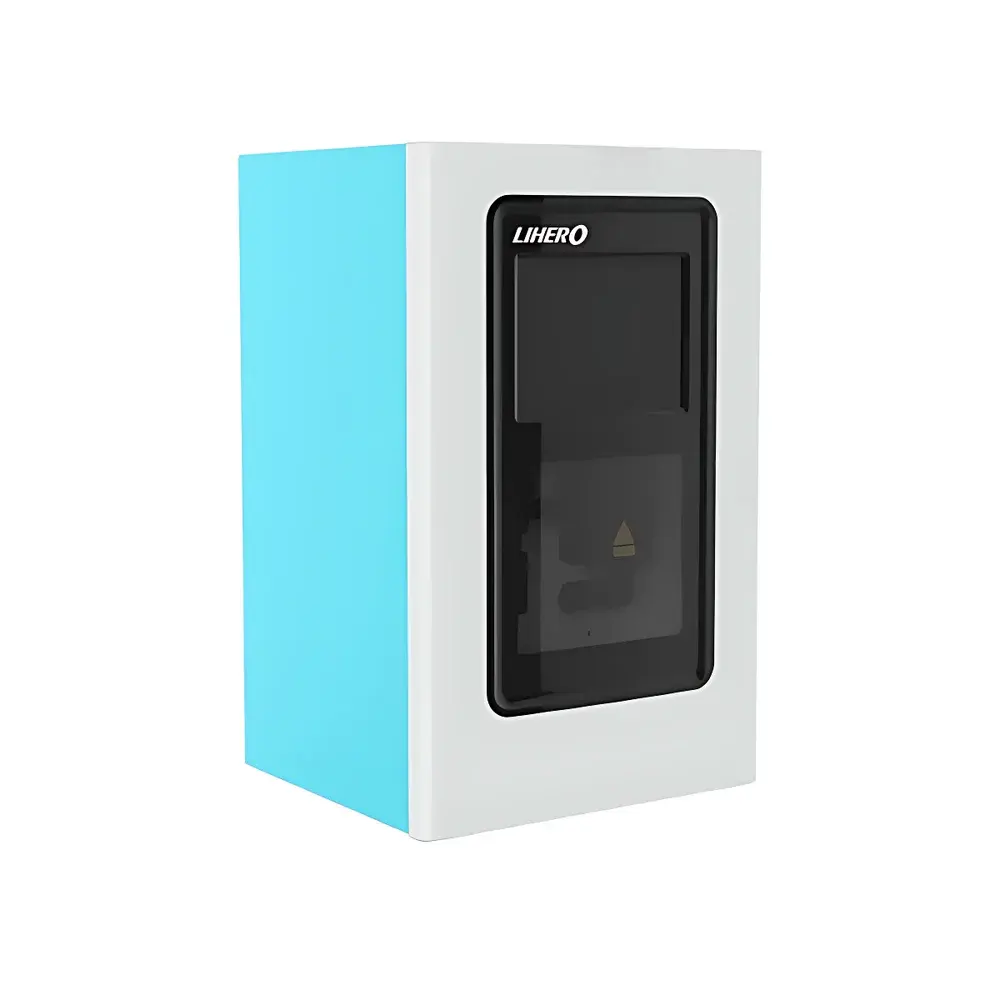
Lihero LFS-2002(CN) Online Cyanide Analyzer
| Brand | Lihero |
|---|---|
| Model | LFS-2002(CN) |
| Type | Online Analyzer |
| Measurement Principle | Iso-nicotinic Acid–Barbituric Acid Spectrophotometry |
| Detection Method | Colorimetric Analysis via Chlorine-Driven CN⁻ Conversion to Cyanogen Chloride (CNCl) |
| Sample Pretreatment | Homogeneous Purge-and-Trap with Automatic Interference Removal |
| Detection Limit | Low-ppb Range (Typical for EPA 335.4–Compliant Systems) |
| Calibration Modes | Auto-zero, Span Check, Standard Calibration, Curve Auto-Standardization, Spike Recovery Test |
| Maintenance Functions | Auto-Cleaning, Auto-Calibration, Reagent-Level Monitoring, Optical Path Self-Balancing |
| Connectivity | Remote Control & Data Upload via Modbus/TCP or 4–20 mA Output |
| Compliance Support | Designed for Continuous Emission/Discharge Monitoring per ISO 11290-2, HJ 484–2009, and EPA Method 335.4 Equivalency |
Overview
The Lihero LFS-2002(CN) Online Cyanide Analyzer is an automated, continuous-monitoring instrument engineered for real-time quantification of total cyanide (CN⁻) in aqueous environmental matrices—including industrial effluents, surface water, groundwater, and wastewater treatment plant influent/effluent streams. It operates on the internationally validated iso-nicotinic acid–barbituric acid (INBA) spectrophotometric method, which conforms to the chemical reaction sequence defined in U.S. EPA Method 335.4 and Chinese standard HJ 484–2009. In this process, cyanide ions are first liberated under acidic distillation conditions (or micro-distillation equivalent), then oxidized by chloramine-T in the presence of active chlorine to form cyanogen chloride (CNCl). CNCl subsequently reacts with iso-nicotinic acid and barbituric acid under controlled pH and temperature to yield a stable, intensely colored chromophore absorbing at 600–630 nm. The absorbance intensity, measured via dual-beam photometry with optical path self-balancing, exhibits strict linearity with cyanide concentration across defined dynamic ranges—enabling trace-level detection with high reproducibility and minimal matrix interference.
Key Features
- Integrated purge-and-trap sample pretreatment module ensures homogeneous volatilization and selective capture of CNCl, effectively eliminating spectral interferences from turbidity, color, sulfide, thiocyanate, and transition metal complexes.
- Constant-flow absorption cell design minimizes baseline drift and enhances signal-to-noise ratio—supporting sub-µg/L (ppb) detection limits and long-term stability (RSD < 3% over 7-day operation).
- Comprehensive automated calibration suite: zero-point verification, span-check validation, multi-point standard curve auto-generation, spike recovery assessment (per ISO 5667-16), and periodic reagent blank compensation.
- Real-time fault diagnostics with event logging: detects and reports reagent depletion (cyanide reagents, buffer, deionized water), component failure (pump valves, heater, photometer), out-of-range measurements, and abnormal kinetic response profiles.
- Adaptive range switching: dynamically selects optimal optical path length or dilution factor based on incoming sample concentration—ensuring accuracy across 0.5–500 µg/L without manual intervention.
- Self-maintaining architecture: scheduled ultrasonic cleaning of reaction coils and flow cells; photometric zero stabilization prior to each measurement cycle; temperature-controlled reaction chamber (±0.3 °C).
Sample Compatibility & Compliance
The LFS-2002(CN) accepts raw or filtered liquid samples with suspended solids < 10 mg/L and conductivity < 20 mS/cm. It is compatible with municipal and industrial wastewater, leachate, cooling tower blowdown, and treated discharge streams. The analyzer meets functional equivalency requirements for continuous cyanide monitoring under China’s HJ 353–2019 (Technical Specifications for Online Monitoring Systems of Pollutant Sources) and supports audit-ready data integrity per GLP principles. While not certified under EPA Certification Program for Continuous Emission Monitoring Systems (CEMS), its methodology aligns with performance criteria outlined in EPA 335.4 for laboratory and field-deployable systems. All internal logs—including calibration records, maintenance events, and alarm histories—are time-stamped and exportable in CSV format for regulatory review.
Software & Data Management
Embedded firmware supports local HMI operation via 7-inch resistive touchscreen and remote supervision through Modbus TCP, RS-485, or analog 4–20 mA output. Configuration, diagnostic access, and historical trend review are enabled via secure web interface (HTTPS) with role-based user permissions (admin/operator/viewer). Data storage includes 30 days of minute-interval measurements, calibration logs, and system health metrics. Optional integration with SCADA or LIMS platforms is facilitated via OPC UA or MQTT protocols. Audit trails comply with basic ALCOA+ principles: attributable, legible, contemporaneous, original, accurate—with electronic signatures available for critical operations (e.g., calibration confirmation).
Applications
- Regulatory compliance monitoring at electroplating, metal finishing, and mining facility discharge points.
- Early-warning detection in surface water intake systems near industrial zones.
- Process control feedback for cyanide destruction units (e.g., alkaline chlorination, hydrogen peroxide oxidation).
- Long-term trend analysis in watershed management programs tracking legacy contamination plumes.
- Support for ISO 14001 environmental management system documentation and annual reporting requirements.
FAQ
What cyanide species does the LFS-2002(CN) measure?
It quantifies total cyanide after acid distillation—i.e., free CN⁻ plus metal-cyanide complexes that release cyanide under distillation conditions (e.g., Cd-, Ni-, Cu-, and Co-cyanides), excluding iron- and cobalt-cyanides unless pretreated with UV digestion.
Is distillation performed onboard or externally?
The unit integrates a micro-distillation module compliant with HJ 484–2009, eliminating need for external glassware while maintaining stoichiometric recovery efficiency ≥ 92% (verified against reference materials).
How frequently must reagents be replenished?
Under continuous operation (1-sample/hour), reagent cartridges (chloramine-T, INBA, buffer) last approximately 30 days; consumption is monitored in real time and triggers low-level alerts 72 hours prior to exhaustion.
Can the analyzer operate unattended for extended periods?
Yes—designed for 90-day unattended deployment with scheduled auto-calibration every 24 hours, automatic cleaning every 6 hours, and redundant power supply options (24 VDC + optional UPS interface).
Does it support third-party data acquisition software?
Yes—Modbus RTU/TCP register maps and ASCII protocol documentation are provided for seamless integration into existing industrial automation infrastructures.
Related Products







