
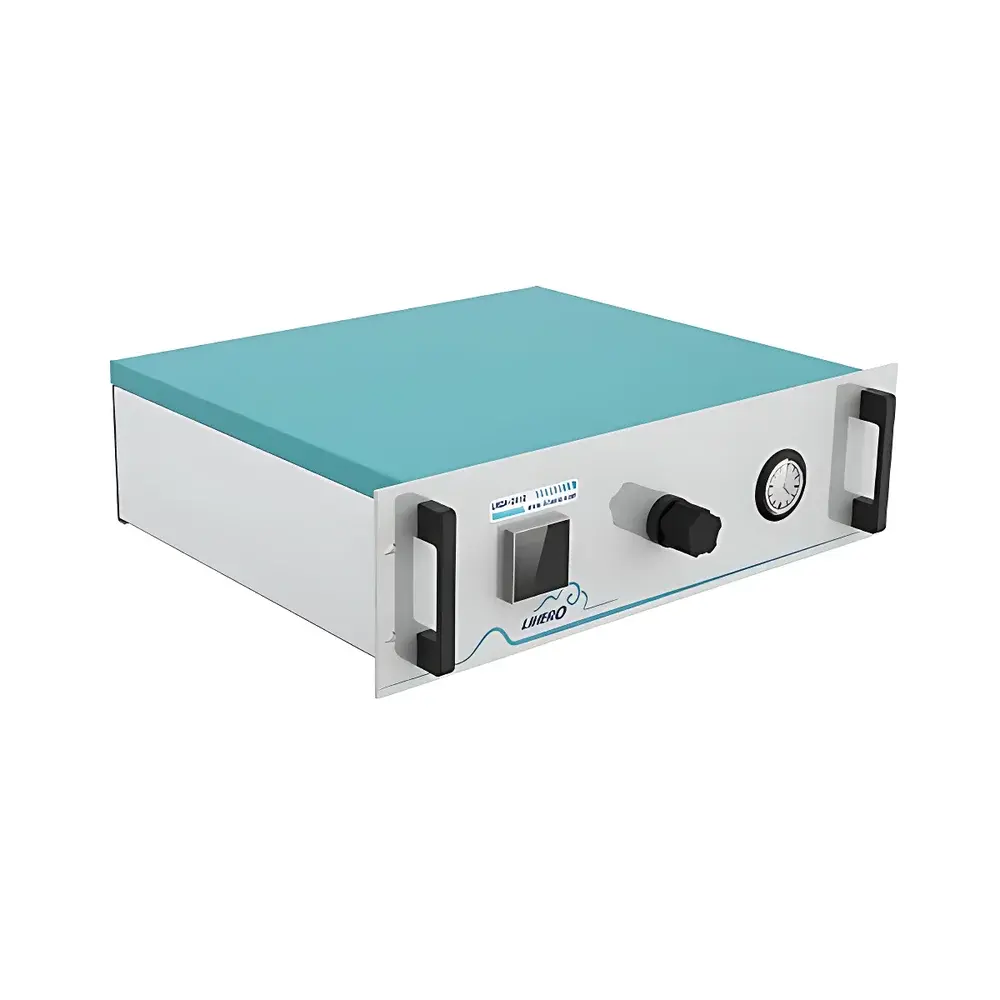
Zero Air Generator LHZA-2012 by Lihero
| Brand | Lihero |
|---|---|
| Origin | Hunan, China |
| Model | LHZA-2012 |
| Output Flow Rate | Up to 20 L/min (adjustable) |
| Dew Point | ≤ –20 °C |
| CO Oxidation Efficiency | >99.9% at 400 °C |
| Hydrocarbon Removal | Catalytic oxidation at elevated temperature |
| SO₂ & NOₓ Removal | Activated carbon + specialized adsorbent media |
| Output Pressure Stability | ±0.02 MPa |
| Power Supply | AC 220 V ±10%, 50/60 Hz |
| Dimensions | 480 × 420 × 280 mm |
| Weight | 22 kg |
Overview
The Lihero LHZA-2012 Zero Air Generator is an engineered solution for producing ultra-pure, hydrocarbon-free, and low-ppb-level contaminant air—commonly referred to as “zero air”—for use in ambient air monitoring, calibration of gas analyzers (e.g., UV photometric O₃, chemiluminescent NOₓ, and flame ionization detectors), and laboratory-grade reference gas preparation. It operates on a multi-stage purification principle: ambient air is first compressed via an oil-free diaphragm compressor; moisture is removed using a high-molecular-weight desiccant tube to achieve a dew point ≤ –20 °C; residual CO and volatile organic compounds (VOCs) are thermally oxidized in a precisely controlled high-temperature catalytic furnace (operating at ~400 °C); and finally, acidic gases—including SO₂, NO, NO₂, and trace ozone—are adsorbed using a dual-bed filtration system composed of activated carbon and proprietary metal oxide impregnated media. The conditioned air passes through a precision pressure regulator to ensure stable delivery across variable downstream demand.
Key Features
- Oil-free diaphragm compressor ensures no lubricant carryover—critical for avoiding carbon contamination in sensitive analytical applications.
- Integrated dew point control with real-time monitoring capability (optional) enables verification of moisture removal performance prior to catalytic stage entry.
- High-efficiency catalytic oxidation chamber maintains consistent thermal profile and residence time, ensuring >99.9% conversion of CO and C₁–C₄ hydrocarbons into CO₂ and H₂O.
- Dual-stage chemical filtration module provides redundant removal of reactive gases, validated against ISO 8573-1:2010 Class 1 for solid particles and Class 2 for water and oil content.
- Pressure-regulated output with built-in safety relief valve guarantees constant delivery pressure (±0.02 MPa), minimizing flow fluctuations during analyzer purging or span-gas dilution.
- Modular consumables design allows field replacement of desiccant tubes, catalyst cartridges, and adsorption beds without specialized tools—reducing downtime and service dependency.
Sample Compatibility & Compliance
The LHZA-2012 is compatible with all standard 1/4″ or 6 mm OD stainless steel or PTFE tubing interfaces used in EPA Method TO-14/TO-15 sampling systems, photometric ozone calibrators (e.g., Thermo Scientific 49i, Horiba APNA-370), and continuous emission monitoring systems (CEMS). Its output meets the zero air specifications defined in U.S. EPA 40 CFR Part 53 (Appendix A) for particulate and gaseous reference method calibration, as well as EN 14625:2012 for ambient air quality measurement—specifically requiring CO < 0.1 ppm, THC < 0.1 ppm, NOₓ < 0.5 ppb, and SO₂ < 0.5 ppb. All internal wetted materials comply with ASTM F519 for corrosion resistance, and the unit supports integration into GLP/GMP environments where audit-ready maintenance logs and consumables tracking are required.
Software & Data Management
While the LHZA-2012 operates as a standalone hardware platform without embedded firmware or touchscreen interface, it supports external data logging via optional analog (4–20 mA) or digital (RS-485 Modbus RTU) outputs for dew point, outlet pressure, and catalyst bed temperature. These signals can be integrated into centralized SCADA or LIMS platforms for preventive maintenance scheduling and regulatory recordkeeping. The unit’s maintenance cycle—typically every 6–12 months depending on ambient air quality—is documented in accordance with ISO/IEC 17025:2017 Clause 6.4.10, enabling traceable calibration history and consumables lifecycle management. No proprietary software is required; configuration and alarm thresholds are set via front-panel DIP switches.
Applications
- Primary and transfer standard calibration of ambient air quality monitors (O₃, NOₓ, SO₂, CO).
- Carrier gas supply for gas chromatography (GC) and GC–MS systems requiring inert, low-hydrocarbon air.
- Baseline verification and zero-checking in continuous emissions monitoring (CEM) systems compliant with EPA Performance Specification 2 and EN 15267.
- Reference air source for optical particle counter (OPC) zero checks and condensation particle counter (CPC) background subtraction.
- Lab-scale generation of certified zero air for method validation per ISO 16000-6 and ASTM D6196.
FAQ
What is the recommended ambient operating temperature range for the LHZA-2012?
The unit is rated for continuous operation between 5 °C and 35 °C. Operation outside this range may affect desiccant efficiency and catalyst longevity.
Can the LHZA-2012 be used with ozone generators requiring ultra-low NOₓ background?
Yes—its dual-stage adsorption system achieves NOₓ residuals below 0.5 ppb, satisfying requirements for UV-based ozone generation and photolysis studies.
Is the output flow rate adjustable, and what is the maximum stable flow?
Flow is continuously adjustable from 0 to 20 L/min via integrated needle valve; full-rated flow maintains pressure stability and purity specification.
How often must consumables be replaced under typical urban air intake conditions?
Desiccant tubes require replacement every 6 months; catalyst cartridges and adsorption beds every 12 months—subject to inlet air quality verification per ISO 8573-1.
Does the unit comply with FDA 21 CFR Part 11 for electronic records in regulated labs?
As a hardware-only generator without electronic data storage or user authentication, it does not fall under Part 11 scope—but its analog/digital outputs support compliant third-party data acquisition systems.



