
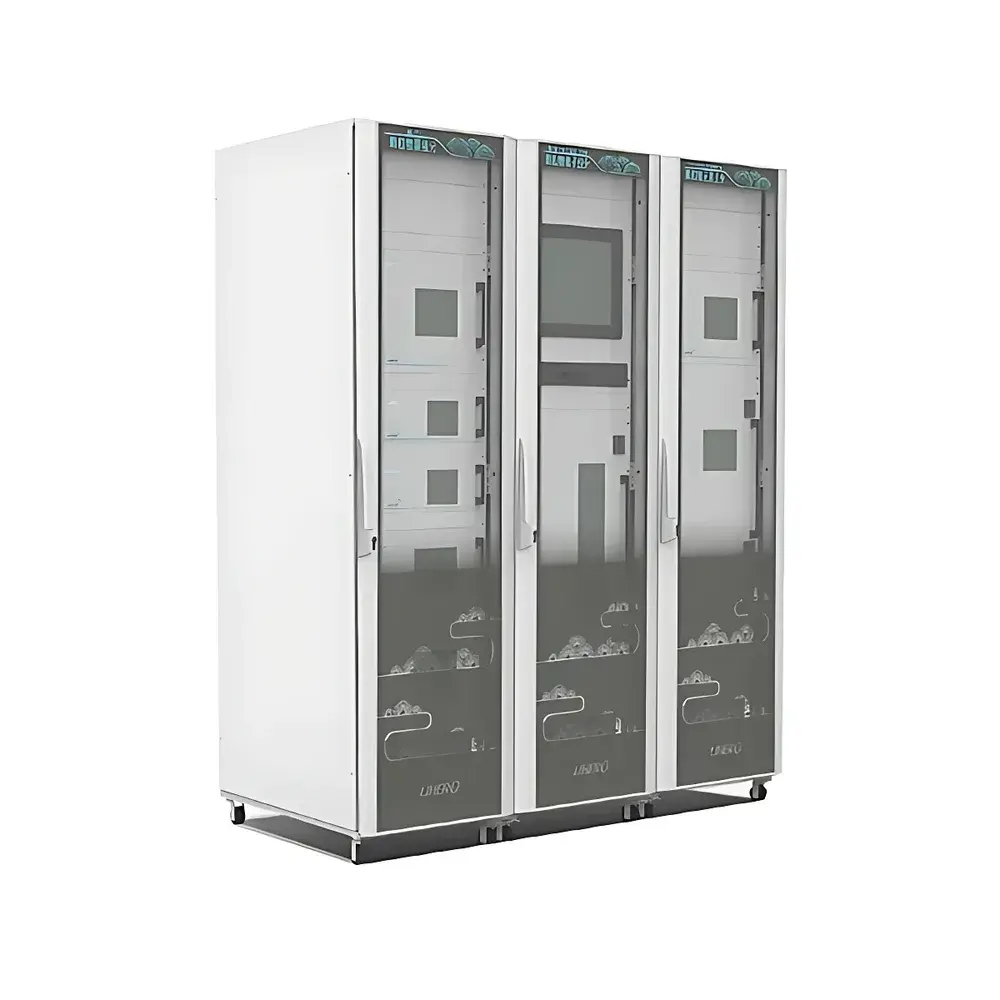
Lihero LFAMS-2010/LFOEC-2018/LFXRF-2019 Integrated Ambient Particulate Matter Composition Monitoring System
| Brand | Lihero |
|---|---|
| Origin | Hunan, China |
| Manufacturer Type | Authorized Distributor |
| Country of Manufacture | China |
| Model | Integrated Ambient Particulate Matter Composition Monitoring System |
| Pricing | Available Upon Request |
Overview
The Lihero Integrated Ambient Particulate Matter Composition Monitoring System is a multi-modal, real-time environmental monitoring platform engineered for comprehensive chemical speciation of atmospheric particulate matter (PM2.5 and PM10). It integrates three core analytical subunits—LFAMS-2010 (water-soluble ionic species), LFOEC-2018 (organic and elemental carbon fractions), and LFXRF-2019 (inorganic elemental composition)—into a unified, synchronized measurement architecture. Each module operates on established physicochemical principles: ion chromatography with suppressed conductivity detection (LFAMS-2010), thermal-optical transmittance (TOT) protocol per IMPROVE_A or NIOSH 5040 methodology (LFOEC-2018), and energy-dispersive X-ray fluorescence spectroscopy (ED-XRF) with fundamental parameter quantification (LFXRF-2019). The system enables concurrent, time-resolved profiling of anions (e.g., SO42−, NO3−, Cl−), cations (e.g., NH4+, Na+, Ca2+), carbonaceous aerosols (OC/EC/TC), and up to 30+ elements (Al, Si, S, K, Ca, Ti, V, Cr, Mn, Fe, Ni, Cu, Zn, As, Se, Br, Sr, Pb, etc.) at sub-hourly temporal resolution. Designed for unattended operation in ambient air quality monitoring stations, research observatories, and regulatory compliance networks, the system supports source apportionment modeling (e.g., PMF, CMB), secondary aerosol formation studies, and long-term trend analysis under variable meteorological conditions.
Key Features
- Fully automated, programmable sampling cycle—user-defined intervals (1–24 hours) with integrated quartz fiber filter tape handling and robotic sample positioning.
- Modular architecture enabling independent calibration, maintenance, and software updates per analytical module without system-wide downtime.
- Integrated humidity and temperature-controlled sample conditioning unit upstream of all analyzers to minimize artifact formation during thermal desorption and preserve ion integrity.
- Onboard QC/QA protocols including daily blank correction, multi-point standard calibration verification, and internal reference material tracking aligned with ISO/IEC 17025 requirements.
- Robust mechanical design compliant with IP54 enclosure rating; operational range: −20 °C to +45 °C; power redundancy support via optional UPS integration.
- Real-time data validation engine flagging outliers based on mass closure balance (ion + carbon + element mass vs. gravimetric PM load), optical attenuation consistency, and thermal evolution profile anomalies.
Sample Compatibility & Compliance
The system accepts standard 47-mm quartz fiber filters (Pallflex Tissuquartz QAT-UP) and accommodates both continuous and discrete sampling modes. Filter loading is performed using EPA TO-13A-compliant high-volume samplers (e.g., Thermo Fisher FH62 IBL or equivalent), ensuring compatibility with national and regional air quality monitoring networks. Data outputs conform to ISO 14644-1 (cleanroom particulate classification), ASTM D6216 (ambient aerosol speciation), and China’s HJ 656-2013 and HJ 93-2013 technical specifications for PM chemical analysis. All modules support audit-ready electronic records with timestamped metadata, adhering to GLP and GMP-aligned data integrity frameworks.
Software & Data Management
The Lihero PM-Composer™ v3.2 control and analysis suite provides centralized instrument orchestration, real-time visualization, and batch processing workflows. It features native export to common environmental data formats (NetCDF, CSV, EPA AQS, EEA AirBase schema) and direct API integration with third-party platforms such as RAVEN, CAMx, and CMAQ for receptor modeling input. Software includes 21 CFR Part 11-compliant user access tiers, electronic signature capability, and immutable audit trails for all method changes, calibration events, and data exports. Raw spectral and chromatographic data are archived in vendor-neutral HDF5 format with embedded calibration coefficients and uncertainty propagation metadata.
Applications
- Source apportionment of urban, industrial, and regional haze episodes using multivariate receptor modeling (PMF, UNMIX).
- Validation of chemical transport model (CTM) predictions for sulfate/nitrate/ammonium aerosol partitioning and secondary organic aerosol (SOA) yields.
- Long-term trend analysis of heavy metal deposition (e.g., Pb, As, Cd) in ecological monitoring programs.
- Health impact assessment studies correlating specific PM components (e.g., water-soluble metals, EC, nitrate) with hospital admission rates.
- Regulatory compliance reporting for national ambient air quality standards (NAAQS, EU Directive 2008/50/EC) and industrial emission permits.
FAQ
What is the minimum detectable mass concentration for sulfate and elemental carbon?
Detection limits are matrix-dependent and calibrated per site-specific filter loading; typical MDLs are 0.05 µg/m³ for SO42− (LFAMS-2010, 24-hr average) and 0.1 µg/m³ for EC (LFOEC-2018, 1-hr average) under standard operating conditions.
Can the system operate unattended for extended periods?
Yes—the system supports fully autonomous operation for ≥30 days with remote diagnostics, email/SMS alerting, and cloud-based health monitoring via optional Lihero CloudLink gateway.
Is method validation documentation available for regulatory submission?
Comprehensive validation reports—including precision, accuracy, linearity, robustness, and inter-laboratory comparison data—are supplied with each installation and updated annually per ISO/IEC 17025 Clause 7.7 requirements.
How is data synchronization managed across the three analytical modules?
All modules share a common GPS-synchronized clock and trigger on a unified time-stamped airflow event; raw data streams are time-aligned within ±5 seconds using embedded NTP and pulse-per-second (PPS) signals.
Does the system support custom calibration standards or alternative analytical methods?
Yes—open calibration configuration allows integration of user-defined standard curves, alternate TOT protocols (e.g., EUSAAR_2), and customized ED-XRF quantification matrices for specialized matrices (e.g., fly ash, sea salt-enriched samples).







