
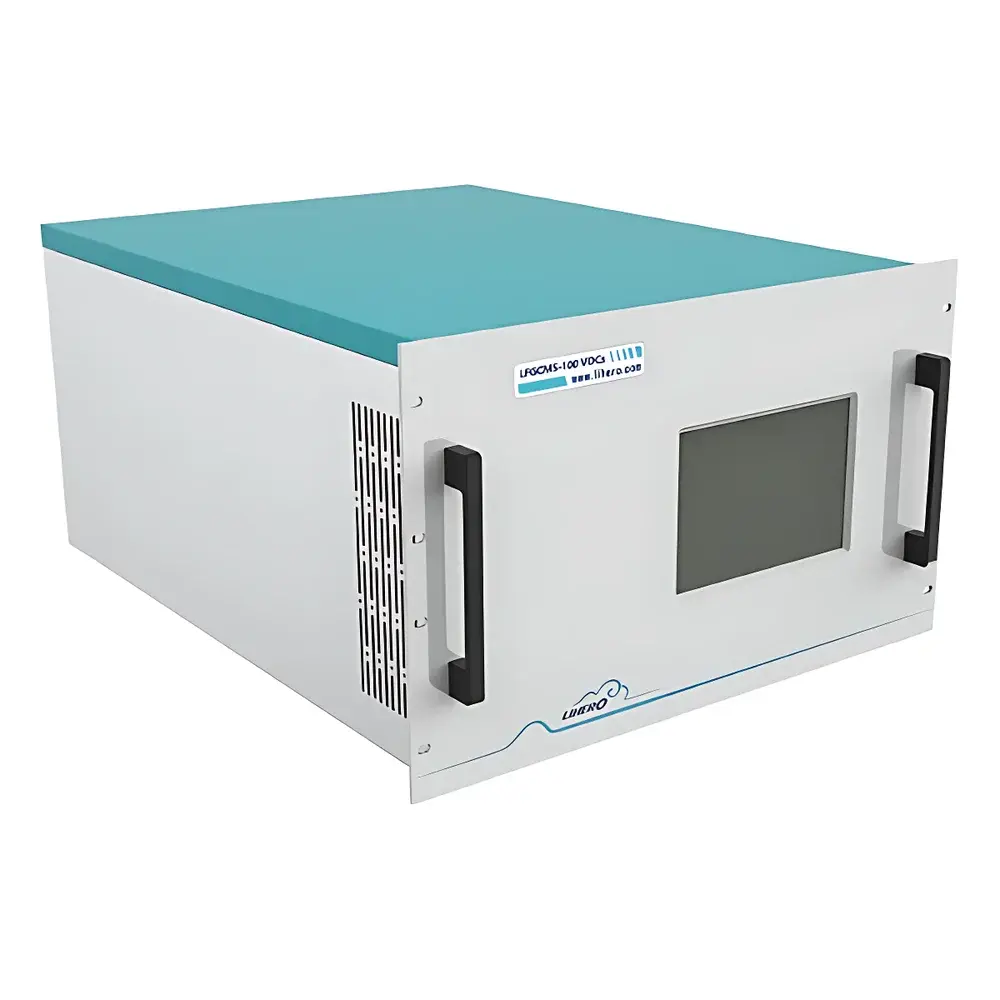
Lihero LFGCMS-100 VOCs Online Gas Chromatography-Mass Spectrometry System
| Brand | Lihero |
|---|---|
| Model | LFGCMS-100 VOCs |
| Origin | Hunan, China |
| Instrument Type | Online GC-MS Analyzer |
| Target Analytes | 116 Speciated Volatile Organic Compounds (VOCs) |
| Regulatory Compliance | HJ 1010–2018 (China) |
| Configuration | Integrated GC-MS with Dual-Stage Differential Turbo-Molecular Pump Vacuum System |
| User Interface | Graphical GUI with Bilingual (Chinese/English) Support |
| Intended Use | Continuous Ambient Air VOC Monitoring |
Overview
The Lihero LFGCMS-100 VOCs Online Gas Chromatography-Mass Spectrometry System is an integrated, field-deployable analytical platform engineered for unattended, real-time speciation and quantification of volatile organic compounds in ambient air. It operates on the fundamental principles of gas chromatographic separation followed by electron ionization (EI) mass spectrometric detection. The system couples a capillary column-based GC module—optimized for polar and non-polar VOC resolution—with a quadrupole mass analyzer capable of unit-mass resolution and full-scan acquisition across m/z 10–300. Designed specifically to meet the stringent performance criteria outlined in China’s HJ 1010–2018 standard, the LFGCMS-100 delivers continuous, high-fidelity data streams suitable for regulatory reporting, source apportionment studies, and trend analysis in urban and industrial boundary monitoring networks.
Key Features
- Real-time speciated VOC monitoring of up to 116 target compounds—including alkanes, alkenes, aromatics, oxygenated VOCs (OVOCs), and halogenated species—without manual intervention or sample pre-concentration.
- Dual-stage differential turbo-molecular pump vacuum system ensures stable ion source pressure (<1×10⁻⁵ Torr) and rapid cycle times, enabling sub-30-minute analysis cycles with reproducible retention time alignment across multi-day deployments.
- Robust, modular architecture with heated transfer lines, programmable oven temperature ramping (40–250 °C), and auto-calibration capability using internal standard surrogates (e.g., deuterated toluene, fluorobenzene).
- Front-panel graphical user interface supports bilingual (English/Chinese) navigation, method setup, real-time chromatogram viewing, alarm threshold configuration, and diagnostic status reporting—all accessible without external PC dependency.
- Engineered for long-term unattended operation: consumables (e.g., GC columns, ion source filaments, pump oil) are rated for ≥6 months under typical ambient monitoring conditions; maintenance intervals are logged automatically with predictive alerts.
Sample Compatibility & Compliance
The LFGCMS-100 is validated for direct analysis of ambient air samples collected via standardized stainless-steel sampling manifolds compliant with HJ 1010–2018 inlet specifications. It accommodates both active sampling (with integrated mass flow-controlled draw at 100–500 mL/min) and optional thermal desorption integration for enriched sampling scenarios. All hardware and firmware components adhere to electromagnetic compatibility (EMC) Class B requirements per GB/T 17626 series and operate reliably within temperature ranges of −20 °C to +50 °C and relative humidity ≤90% RH (non-condensing). The system satisfies the data integrity and audit trail provisions referenced in China’s Ministry of Ecology and Environment (MEE) 2019 “Monitoring Plan for VOCs in Ambient Air of Prefecture-Level and Above Cities,” including mandatory calibration frequency (≥once per 7 days), system suitability testing (SST), and raw data retention for ≥180 days.
Software & Data Management
The embedded acquisition and control software provides full method development, sequence scheduling, peak integration (using adaptive baseline algorithms), library matching (NIST MS Search 2.4 with custom VOC spectral library), and automated report generation in PDF/CSV formats. Data export conforms to MEE-specified XML schema for seamless ingestion into provincial environmental information platforms. Audit trails record all user actions—including method edits, calibration events, and instrument parameter changes—with timestamp, operator ID, and IP address (where network-enabled). While not natively 21 CFR Part 11 compliant, the system supports third-party validation packages for GLP/GMP-aligned laboratories requiring electronic signature and role-based access control extensions.
Applications
- Ambient air quality monitoring networks operated by municipal and provincial ecological environment bureaus.
- Industrial fence-line monitoring for petrochemical, pharmaceutical, coating, and printing facilities subject to VOC emission permits.
- Source identification and temporal profiling during photochemical smog episodes or odor complaint investigations.
- Validation of low-cost sensor networks through co-location studies and bias correction modeling.
- Research applications requiring high-time-resolution speciated VOC datasets for atmospheric chemistry modeling (e.g., OH reactivity estimation, ozone formation potential calculation).
FAQ
What regulatory standards does the LFGCMS-100 meet?
It is fully aligned with HJ 1010–2018 and implements the operational and performance verification protocols specified in the MEE’s 2019 VOC Monitoring Plan.
Can the system be integrated with existing SCADA or EMS platforms?
Yes—via Modbus TCP or OPC UA interfaces; analog outputs (4–20 mA) are available for key parameters including total VOC concentration and individual compound flags.
Is remote diagnostics supported?
The system includes embedded web server functionality for secure HTTPS-based remote status monitoring, log download, and limited parameter adjustment (subject to administrator authentication).
What is the typical detection limit for benzene and toluene?
Under standard ambient air sampling conditions (200 mL/min, 30-min cycle), method detection limits (MDLs) are ≤50 pptv for benzene and ≤30 pptv for toluene, as verified per HJ 1010–2018 Annex C.
Does the system require cryogenic cooling or liquid nitrogen?
No—the quadrupole mass analyzer uses conduction-cooled electronics and does not rely on cryogens; the turbo-molecular pump employs air-cooled bearings and requires no external coolant.







