
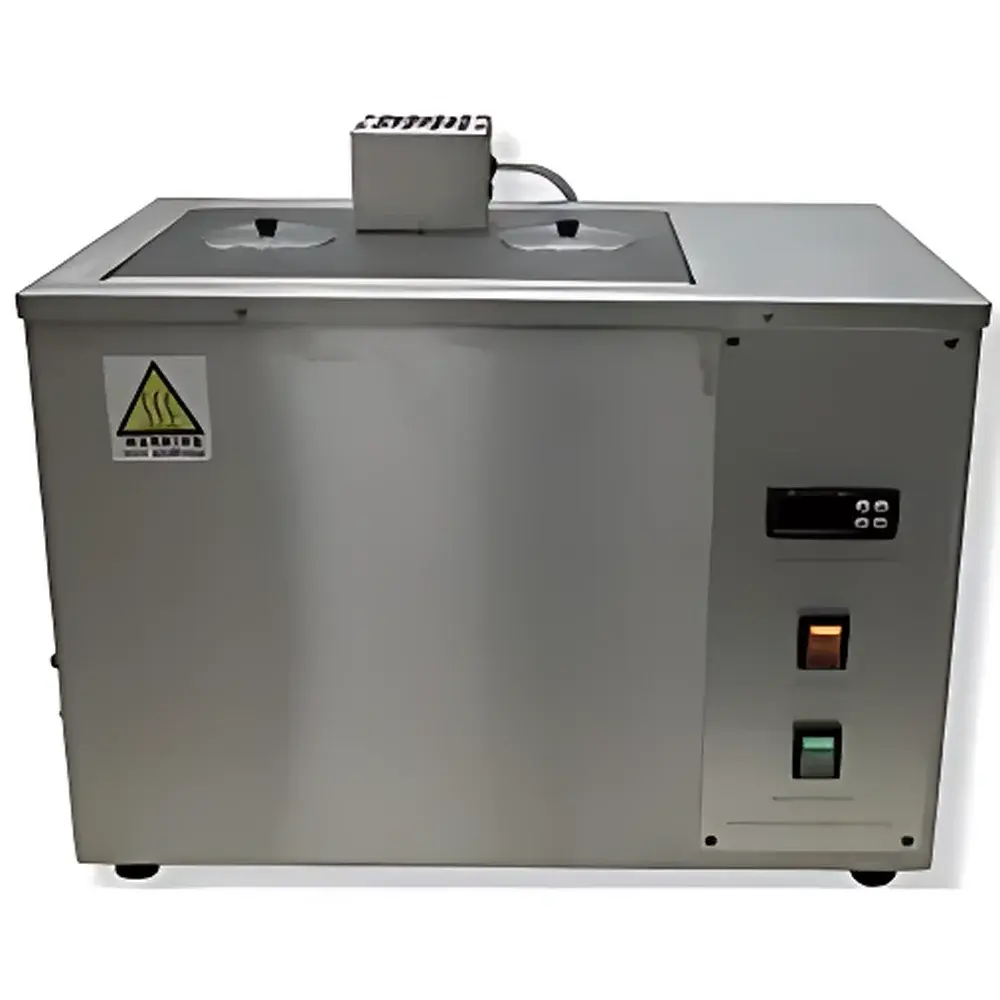
SDM 942 Lubricating Grease Oxidation Stability Tester
| Brand | SDM |
|---|---|
| Origin | Italy |
| Model | 942 |
| Temperature Range | Ambient to 120 °C (±0.1 °C stability) |
| Power Supply | 220 V, 50/60 Hz |
| Heating Power | 1200 W |
| Dimensions | 55 × 36 × 45 cm |
| Weight | 26 kg |
| Compliance | ASTM D942, IP 142, DIN 51808 |
| Construction | Double-walled insulated stainless steel housing |
| Temperature Control | PID controller with PT100A sensor and over-temperature alarm |
| Safety Features | Low-level liquid detection with visual alarm |
| Agitation | Integrated electric stirrer |
| Pressure Vessel Interface | Dual-port lid for oxidation bomb mounting |
Overview
The SDM 942 Lubricating Grease Oxidation Stability Tester is a precision-engineered benchtop instrument designed to evaluate the resistance of lubricating greases to oxidative degradation under accelerated, controlled conditions. It operates on the principle of pressurized oxygen exposure at elevated temperatures—specifically aligned with the gravimetric and pressure-drop methodology defined in ASTM D942, IP 142, and DIN 51808. In this test, a grease sample is sealed in a stainless-steel oxidation bomb, charged with pure oxygen to an initial pressure (typically 85–100 psi), and immersed in a thermally stabilized bath maintained at 99 °C or 120 °C. The time required for the internal pressure to drop by a specified amount (e.g., 25.4 kPa or 3.7 psi) serves as the quantitative indicator of oxidation onset—directly correlating with service-life prediction and formulation robustness. The SDM 942 implements this protocol with metrological rigor, leveraging a double-walled insulated stainless-steel bath, high-stability PID temperature regulation, and real-time thermal monitoring via a calibrated PT100A platinum resistance thermometer.
Key Features
- Double-walled, fully insulated stainless-steel bath construction ensures minimal thermal gradient and exceptional temperature uniformity across the test zone.
- PID temperature controller with integrated PT100A probe delivers ±0.1 °C thermal stability over the full operating range (ambient to 120 °C), meeting the repeatability requirements of ASTM D942 Annex A3.
- Dual-port lid design accommodates standard ASTM-compliant oxidation bombs (e.g., 114 mL or 250 mL capacity) with gas-tight sealing and pressure monitoring interfaces.
- Electrically driven magnetic stirrer provides consistent, non-intrusive agitation of the bath medium—critical for eliminating localized hot spots and ensuring homogeneous heat transfer to the bomb surface.
- Redundant safety architecture includes over-temperature cutoff, low-bath-fluid level detection with illuminated warning indicator, and fail-safe power interruption upon sensor fault or thermal excursion.
- Compact footprint (55 × 36 × 45 cm) and optimized 26 kg mass facilitate integration into QC laboratories compliant with ISO/IEC 17025 spatial and vibration requirements.
Sample Compatibility & Compliance
The SDM 942 is validated for use with NLGI grades 00 through 3 greases, including lithium-, calcium-, aluminum-, and polyurea-thickened formulations. It supports both single-bomb and multi-bomb test configurations when used with auxiliary manifolds (sold separately). All mechanical and thermal specifications adhere strictly to the apparatus requirements outlined in ASTM D942 Section 6, IP 142 Clause 4.2, and DIN 51808 Part 1. The unit’s stainless-steel wetted surfaces resist corrosion from acidic oxidation byproducts, ensuring long-term calibration integrity and minimizing cross-contamination risk between sequential tests. No software-based compliance reporting is embedded; however, raw time–pressure data may be exported for external audit trails required under GLP or ISO 9001 quality systems.
Software & Data Management
The SDM 942 operates as a standalone hardware platform with analog/digital hybrid control—no embedded firmware or proprietary software is required for basic operation. Temperature setpoint, real-time bath temperature, and elapsed test time are displayed on a dual-line LED interface. For laboratories requiring electronic data capture, optional analog voltage outputs (0–10 V DC) are available for connection to external data loggers or LIMS-compatible acquisition systems. While the instrument itself does not generate 21 CFR Part 11-compliant electronic records, its deterministic analog control loop and physical alarm indicators support manual audit documentation per FDA GLP guidelines (21 CFR Part 58). Calibration certificates traceable to NIST standards can be supplied upon request.
Applications
- Formulation development of oxidation-resistant greases for automotive wheel bearings, electric motor applications, and wind turbine pitch systems.
- Quality control release testing of incoming grease batches against OEM-specified oxidation induction times (OIT).
- Comparative shelf-life assessment of antioxidant packages (e.g., hindered phenols vs. aromatic amines) under standardized stress conditions.
- Root-cause analysis of premature grease hardening or oil bleed in field-failure investigations.
- Supporting ASTM D3336 and D6185 correlation studies where oxidation stability intersects with mechanical stability metrics.
FAQ
Does the SDM 942 comply with current editions of ASTM D942?
Yes—the mechanical configuration, temperature control accuracy, bath geometry, and pressure vessel interface meet all apparatus requirements specified in ASTM D942-22 (Standard Test Method for Oxidation Stability of Lubricating Grease).
Can the instrument be used for testing lubricating oils?
No—ASTM D942 is explicitly limited to greases. For oils, refer to ASTM D2272 (RBP) or D943 (TOST); the SDM 942 lacks the sample geometry, vapor management, and oxidation product condensation features required for those methods.
Is third-party calibration certification included?
Calibration verification data is provided with shipment. NIST-traceable calibration certificates (including PT100A probe and pressure transducer validation) are available as an optional add-on service.
What maintenance intervals are recommended?
Visual inspection of bath fluid level and gasket integrity before each test cycle; annual verification of PID controller linearity and alarm thresholds by qualified technical personnel.
Is the unit suitable for unattended overnight operation?
Yes—provided ambient laboratory conditions remain within ISO 17025 environmental tolerances (20–25 °C, <65% RH) and the bath fluid level is verified prior to initiation. The low-level and over-temperature alarms remain active during extended runs.
Related Products





