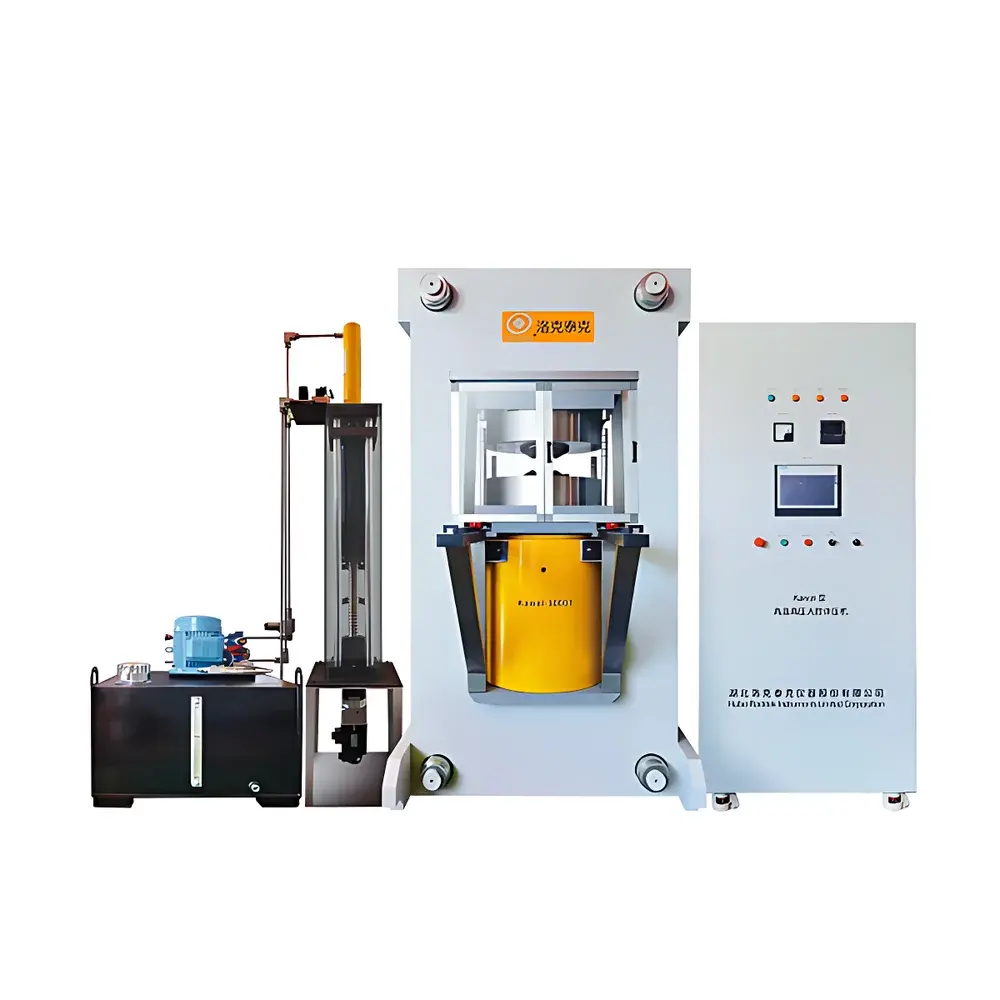
Rocktek RTK-Kawai Large-Volume Press for High-Pressure High-Temperature (HPHT) Research
| Brand | Rocktek |
|---|---|
| Origin | Hubei, China |
| Model | RTK-Kawai Large-Volume Multi-Anvil Press |
| Maximum Load Capacity | 1000–2000 metric tons |
| Maximum Pressure | >20 GPa |
| Maximum Temperature | >2000 °C |
| Anvil Material | Tungsten Carbide (WC) |
| Stroke | 150 mm |
| Low-Pressure Drive | Hydraulic System |
| High-Pressure Regulation | Servo-Motor-Controlled Precision Actuation |
| Pressure Control Accuracy | ±0.5 bar |
| Control Architecture | PLC-Based Segmented Programmable Logic with Real-Time Digital Pressure Feedback |
| Communication Interface | Ethernet (TCP/IP) to Host PC |
| Compliance | Designed for ISO/IEC 17025-aligned laboratory environments |
Overview
The Rocktek RTK-Kawai Large-Volume Press is a precision-engineered high-pressure high-temperature (HPHT) apparatus designed for geophysical, planetary science, and advanced materials synthesis research. It implements the Kawai-type 6–8 multi-anvil configuration—a widely adopted geometry in solid-state physics and Earth sciences—where eight tungsten carbide (WC) cubes converge symmetrically onto a central octahedral sample volume. This architecture enables uniform stress distribution and scalable pressure generation within large-volume assemblies (LVAs), supporting sample diameters up to 10 mm and enabling reproducible thermodynamic conditions exceeding 20 GPa and 2000 °C. Unlike diamond anvil cells (DACs), the RTK-Kawai system delivers macroscopic sample quantities suitable for post-run ex situ analysis (e.g., XRD, SEM-EDS, Raman spectroscopy) and in situ synchrotron measurements when integrated with beamline-compatible frames.
Key Features
- Kawai-type 6–8 multi-anvil assembly with WC anvils and pre-stressed steel frame, engineered for mechanical stability under sustained ultra-high loads
- Hybrid actuation system: high-flow hydraulic drive for rapid low-pressure positioning (≤1 GPa), followed by fine-resolution servo-motor-controlled pressure regulation in the high-pressure regime (1–25 GPa)
- Segmented PLC-based control logic permitting user-defined pressure–time profiles with independent setpoints per segment, including ramp rates, dwell durations, and stepwise increments
- Digital pressure transduction via calibrated strain-gauge or piezoresistive sensors mounted directly on the working piston, delivering real-time feedback with ±0.5 bar absolute accuracy
- Open-frame structural design facilitating multi-probe access—including thermocouple leads, laser heating optics, electrical resistivity wires, and synchrotron X-ray paths—without compromising mechanical rigidity
- Ethernet-enabled communication protocol compliant with standard Modbus TCP and OPC UA frameworks, allowing integration into centralized lab automation systems and remote monitoring platforms
Sample Compatibility & Compliance
The RTK-Kawai press accommodates diverse sample geometries and containment media, including graphite heaters, MgO or NaCl pressure-transmitting media, and borosilicate or alumina insulating sleeves. Its modular furnace assembly supports Type C (W–Re) thermocouples for direct temperature measurement at the sample position, traceable to NIST standards. The system is designed to operate within laboratories adhering to ISO/IEC 17025 accreditation criteria for testing and calibration laboratories. While not certified as medical or pharmaceutical equipment, its programmable logic controller (PLC) retains full audit trails of pressure setpoints, actual values, timestamps, and fault logs—supporting GLP-compliant documentation practices. All electrical subsystems conform to IEC 61000-6-3 (EMC emission limits) and IEC 61000-6-2 (immunity requirements).
Software & Data Management
The Rocktek HPHT Control Suite runs on Windows-based host PCs and provides a deterministic real-time interface for configuring, executing, and archiving HPHT experiments. Each experimental run generates a timestamped binary log file containing synchronized pressure, temperature, stroke position, and status flags. Export formats include CSV and HDF5 for compatibility with Python (NumPy/Pandas), MATLAB, and commercial data analysis tools. The software supports role-based user authentication, electronic signatures, and configurable data retention policies aligned with 21 CFR Part 11 principles—though formal validation must be performed by end users per their institutional SOPs. Remote diagnostics and firmware updates are supported via secure SSH tunneling.
Applications
- Synthesis and phase stability studies of deep-Earth minerals (e.g., bridgmanite, ferropericlase, CaSiO₃-perovskite) under mantle-relevant P–T conditions
- High-pressure metallurgy: solidification behavior of refractory alloys, superconducting intermetallics, and amorphous metallic glasses
- In situ resistivity and Seebeck coefficient measurements during phase transitions in quantum materials
- Calibration of pressure standards (e.g., gold, platinum, or ruby fluorescence scales) across extended GPa ranges
- Development of novel ceramic composites and ultra-hard materials via HPHT sintering protocols
- Geodynamic modeling input generation through rheological property mapping of mantle analogs
FAQ
What is the maximum usable sample volume in the RTK-Kawai press?
Standard configurations support octahedral sample volumes of 3–10 mm edge length, corresponding to 0.1–1.0 cm³ compressed volume depending on pressure medium and thermal insulation layout.
Is the system compatible with synchrotron radiation facilities?
Yes—the open-frame architecture and modular top/bottom plates allow straightforward integration with beamline hutches; optional motorized XYZ stages and vacuum-compatible feedthroughs are available upon request.
Can the pressure calibration be independently verified?
Absolutely—users may perform in situ ruby fluorescence or Sm:YAG R1-line calibrations using standard optical access ports; all pressure sensor outputs are accessible via analog voltage or digital register reads for cross-validation.
Does Rocktek provide application support for experimental design?
Rocktek collaborates with academic and national lab partners to co-develop LVA assembly protocols, furnace layouts, and P–T trajectory optimization strategies—support is delivered via technical workshops and documented SOP libraries.
What maintenance intervals are recommended for long-term operational reliability?
Hydraulic fluid replacement every 18 months, WC anvil inspection after 50 high-pressure cycles (>15 GPa), and annual calibration of pressure transducers and thermocouple reference junctions—full service history tracking is embedded in the control software.