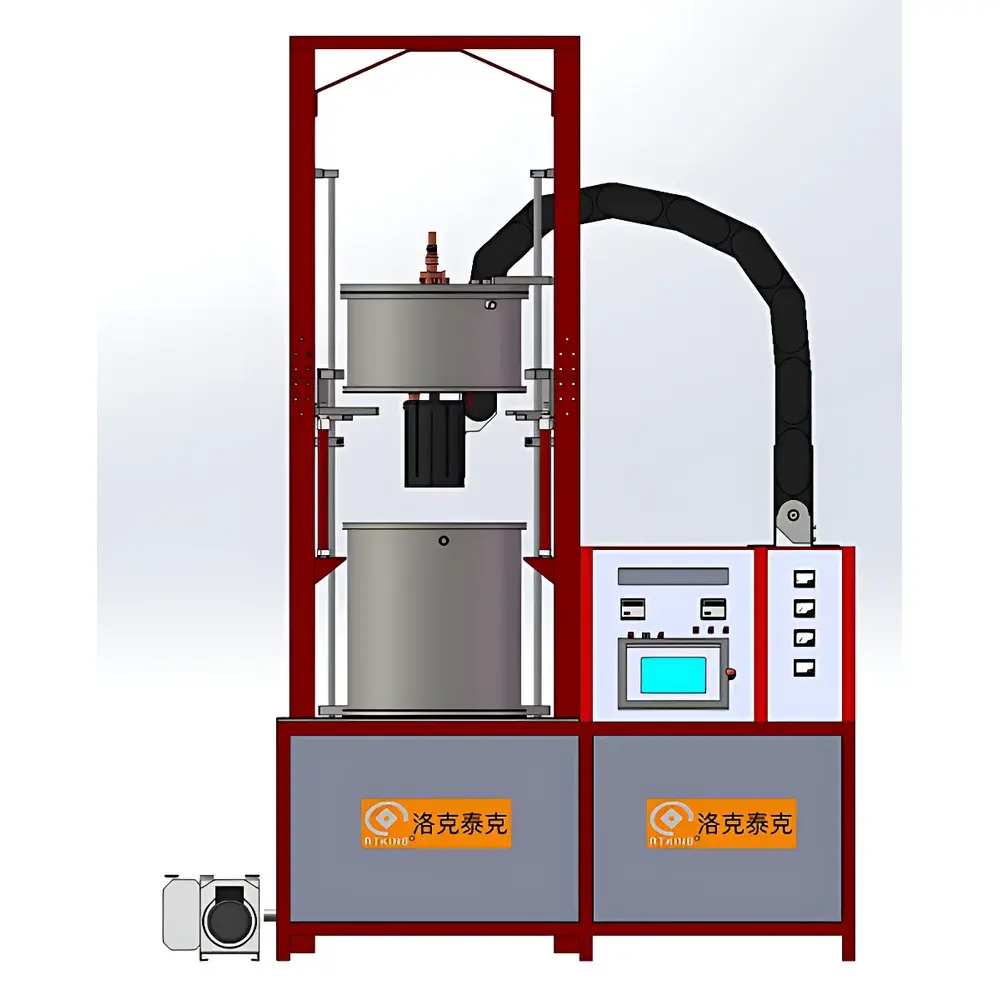
Rotary Atmosphere Sintering & Centrifugal Sintering Furnace RTK-003
| Brand | Rocktek |
|---|---|
| Origin | Hubei, China |
| Model | RTK-003 |
| Max Operating Temperature | 2000 °C (Rated: 2100 °C) |
| Temperature Control | Single-zone PID |
| Ramp Rate | 0–20 °C/min (adjustable) |
| Ultimate Vacuum | ≤30 Pa (achieved within ≤30 min) |
| Pressure Rise Rate | ≤0.65 Pa/h |
| Heating System | Cage-type graphite heater |
| Cooling Method | Forced recirculating water cooling (furnace shell, top/bottom flanges, copper electrodes, cables) |
| Control Architecture | Industrial PC + high-performance hybrid logic controller |
| Operation Modes | Fully automatic / local manual |
| Data Logging | Real-time acquisition of temperature, vacuum pressure, runtime |
| Compliance Support | GLP-compliant data integrity (audit trail, user access control, electronic signature readiness per FDA 21 CFR Part 11) |
Overview
The Rocktek RTK-003 Rotary Atmosphere Sintering & Centrifugal Sintering Furnace is an advanced high-temperature thermal processing system engineered for controlled solid-state densification, phase transformation, and microstructural evolution under programmable atmosphere and rotational mechanical stress. Unlike conventional static sintering furnaces, the RTK-003 integrates synchronized rotation of the sample chamber with precise vacuum/atmosphere management and ultra-stable high-temperature control—enabling centrifugal force-assisted particle rearrangement, enhanced mass transport, and uniform thermal exposure during sintering. Its core architecture employs a cage-type graphite heating element housed within a water-cooled stainless-steel vacuum vessel, rated for continuous operation at 2000 °C and short-term excursions to 2100 °C. The furnace operates under single-zone PID temperature regulation with ramp rate programmability from 0 to 20 °C/min, supporting multi-segment thermal profiles essential for graded sintering, binder burnout, and reactive synthesis protocols.
Key Features
- Vertical lift furnace design with integrated graphite heater cage—enables safe, tool-free heater retraction during sample loading/unloading without thermal shock or alignment recalibration.
- Recirculating water cooling system applied uniformly across furnace shell, top/bottom flanges, copper current feedthroughs, and high-current cabling—ensuring thermal stability, electrical isolation integrity, and extended component service life.
- Dual-mode control architecture: industrial PC running real-time HMI software (WinCC-based configuration) paired with a hardened hybrid logic controller—providing deterministic response for safety-critical interlocks and seamless transition between automatic sequence execution and local manual override.
- Comprehensive fault mitigation suite including over-temperature cutoff, power failure recovery with thermal hold, vacuum breach detection, and coolant flow monitoring—all logged with timestamps and actionable status codes.
- Onboard data historian with timestamped acquisition of temperature (Type C thermocouple), vacuum pressure (capacitance manometer), rotational speed (encoder feedback), and cumulative operational hours—supporting traceability, root-cause analysis, and regulatory review.
Sample Compatibility & Compliance
The RTK-003 accommodates cylindrical and disc-shaped samples up to Ø120 mm × H80 mm (custom configurations available), compatible with inert (Ar, N₂), reducing (H₂/Ar mixtures), and vacuum environments down to 30 Pa base pressure. Its mechanical rotation capability (0–60 rpm, variable torque output) supports centrifugal sintering of metal matrix composites, ceramic preforms, and powder metallurgy compacts where gravitational segregation or density gradients must be suppressed. The system meets structural and electrical safety requirements per IEC 61000-6-2 (EMC immunity) and IEC 61000-6-4 (EMC emissions). Data handling architecture aligns with ALCOA+ principles (Attributable, Legible, Contemporaneous, Original, Accurate, Complete, Consistent, Enduring, Available) and provides foundational infrastructure for FDA 21 CFR Part 11 compliance—including role-based user authentication, electronic signature capture, and immutable audit trails for all parameter changes and operational events.
Software & Data Management
Control and monitoring are executed via a Windows-based HMI platform built using Siemens WinCC Unified Runtime, configured with custom SCADA objects for thermal profiling, vacuum sequencing, and motion coordination. Users define multi-step sintering recipes—including dwell times, ramp rates, gas flow setpoints, and rotational acceleration profiles—via intuitive drag-and-drop interface. All process variables are archived in binary-coded decimal (BCD) format with millisecond-resolution timestamps, stored redundantly on both the PLC’s non-volatile memory and the industrial PC’s SSD. Historical trends can be exported as CSV or MATLAB-compatible .mat files. Built-in replay mode allows synchronized visualization of temperature, pressure, and rotation curves against real-time event markers (e.g., “Heater Retracted”, “Vacuum Pump Stopped”). Remote diagnostics via secure TLS 1.2-enabled OPC UA server (port 4840) enables integration into centralized MES or LIMS platforms.
Applications
- Sintering of refractory carbides (WC-Co, TiC-Ni), ultra-high-temperature ceramics (ZrB₂-SiC, HfC), and rare-earth doped phosphors requiring homogeneous grain growth under controlled partial pressures.
- Centrifugal densification of functionally graded materials (FGMs) where compositional gradients must be preserved during consolidation without interdiffusion-driven blurring.
- Rotational heat treatment of additively manufactured (AM) metal parts to relieve residual stress while minimizing distortion through balanced thermal-mechanical loading.
- Atmosphere-controlled annealing of oxide superconductors (e.g., YBCO tapes) and battery cathode precursors (NMC, LFP) where oxygen stoichiometry directly governs electrochemical performance.
- Process development for solid-state recycling of spent lithium-ion battery cathodes—leveraging rotation to enhance interfacial contact between recycled active material and dopant additives under low-oxygen sintering conditions.
FAQ
What vacuum level can the RTK-003 achieve, and how quickly?
The furnace reaches ≤30 Pa within 30 minutes using its integrated two-stage rotary vane + turbomolecular pumping system. Base pressure stability is maintained at ≤0.65 Pa/h during extended holds.
Is the rotation mechanism compatible with high-temperature operation?
Yes—the rotary feedthrough uses high-purity alumina-ceramic seals and water-cooled graphite shaft extensions, rated for continuous operation up to 2000 °C without lubricant degradation or outgassing.
Can the system be integrated into an existing factory automation network?
Absolutely. The RTK-003 supports OPC UA (compliant with IEC 62541), Modbus TCP, and EtherNet/IP protocols for bidirectional communication with DCS, SCADA, or MES systems.
Does the control software support automated recipe validation per GMP guidelines?
The HMI includes configurable electronic signature workflows, change control logs, and IQ/OQ template export functions—enabling users to execute protocol-driven qualification activities aligned with ISO 9001 and ASTM E2500.
What maintenance intervals are recommended for the graphite heater and vacuum components?
Graphite heater inspection is advised every 200 operational hours; vacuum pump oil replacement every 3000 hours; and O-ring integrity verification prior to each high-temperature run above 1600 °C.