
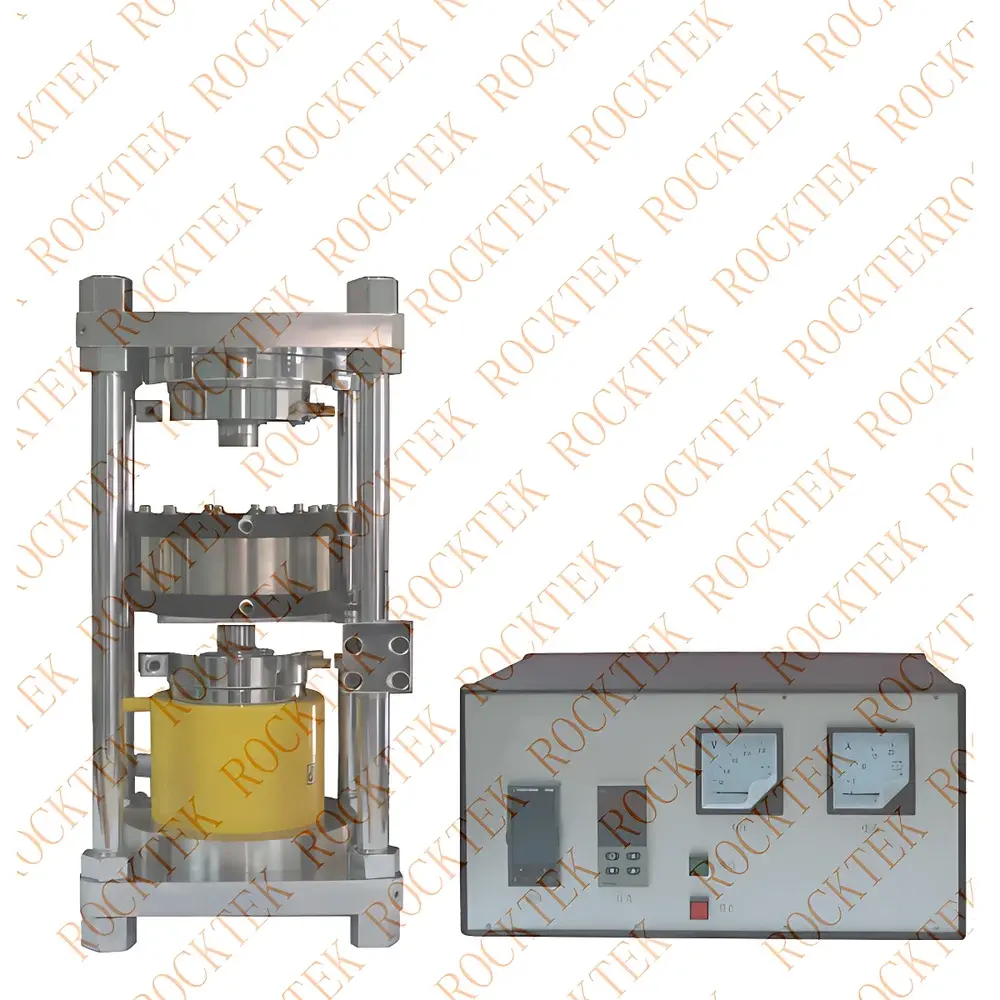
Rocktek Rocktek-1 High-Temperature High-Pressure Sintering Furnace
| Brand | Rocktek |
|---|---|
| Origin | Hubei, China |
| Model | Rocktek-1 |
| Max Operating Temperature | 1800 °C |
| Max Static Pressure | 4 GPa |
| Heating Method | Resistive (Graphite or Ceramic Heating Elements) |
| Pressure Generation | Hydraulic or Mechanical Piston-Based Static Press System |
| Compliance | Designed for laboratory-scale static high-pressure synthesis per ASTM E2567 and ISO 13320 principles (application-specific calibration required) |
Overview
The Rocktek Rocktek-1 High-Temperature High-Pressure Sintering Furnace is a statically loaded, resistively heated apparatus engineered for controlled solid-state synthesis and phase transformation studies under simultaneous extreme thermal and mechanical conditions. It operates on the principle of uniaxial or cubic anvil-based static pressure generation—typically employing tungsten carbide or sintered diamond anvils coupled with hydraulic or servo-mechanical force transmission—combined with precision-resistive heating elements (graphite, molybdenum disilicide, or silicon carbide depending on temperature range). This architecture enables stable, reproducible co-application of temperatures up to 1800 °C and static pressures up to 4 GPa within a compact, shielded chamber. Unlike dynamic (shock) or gas-mediated high-pressure systems, the Rocktek-1 delivers quasi-static thermodynamic states suitable for equilibrium-phase mapping, crystallographic stability analysis, and kinetic studies of solid-state reactions. Its design prioritizes thermal homogeneity across the sample volume (< ±5 °C at 1600 °C over 5 mm axial zone) and pressure uniformity (±3% deviation across central 2 mm sample region), critical for quantitative XRD, Raman, and electrical transport measurements conducted in situ or ex situ.
Key Features
- Integrated dual-control architecture: independent closed-loop regulation of temperature (via Type S or C thermocouples + PID algorithm) and pressure (via load cell feedback + proportional hydraulic valve or stepper-driven mechanical actuator)
- Modular pressure vessel design compatible with standard Bridgman-type, multi-anvil (e.g., 6–8 mm cubic press), or piston-cylinder configurations
- Refractory internal lining (tantalum carbide or boron nitride) ensuring chemical inertness against reactive samples (e.g., alkali metal oxides, molten salts)
- Programmable ramp/soak profiles with up to 99 segments, supporting complex thermal histories including quenching protocols via rapid pressure release interlock
- Front-loading chamber with water-cooled flange and vacuum-tight metallic gasketing (≤1×10⁻⁵ mbar base pressure with optional turbomolecular pump)
- CE-compliant safety interlocks: overtemperature cutoff, pressure relief burst disc, door position sensing, and emergency power-off sequence
Sample Compatibility & Compliance
The Rocktek-1 accommodates cylindrical or toroidal samples (diameter: 1–8 mm; height: 1–5 mm), including ceramic powders, sintered compacts, single crystals, and metallic alloys. It supports inert (Ar, N₂), reducing (H₂/Ar), or oxidizing (O₂-enriched) atmospheres when integrated with gas flow controllers. All structural materials conform to ASTM F899 (tool steels) and ISO 7583 (high-temperature ceramics). Pressure calibration follows NIST-traceable dead-weight standards; temperature calibration is certified per ISO/IEC 17025-accredited procedures using fixed-point cells (e.g., Au, Pt, Co-C). The system meets essential requirements of EU Machinery Directive 2006/42/EC and is designed to support GLP-compliant documentation workflows—including audit trails for setpoint changes, alarm logs, and calibration records—when used with Rocktek’s optional data acquisition module.
Software & Data Management
The furnace interfaces with Rocktek ControlSuite™ v3.2 (Windows-based), providing real-time visualization of temperature, pressure, and power consumption with 100 ms sampling resolution. The software supports IEC 61508 SIL2-level logic for safety-critical sequences and includes FDA 21 CFR Part 11-compliant user access control (role-based permissions), electronic signatures, and immutable data archiving. Export formats include CSV, HDF5, and XML for direct ingestion into MATLAB, Python (via NumPy/Pandas), or Thermo-Calc thermodynamic modeling platforms. Optional integration with third-party synchrotron beamline control systems (EPICS IOC-compatible) enables synchronized time-resolved diffraction experiments.
Applications
- Synthesis and stabilization of high-pressure polymorphs: e.g., wurtzite-to-rocksalt phase transitions in ZnO, post-perovskite phases in MgSiO₃ relevant to lower mantle mineralogy
- Processing of functional ceramics: densification of transparent YAG laser gain media, grain-boundary engineering in piezoelectric PZT, and defect-controlled growth of multiferroic BiFeO₃
- Metastable alloy development: high-entropy oxide ceramics, amorphous-to-nanocrystalline transformations in Fe-based soft magnets
- Geochemical simulation: redox equilibria of transition metals (Fe²⁺/Fe³⁺, Cr³⁺/Cr⁶⁺) under mantle-relevant fO₂ gradients
- Pharmaceutical solid-form screening: pressure-induced cocrystal formation and polymorph interconversion kinetics
- Aerospace material qualification: creep resistance evaluation of Ni-based superalloys under combined thermal-mechanical stress
FAQ
What pressure media are compatible with the Rocktek-1 system?
Common solid pressure-transmitting media include NaCl, KCl, MgO, and borosilicate glass; fluid media such as silicone oil or alcohol mixtures may be used below 800 °C with appropriate sealing modifications.
Can the system be upgraded for in situ X-ray diffraction?
Yes—optional beryllium or diamond X-ray windows (2–5 mm diameter) and motorized sample positioning stages are available for integration with laboratory microfocus sources or synchrotron beamlines.
Is remote monitoring supported?
The ControlSuite™ platform includes secure TLS-encrypted web interface (HTTPS) for real-time status viewing and limited parameter adjustment from off-site locations, compliant with institutional IT security policies.
What maintenance intervals are recommended?
Heating elements and pressure seals require inspection every 200 operational hours; full recalibration (temperature and pressure) is advised annually or after 500 high-pressure cycles.
Does Rocktek provide application-specific method development support?
Yes—Rocktek’s Application Engineering Group offers collaborative protocol development, including thermal-pressure pathway optimization and failure mode analysis, under NDA-bound technical service agreements.
Related Products



