
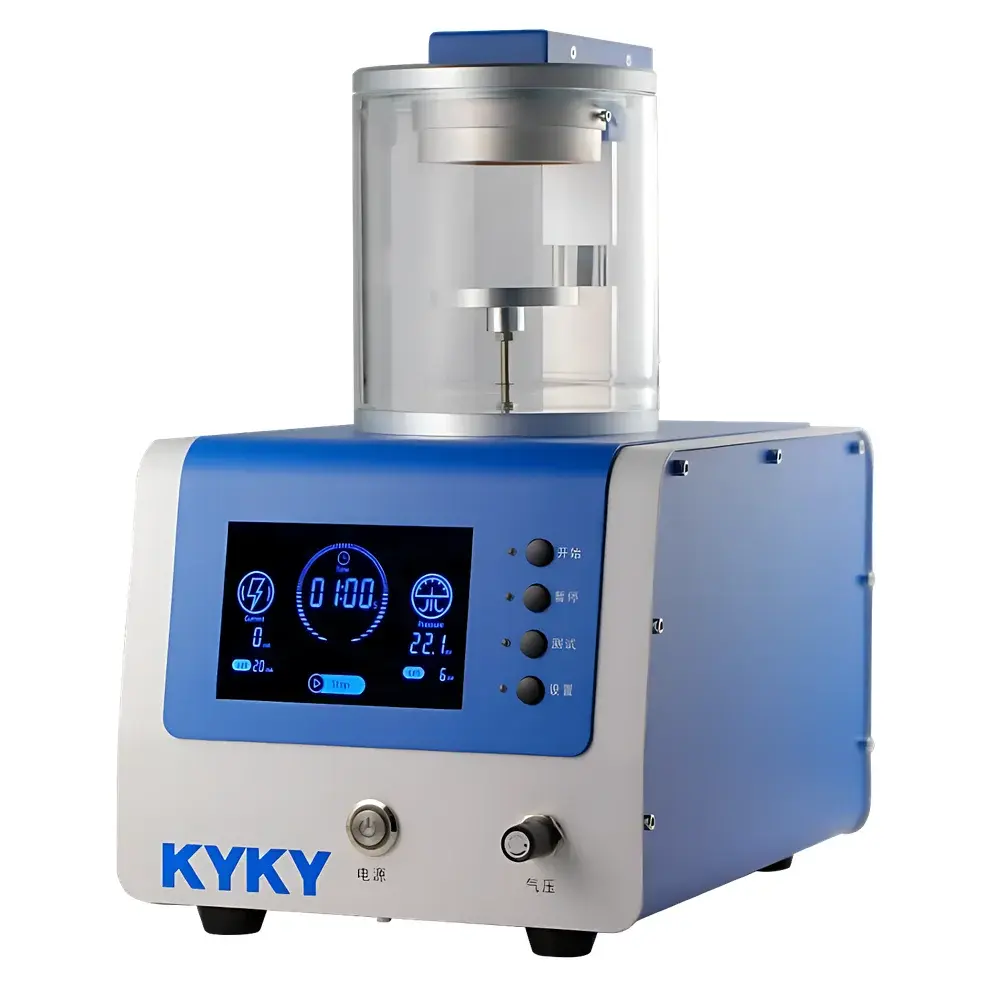
KYKY SBC-16 Desktop Magnetron Ion Sputter Coater
| Brand | KYKY |
|---|---|
| Origin | Beijing, China |
| Manufacturer Type | Direct Manufacturer |
| Country of Origin | China |
| Model | SBC-16 |
| Target Material (Standard) | Au (57 mm diameter × 0.1 mm thickness) |
| Optional Targets | Pt, Au/Pd, Pt/Pd |
| Control System | Microprocessor-based timer (1–999 s), automatic pump-down, sputtering, and venting sequence |
| Chamber Dimensions | Stainless steel, Ø120 mm × H75 mm |
| Viewport Dimensions | Ø120 mm × H45 mm |
| Sample Stage | Standard rotary stage (Ø40 mm), accommodates 4 standard SEM stubs |
| Sputtering Gas | Argon (recommended) or dry air |
| Operating Pressure Range | Atmospheric to 1×10⁻³ mbar |
| Ultimate Vacuum | ≤1×10⁻⁴ mbar |
| Pumping Speed | 133 L/min |
| Sputtering Current | 5–30 mA (digitally regulated, pressure-independent) |
| Acoustic Noise Level | ≤56 dB(A) |
Overview
The KYKY SBC-16 Desktop Magnetron Ion Sputter Coater is a compact, benchtop thin-film deposition system engineered for high-fidelity conductive coating of non-conductive specimens prior to scanning electron microscopy (SEM) analysis. It employs DC magnetron sputtering—a low-energy, cold-process physical vapor deposition (PVD) technique—where a plasma discharge is confined near the target surface by permanent magnets, enhancing ionization efficiency while minimizing thermal load on sensitive samples. Unlike thermal evaporation methods, magnetron sputtering delivers uniform, fine-grained metallic films with minimal grain growth and negligible substrate heating—critical for preserving delicate biological tissues, polymers, ceramics, and fractured surfaces. The SBC-16 integrates vacuum integrity, process repeatability, and operational safety into a single-unit architecture designed for routine laboratory use in materials science, life sciences, geology, and failure analysis labs.
Key Features
- DC magnetron sputtering source with permanent magnet array ensures stable plasma confinement and high target utilization efficiency
- Digitally regulated sputtering current (5–30 mA), independent of chamber pressure fluctuations, enabling consistent deposition rates across batch runs
- Microprocessor-controlled operation with programmable timer (1–999 s), automated pump-down, sputtering, and post-cycle venting sequences
- Stainless steel vacuum chamber (Ø120 mm × H75 mm) with large-diameter borosilicate viewport (Ø120 mm × H45 mm) for real-time process monitoring
- Standard rotary sample stage (Ø40 mm) supporting up to four 12.7 mm SEM stubs; optional motorized tilt-rotary stage (–90° to +90° tilt, 0–60 rpm continuous adjustment) for conformal coating of topographically complex specimens
- Dual mechanical interlocks prevent chamber opening during vacuum operation and ensure safe power cutoff during venting
- Integrated dual-stage vacuum system achieving ultimate pressure ≤1×10⁻⁴ mbar with pumping speed of 133 L/min
- Low-noise design (<56 dB[A]) suitable for shared laboratory environments without dedicated acoustic enclosures
Sample Compatibility & Compliance
The SBC-16 accommodates a broad range of non-conductive and beam-sensitive specimens, including biological sections, insulating polymers, oxide ceramics, geological thin sections, and forensic trace evidence. Its low-energy sputtering protocol avoids charging artifacts, edge rounding, and thermal degradation commonly observed with high-voltage or thermal coating methods. The system complies with ISO 14644-1 Class 8 cleanroom ambient requirements when operated under controlled lab conditions. All electrical and vacuum subsystems meet IEC 61010-1 safety standards for laboratory equipment. While not certified for GMP or FDA 21 CFR Part 11 compliance out-of-the-box, its digital control log, repeatable parameter sets, and hardware interlocks support audit-ready documentation when integrated into GLP-aligned workflows.
Software & Data Management
The SBC-16 operates via an embedded microprocessor controller with no external PC dependency. All process parameters—including sputtering time, current setpoint, and vacuum status—are displayed on a high-contrast LED interface. The controller retains last-used settings and supports manual override at any stage. For laboratories requiring electronic recordkeeping, the unit provides TTL-level output signals (via rear-panel DB9 connector) compatible with external data acquisition systems or LabVIEW-based logging platforms. Optional RS-232 or USB-to-serial adapters enable integration with LIMS or ELN systems where timestamped run logs, operator ID tagging, and parameter versioning are required for regulatory traceability.
Applications
- Routine gold or platinum coating of SEM specimens for high-resolution secondary electron imaging
- Preparation of TEM grid coatings for electron-transparent support films
- Deposition of conductive layers on FIB-SEM cross-sections to suppress charging during in-situ milling
- Thin-film calibration standards for EDS quantification and charge compensation studies
- Surface modification of insulating substrates prior to XPS or AES analysis
- Research-scale metallization of microfluidic devices and MEMS components
FAQ
What target materials are supported, and how is target replacement performed?
The SBC-16 ships with a standard 57 mm diameter × 0.1 mm thick Au target. Optional targets include Pt, Au/Pd (80/20), and Pt/Pd (80/20). Target replacement requires only two M3 screws and takes less than 90 seconds with no vacuum break needed—target holders are pre-aligned and secured via spring-loaded contacts.
Can the system operate with gases other than argon?
Yes—dry compressed air may be used for rapid, low-cost coating of robust samples; however, argon is strongly recommended for reproducible film morphology, reduced oxidation risk, and optimal sputter yield.
Is the tilt-rotary stage necessary for most applications?
For flat, planar specimens, the standard rotary stage suffices. The tilt-rotary option is essential when coating irregularly shaped samples (e.g., fracture surfaces, porous scaffolds, or mounted device packages) to achieve uniform coverage without shadowing effects.
How does the pressure-independent current regulation improve coating consistency?
Unlike analog current supplies, the SBC-16’s digital feedback loop continuously adjusts voltage to maintain constant current regardless of dynamic gas density changes during pump-down or sputtering—ensuring linear deposition kinetics and eliminating run-to-run variability caused by pressure drift.
What maintenance is required for long-term reliability?
Routine maintenance includes monthly O-ring inspection and silicone grease application, quarterly cleaning of the target surface and shield, and annual calibration of the Pirani gauge. No consumables beyond targets and vacuum pump oil are required.



