
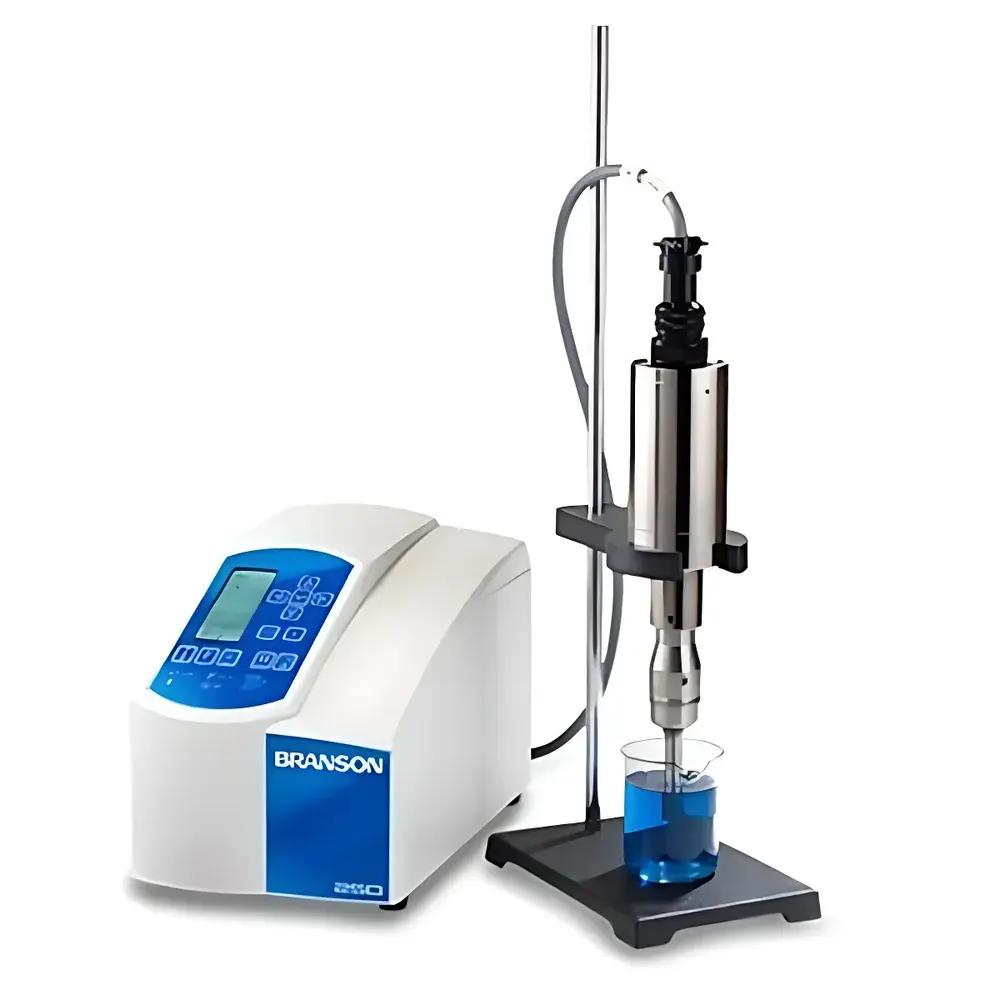
Branson SFX250 Ultrasonic Cell Disruptor
| Brand | Branson |
|---|---|
| Origin | USA |
| Model | SFX250 |
| Instrument Type | Ultrasonic Cell Disruptor |
| Operating Frequency | 40 kHz |
| Ultrasonic Output Power | 150 W |
| Temperature Range | 0–99 °C |
| Sample Volume Capacity | 1 mL (with 1/8" microtip) |
| Number of Samples Processed Simultaneously | 1 |
| Compliance | CE, UL Listed, RoHS Compliant |
Overview
The Branson SFX250 Ultrasonic Cell Disruptor is an engineered benchtop sonicator designed for reproducible, controlled lysis of biological cells and subcellular structures in research and quality control laboratories. It operates on the principle of high-intensity ultrasonic cavitation—where acoustic energy at 40 kHz generates transient microbubbles in liquid media that collapse violently, producing localized shear forces, microstreaming, and shockwaves. These physical effects disrupt cellular membranes, organelles, and inclusion bodies without significant thermal denaturation when operated under temperature-controlled conditions. Unlike continuous-wave homogenizers, the SFX250 delivers pulsed or continuous ultrasonic energy with precise duty cycle control, enabling optimization for sensitive biomolecules such as enzymes, nucleic acids, and membrane proteins. Its architecture integrates a solid-state generator, piezoelectric transducer, and interchangeable titanium alloy probes—ensuring mechanical stability, consistent energy delivery, and minimal metal leaching into samples.
Key Features
- Programmable operation with up to 10 user-defined protocols, each configurable for amplitude (10–100%), pulse duration (0.1–9.9 s), pause interval (0.1–9.9 s), and total treatment time (1 s–99 min 59 s)
- Digital temperature monitoring via integrated thermistor probe; real-time display and automatic power modulation to maintain setpoint within ±1 °C (0–99 °C range)
- Microtip compatibility: Standard 1/8″ (3.2 mm) titanium probe optimized for volumes from 200 µL to 10 mL; optional probes (1/4″, 1/2″) available for larger-volume processing
- Energy control mode enables consistent energy delivery (J/mL) independent of load impedance, improving inter-run reproducibility across sample batches
- Robust aluminum chassis with vibration-dampening feet; front-panel LCD with tactile keypad and status LED indicators for operational feedback
- Compliance-ready design: Supports audit trails via optional RS-232 or USB data logging; firmware supports timestamped event recording per ICH-GCP and FDA 21 CFR Part 11 requirements when paired with validated software
Sample Compatibility & Compliance
The SFX250 accommodates a broad spectrum of biological matrices—including mammalian cell suspensions, bacterial cultures (E. coli, Bacillus spp.), yeast, plant tissue homogenates, viral lysates, and spore preparations—without requiring chemical lysis reagents. Its low-volume microtip configuration minimizes cross-contamination risk and supports sterile technique when used with disposable probe sleeves. The instrument meets international safety and electromagnetic compatibility standards: UL 61010-1, CE marking per Directive 2014/30/EU (EMC) and 2014/35/EU (LVD), and RoHS 2011/65/EU. For regulated environments, it is routinely deployed in GLP-compliant labs performing USP sterility testing preparation, ISO 11137 bioburden reduction validation, and ASTM E2874-13 microbial disruption protocols.
Software & Data Management
While the SFX250 operates as a standalone unit, its digital interface supports external data acquisition via RS-232 or USB-to-serial adapters. When connected to validated PC-based software (e.g., Branson Sonics Suite v3.2+), users can export timestamped logs containing amplitude, actual power output (W), cumulative energy (J), temperature history, and fault codes. All exported files are saved in CSV format with MD5 checksums for integrity verification. Audit trail functionality includes operator ID entry, protocol version tracking, and electronic signature capture—enabling full traceability required under GMP Annex 11 and ISO/IEC 17025 accreditation frameworks.
Applications
- Preparative lysis for protein extraction and purification workflows (e.g., His-tagged recombinant protein isolation)
- Nucleic acid release from Gram-positive bacteria and fungal cells prior to qPCR or NGS library prep
- Disruption of inclusion bodies followed by solubilization and refolding studies
- Emulsification of lipid nanoparticles (LNPs) and nanoemulsions for drug delivery formulation development
- Accelerated solvent extraction of phytochemicals from botanical matrices (e.g., curcuminoids, polyphenols)
- Cleaning and decontamination of microfluidic channels and capillary electrophoresis tubing
FAQ
What is the maximum recommended sample volume for the standard 1/8″ probe?
The 1/8″ microtip is validated for optimal cavitation efficiency between 200 µL and 10 mL. Volumes below 200 µL risk probe overheating and inconsistent energy coupling.
Can the SFX250 be used in a cold room or refrigerated environment?
Yes—the unit is rated for ambient operation between 10–35 °C and relative humidity ≤80% non-condensing. External cooling baths or dry ice jackets may be used with appropriate probe insulation.
Is calibration required before first use or after probe replacement?
No factory calibration is needed; however, users must perform amplitude verification using a calibrated hydrophone or calorimetric method per ASTM E1779-20 annually or after major maintenance.
Does the SFX250 support remote start/stop via TTL or analog signal input?
No—remote triggering is not natively supported. Integration with automated liquid handlers requires external relay control of the footswitch input.
How often should the titanium probe tip be inspected for erosion or pitting?
Visual inspection is recommended before each use. Tip replacement is advised after ~200 hours of cumulative operation or upon visible surface degradation, as eroded tips reduce cavitation efficiency and increase sample heating.






