
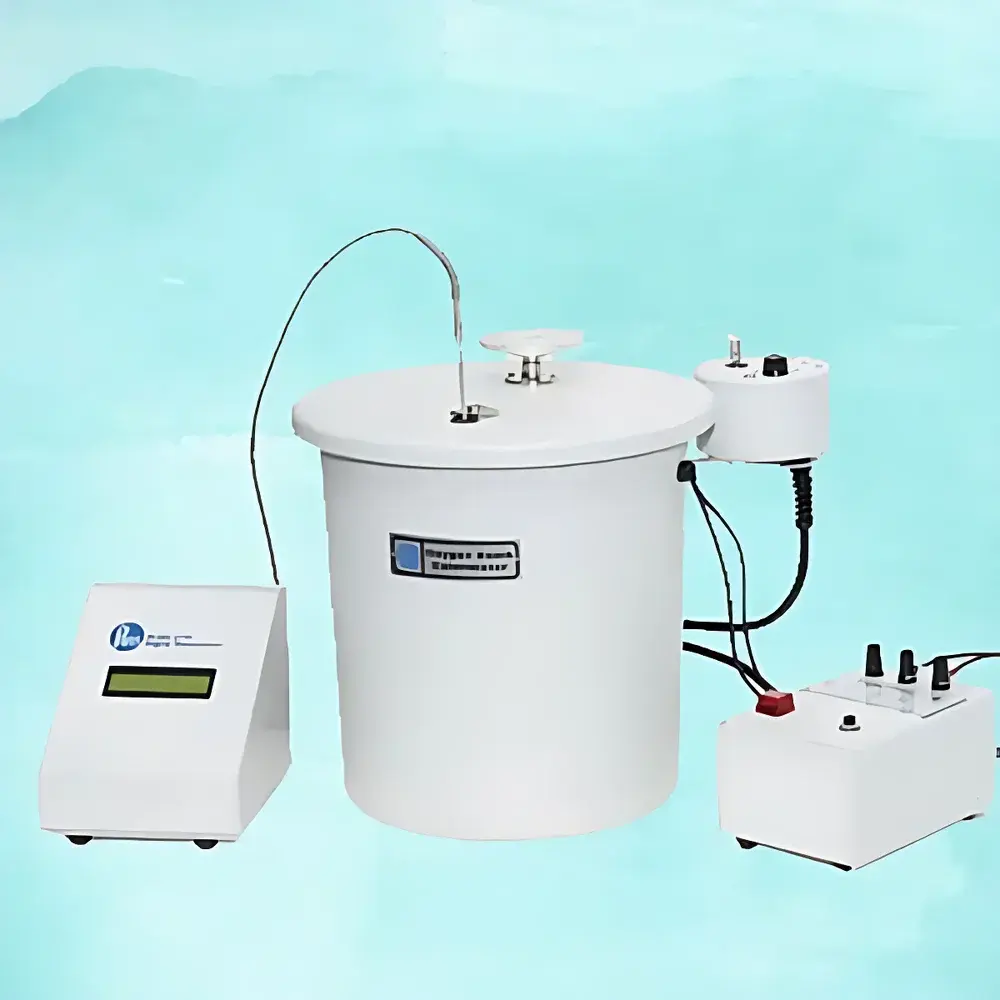
Parr 1341 Educational Bomb Calorimeter
| Brand | Parr Instruments |
|---|---|
| Origin | USA |
| Instrument Type | Oxygen Bomb Calorimeter |
| Measurement Mode | Isoperibol Calorimetry |
| Automation Level | Semi-Automatic |
| Temperature Resolution | 0.001 °C |
| Relative Standard Deviation | ≤0.3% |
| Bomb Types | 1108P (Alloy 20), 1108PCL (Hastelloy G-30), 1104 (High-Pressure Bomb) |
| Bomb Sealing | Threaded Cap Closure |
| Sample Throughput | 2–3 Determinations per Hour |
| Bomb Design | Removable Vessel Assembly |
| Compliance | ASTM D240, ASTM D4809, ISO 1928, EN 14918, GB/T 213 |
Overview
The Parr 1341 Educational Bomb Calorimeter is a rigorously engineered isoperibol oxygen bomb calorimeter designed specifically for undergraduate and graduate-level physical chemistry, fuel science, and materials thermodynamics laboratories. It operates on the fundamental principle of constant-temperature jacket calorimetry: a precisely weighed combustible sample is sealed in a high-pressure oxygen environment within a robust stainless-steel or alloy bomb, ignited electrically, and the resulting temperature rise in a thermally stabilized water bath is measured with high-resolution thermistors. The heat of combustion is calculated using the calibrated heat capacity of the system—comprising the bomb, water, and surrounding jacket—under strictly controlled ambient conditions. Unlike adiabatic or static-jacket designs requiring complex thermal compensation algorithms, the 1341 employs a passive isoperibol configuration with a fixed-temperature outer jacket, delivering exceptional repeatability and pedagogical transparency without compromising metrological integrity. Its mechanical simplicity—featuring manually loaded, threaded-cap sealed bombs and gravity-fed water circulation—ensures students directly observe and engage with core thermodynamic concepts: energy conservation, calibration via benzoic acid standards, and correction for ignition wire, nitric acid formation, and sulfur contributions.
Key Features
- Modular, removable bomb assembly with standardized 1108P (Alloy 20), 1108PCL (Hastelloy G-30), and 1104 (high-pressure) configurations—enabling safe analysis of diverse fuels including coal, biomass pellets, liquid hydrocarbons, and synthetic polymers.
- High-stability isoperibol jacket maintained at constant ambient temperature via air-circulating enclosure—eliminating active refrigeration and reducing operational complexity while preserving ±0.001 °C temperature resolution.
- Integrated digital thermometer with NIST-traceable calibration and real-time data logging capability—supporting manual or PC-linked acquisition of temperature vs. time profiles during combustion events.
- Robust mechanical design optimized for classroom durability: all major components—including stirrer motor, ignition circuit, and water bath—feature accessible service points and tool-free disassembly for maintenance and student demonstration.
- Compliance-ready architecture: full traceability of calibration constants, documented uncertainty budgets, and audit-ready procedural logs align with GLP principles and support integration into laboratory quality management systems.
Sample Compatibility & Compliance
The Parr 1341 accommodates solid, liquid, and slurry samples up to 1.2 g mass in standard crucibles, with optional high-energy ignition wires and capsule holders for low-volatility or heterogeneous matrices. It meets the essential performance criteria of ASTM D240 (heat of combustion of liquid hydrocarbon fuels), ASTM D4809 (determination of gross calorific value of liquid fuels by bomb calorimetry), ISO 1928 (solid mineral fuels), EN 14918 (biomass solid fuels), and GB/T 213 (Chinese national standard for coal). All bomb vessels are ASME BPVC Section VIII Division 1 certified and pressure-tested to 400 bar, with Alloy 20 and Hastelloy G-30 variants providing corrosion resistance against halogenated and sulfur-rich combustion products. Routine verification includes benzoic acid calibration (NIST SRM 39j) and replicate analysis to confirm ≤0.3% relative standard deviation across ≥5 consecutive runs.
Software & Data Management
While the base 1341 operates in semi-automatic mode with analog/digital instrumentation, it supports optional USB-enabled data acquisition modules compatible with Windows-based software (e.g., Parr’s CalWin v5.x). This software enables automated temperature curve fitting using the Regnault-Pfaundler method, real-time correction for heat exchange with the surroundings, and generation of ASTM-compliant reports—including gross calorific value (GCV), net calorific value (NCV), and moisture- and ash-corrected results. Audit trails record operator ID, calibration date, sample ID, and raw thermistor voltage outputs, satisfying requirements for FDA 21 CFR Part 11–aligned environments where electronic records are subject to review.
Applications
- Determination of higher heating value (HHV) and lower heating value (LHV) of fossil fuels, biofuels, and waste-derived fuels per international regulatory frameworks.
- Thermodynamic characterization of energetic materials, pharmaceutical excipients, and polymer additives in research and quality control settings.
- Teaching laboratories focused on first-law thermodynamics, calorimetric calibration protocols, and uncertainty propagation in physical measurements.
- Validation of alternative fuel formulations under ASTM D7566 Annexes and ISO/IEC 17025-accredited testing workflows.
FAQ
What distinguishes the 1341 from Parr’s research-grade calorimeters (e.g., Model 6400)?
The 1341 prioritizes instructional clarity and mechanical accessibility over ultra-high automation; it lacks integrated oxygen filling stations, automatic bomb handling, or dual-temperature jacket control—but retains identical bomb metallurgy, calibration methodology, and metrological traceability.
Can the 1341 be upgraded to full automation?
Yes—via retrofit with the Parr 1341-Auto accessory kit, which adds programmable stirrer control, timed ignition sequencing, and digital pressure monitoring, enabling unattended operation while preserving educational visibility.
Is training and method documentation included?
Each unit ships with the Parr Instruction Manual (P/N 1341-MAN), ASTM/ISO application notes, and a validated SOP template compliant with ISO/IEC 17025 clause 7.2.2 for method validation.



