
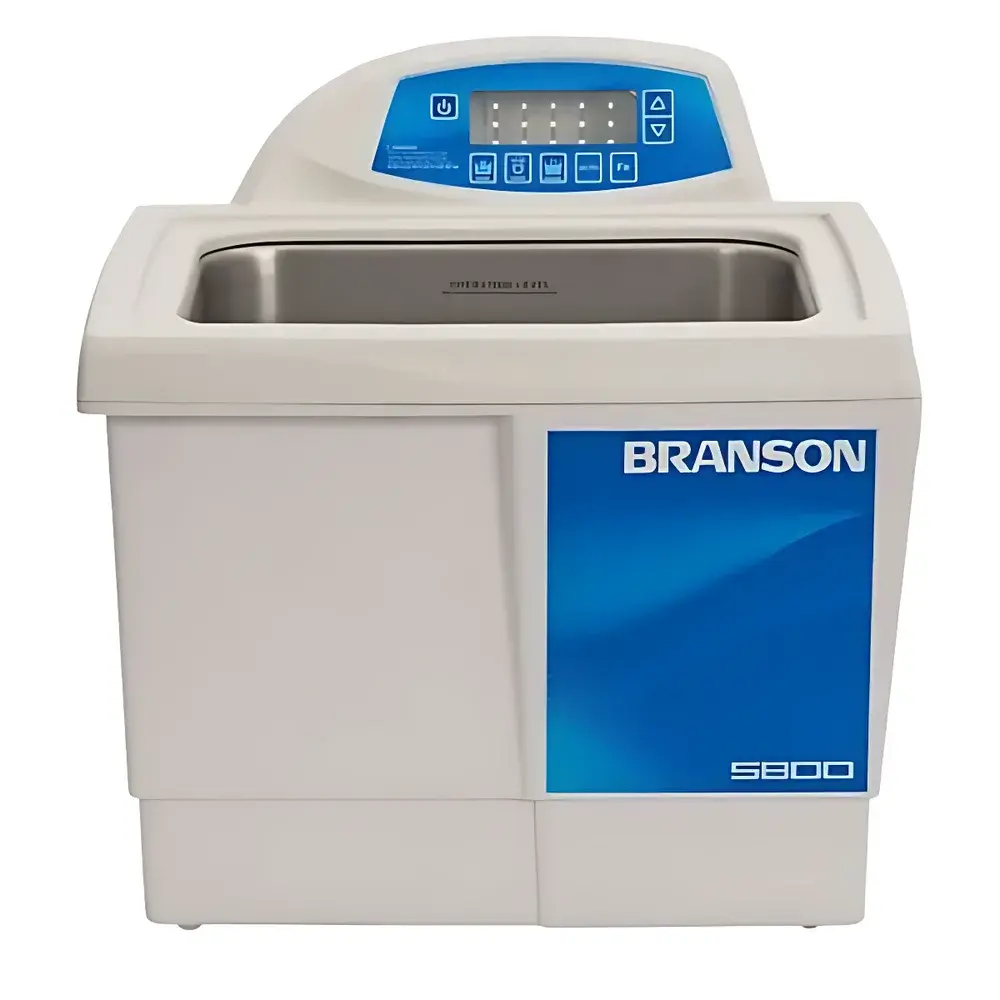
Branson CPX5800-C Ultrasonic Cleaner
| Brand | Branson |
|---|---|
| Origin | USA |
| Model | CPX5800-C |
| Tank Capacity | 9.5 L |
| Ultrasonic Frequency | 40 kHz |
| Ultrasonic Power Output | 180 W |
| Adjustable Power | Yes |
| Adjustable Temperature | Yes (0–69 °C) |
| Adjustable Timer | Yes (1–99 min) |
| Sound-Dampening Lid | Yes |
| Manual Fill/Drain | Yes |
| Construction Material | Polypropylene (PP) |
| Heating Power | 500 W |
| Total Power Consumption | 880 W |
| Input Voltage | 220 V, 50/60 Hz |
| Dimensions (W×D×H) | 492 × 292 × 152 mm |
Overview
The Branson CPX5800-C Ultrasonic Cleaner is a precision-engineered, general-purpose laboratory ultrasonic cleaning system designed for reproducible, non-destructive removal of particulate, organic, and oily contaminants from delicate and complex-surface components. It operates on the principle of high-frequency acoustic cavitation: at 40 kHz, piezoelectric transducers generate controlled pressure waves in the cleaning bath, inducing transient microbubble formation and collapse (cavitation) that mechanically dislodge contaminants from surfaces—including blind holes, crevices, and microstructures—without mechanical abrasion or thermal degradation. Engineered for routine use in regulated environments, the CPX5800-C meets foundational requirements for cleaning validation protocols in analytical laboratories, medical device reprocessing support, and QC/QA workflows where trace residue control is critical.
Key Features
- Digital microprocessor control with dual-display interface showing real-time bath temperature and setpoint, enabling precise thermal management during cleaning cycles.
- Polypropylene (PP) tank construction ensures chemical resistance to common aqueous detergents, mild acids, and alkaline solutions—compatible with ISO 15883-1 validated cleaning chemistries.
- Langevin-type transducer assembly with metal-ceramic composite elements mounted via adhesive bonding to the tank bottom—optimized for long-term mechanical stability and consistent energy transfer.
- Sweep-frequency operation minimizes standing wave formation and hot spots, ensuring uniform cavitation distribution across the full 9.5 L working volume.
- Vertically oriented internal PCB layout with conformal coating provides enhanced protection against condensation and incidental liquid ingress.
- Ergonomic control panel positioned above the tank rim prevents exposure to splashes and vapors; tactile, rubberized power switch enhances operator safety.
- Integrated sound-dampening lid functions as both acoustic barrier and removable drip tray; equipped with manual drain valve for rapid bath exchange without disassembly.
- Calibrated water-level indicator ensures optimal coupling between transducers and liquid medium—critical for maintaining peak cavitation efficiency per ASTM E1755-00 guidelines.
Sample Compatibility & Compliance
The CPX5800-C accommodates a broad range of sample geometries and materials, including stainless steel surgical instruments, glassware (vials, cuvettes, chromatography columns), optical components (lenses, prisms), printed circuit boards, dental tools, and jewelry substrates. Its 40 kHz frequency balances penetration depth and surface shear force—ideal for moderate-soil loads on non-porous or lightly porous substrates. While not certified as a standalone sterilizer, it supports pre-sterilization cleaning steps aligned with AAMI ST79:2017 and ISO 17664-1 requirements. The unit complies with IEC 61000-6-3 (EMC emissions) and IEC 61010-1 (safety for laboratory equipment). Optional accessories—including mesh baskets, beaker holders, and degassing trays—enable configuration for GLP/GMP-aligned documentation and traceability.
Software & Data Management
The CPX5800-C operates via embedded firmware without external PC dependency. All operational parameters—including time, temperature, and power level—are stored in non-volatile memory and recalled upon power-up. While it does not feature network connectivity or audit trail functionality, its deterministic timer and calibrated heating system support manual recordkeeping compliant with FDA 21 CFR Part 11 Annex 11 principles when used within documented SOPs. For laboratories requiring electronic data capture, integration with external environmental monitoring systems (via optional analog output modules) is feasible through third-party OEM interfaces.
Applications
- Pre-analytical sample preparation: cleaning HPLC vials, autosampler needles, and syringe filters to prevent carryover contamination.
- Microelectronics: removal of flux residues and particulates from SMT components prior to AOI inspection.
- Dental & orthopedic labs: decontamination of impression trays, burs, and casting flasks before autoclaving.
- Research microscopy: restoration of objective lenses and stage clips without solvent-induced coating damage.
- Pharmaceutical manufacturing support: cleaning of tablet punches, capsule fillers, and contact parts per USP cleaning validation guidance.
- Academic teaching labs: standardized instruction in physical cleaning mechanisms, cavitation physics, and parameter optimization.
FAQ
What is the recommended cleaning solution for use with the CPX5800-C?
Aqueous alkaline or neutral pH detergents compatible with polypropylene are preferred. Avoid halogenated solvents, strong oxidizers, or undiluted acids unless verified for material compatibility.
Can the CPX5800-C be used for degassing solvents?
Yes—its sweep-frequency mode and stable temperature control support effective degassing of HPLC-grade mobile phases when operated at low power (30–50%) and ambient temperature for 5–10 minutes.
Is the tank volume specified as usable or gross capacity?
The 9.5 L rating reflects the maximum recommended working volume at the marked fill line—not the total internal cavity volume (20.81 L)—to ensure optimal transduction efficiency and thermal uniformity.
Does this model meet CE or UKCA marking requirements?
As an imported unit intended for integration into end-user systems, it carries UL/cULus certification per ANSI/UL 61010-1 and complies with applicable EMC directives; formal CE/UKCA marking requires local conformity assessment by the importing distributor.
How often should the transducers be serviced or recalibrated?
No scheduled recalibration is required. Transducer performance is verified during factory acceptance testing (FAT); periodic verification of cavitation intensity using aluminum foil test per ASTM E2810 may be conducted annually in GxP settings.



