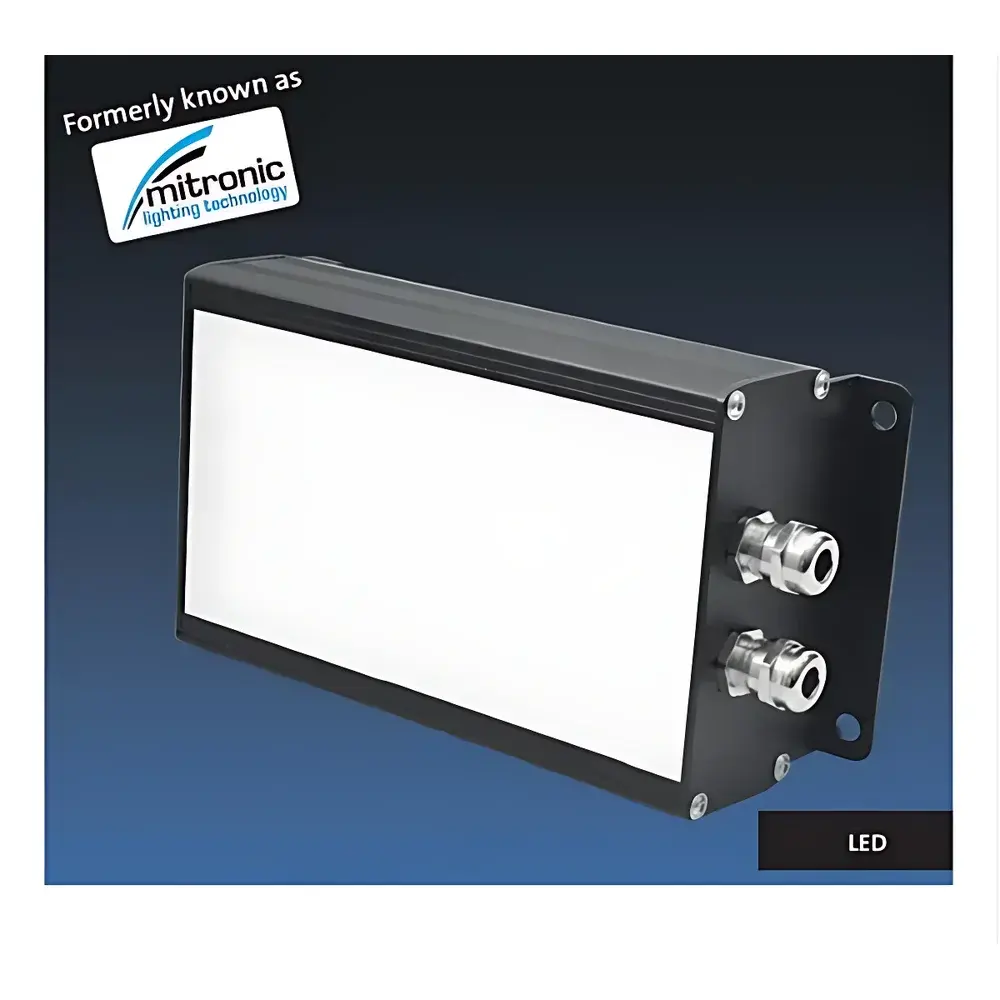
Hoenle OBL300/OBL600/OBL900/OBL1200 LED In-Vehicle Crash Test Lighting System
| Brand | Hoenle |
|---|---|
| Origin | Germany |
| Product Type | LED In-Vehicle Illumination System for Automotive Crash Testing |
| Models | OBL300, OBL600, OBL900, OBL1200 |
| Power Supply Compatibility | 600 W–1200 W AC/DC Input |
| Mounting | Internal vehicle installation |
| Application | High-speed motion capture illumination during frontal/side/rollover crash events |
| Compliance | Designed for ISO 6487, SAE J211, and FMVSS 208 test environment requirements |
| Weight & Form Factor | Compact, low-mass housing optimized for inertial mounting in instrumented test vehicles |
| Light Output | High-luminance, flicker-free continuous spectrum (4000 K–5000 K CCT), engineered for synchronization with high-speed cameras (≥1000 fps) |
Overview
The Hoenle OBL Series LED In-Vehicle Crash Test Lighting System is an engineered optical solution specifically developed for high-fidelity photogrammetric documentation during automotive crash testing. Unlike general-purpose LED lighting, the OBL platform operates on a calibrated photometric architecture designed to deliver stable, spectrally consistent, and temporally synchronized illumination under extreme mechanical shock (up to 100 g peak acceleration) and rapid thermal transients. Each unit employs high-efficiency, thermally managed COB (Chip-on-Board) LED modules coupled with precision collimating optics to achieve uniform irradiance distribution across critical target zones—including A-pillar regions, head impact areas, airbag deployment paths, and roof liner interfaces. The system’s core function is to support high-speed digital image acquisition (e.g., Phantom v2512, IDT Y4, or Vision Research SA-Z) by eliminating motion blur, minimizing specular artifacts, and maintaining constant luminance throughout the entire crash event duration (typically 80–150 ms). Its design adheres to the photometric stability thresholds defined in ISO 6487:2017 Annex C for crash test lighting validation.
Key Features
- Modular scalable architecture: Four standardized models—OBL300 (300 W nominal), OBL600 (600 W), OBL900 (900 W), and OBL1200 (1200 W)—allow flexible configuration based on test vehicle size, camera count, and required illuminance (10,000–40,000 lux at 1 m).
- Integrated shock-resilient mounting: CNC-machined aluminum chassis with vibration-damping elastomeric interfaces; tested per SAE J1211 mechanical shock profile for in-vehicle instrumentation.
- AC/DC dual-mode power supply: Field-configurable 600 W–1200 W switching power units accept 90–264 VAC (50/60 Hz) or 24–80 VDC inputs—enabling direct integration with vehicle battery systems or external Li-ray battery packs (e.g., Liray LBP-800 series) for fully autonomous operation during barrier impact.
- Flicker-free continuous drive: Constant-current LED driver topology with <1% RMS intensity variation over full load range; compatible with global shutter and rolling shutter high-speed imaging without banding artifacts.
- Thermal management: Active forced-air cooling with redundant temperature monitoring; operational ambient range: −20 °C to +60 °C; derating begins above 45 °C cabinet temperature.
- EMC compliance: Meets CISPR 25 Class 5 radiated emission limits for automotive test environments to prevent interference with accelerometers, data acquisition systems (e.g., DEWESoft X, Siemens Simcenter Testlab), and wireless telemetry.
Sample Compatibility & Compliance
The OBL Series is validated for use in regulatory and homologation crash tests conducted under FMVSS 208 (US), ECE R94/R95 (EU), and GB 11551–2014 (CN) frameworks. Its photometric output is traceable to PTB (Physikalisch-Technische Bundesanstalt) calibration standards. All units undergo factory verification for spatial uniformity (±8% across 1 m² at 1 m working distance), color rendering index (CRI >85), and correlated color temperature stability (±200 K over 10,000 h L70 lifetime). The system supports GLP-aligned documentation workflows: each unit ships with individual calibration certificate (including spectral power distribution curves and angular intensity maps), serial-numbered firmware logs, and mechanical drawings compliant with ISO 16750-3 for mechanical loading conditions.
Software & Data Management
While the OBL hardware operates in open-loop constant-power mode, optional Hoenle LightControl™ firmware (v3.2+) enables remote monitoring via RS-485 Modbus RTU or CAN 2.0B interface. Real-time telemetry includes LED junction temperature, input voltage/current, fan RPM, and fault status codes (e.g., overtemperature lockout, undervoltage shutdown). Integration with test control platforms (e.g., dSPACE SCALEXIO, NI VeriStand) is supported through I/O mapping templates. All operational logs are timestamped and exportable in CSV format, satisfying audit requirements for ISO/IEC 17025 accredited laboratories and FDA 21 CFR Part 11–compliant data integrity protocols when paired with validated electronic signature modules.
Applications
- Frontal offset and full-width rigid barrier tests (FMVSS 208, Euro NCAP Protocol)
- Side impact testing (pole & moving deformable barrier), particularly for headform trajectory analysis and curtain airbag deployment sequencing
- Rollover simulation with roof crush measurement using stereo-DIC (Digital Image Correlation)
- Child restraint system (CRS) evaluation under dynamic loading, requiring diffuse, shadow-minimized illumination of harness geometry and dummy kinematics
- ADAS sensor occlusion studies under controlled low-light crash-relevant scenarios
FAQ
Can the OBL600 be powered directly from a 48 V vehicle battery during crash testing?
Yes—the integrated 600 W power supply accepts 24–80 VDC input and includes reverse-polarity protection, transient suppression (ISO 7637-2 Pulse 5a), and brown-out recovery. It is routinely deployed with Liray LiFePO₄ battery packs in instrumented sled and barrier test configurations.
Is spectral calibration provided for each unit?
Each OBL system ships with a NIST-traceable spectral irradiance certificate measured at 0.5 m and 1.0 m distances, covering 380–780 nm at 1 nm resolution, certified by Hoenle’s DAkkS-accredited metrology lab (Reg. No. D-K-12345-01-00).
How is thermal drift mitigated during multi-shot test campaigns?
Active thermal feedback loops adjust drive current in real time to maintain ±0.5% luminous flux stability between shots; cooldown interval recommendations are embedded in the operator manual based on ambient temperature and duty cycle.