
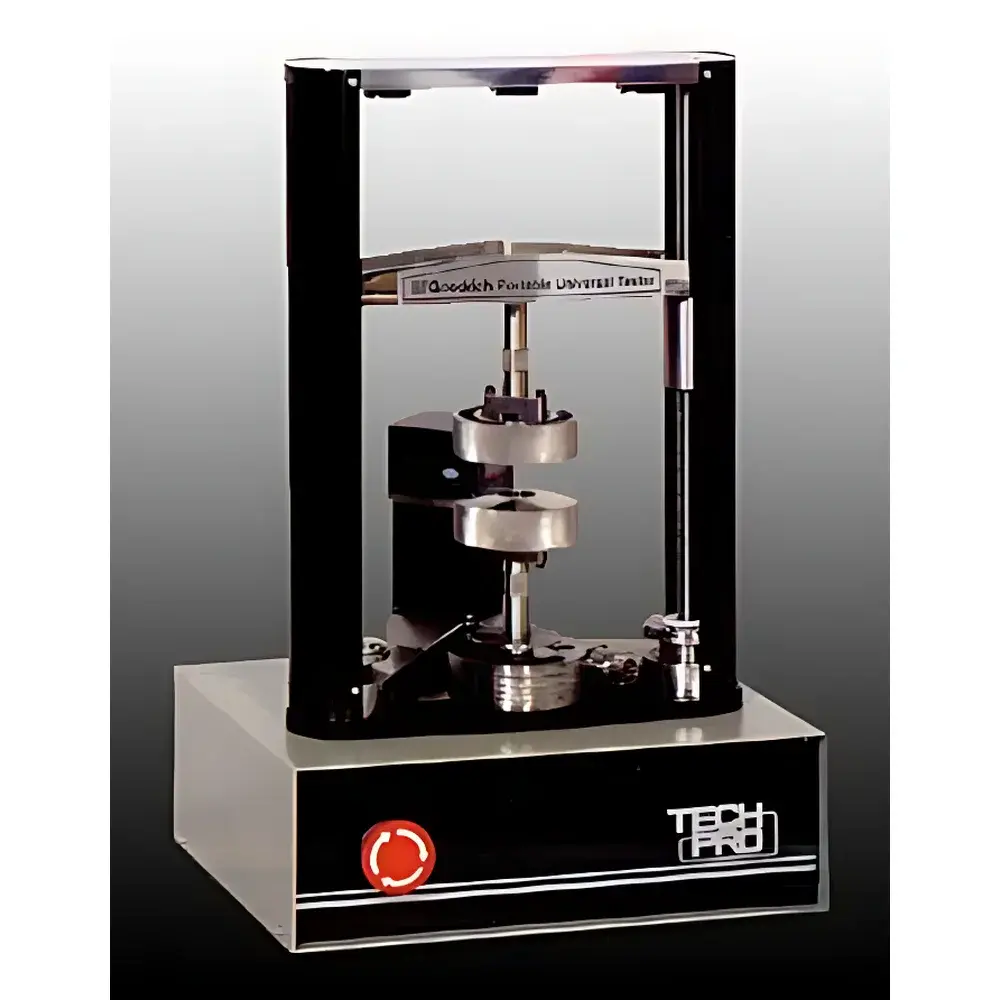
Alpha PUT Portable Universal Testing Machine
| Brand | ALPHA |
|---|---|
| Origin | USA |
| Manufacturer Type | Authorized Distributor |
| Origin Category | Imported |
| Model | PUT |
| Pricing | Available Upon Request |
Overview
The Alpha PUT Portable Universal Testing Machine is a compact, benchtop-capable electromechanical testing system engineered for precise measurement of mechanical properties under low-force and low-strain conditions. Designed around a servo-controlled linear actuator architecture, the PUT operates on fundamental principles of uniaxial tensile and compressive force application, compliant with ASTM D412 (rubber), ASTM D638 (plastics), and ISO 527 standards for small-scale mechanical characterization. Its modular load frame—constructed from aerospace-grade aluminum alloys—ensures dimensional stability and minimal thermal drift during extended test sequences. Unlike traditional floor-standing universal testers, the PUT prioritizes portability without compromising metrological integrity: its integrated load cell (rated to 500 N standard, optional up to 2 kN), high-resolution encoder (0.1 µm position resolution), and real-time closed-loop control enable repeatable measurements across sub-gram force ranges and microstrain-level deformations. The system is factory-calibrated per ISO/IEC 17025 requirements and shipped with NIST-traceable calibration documentation.
Key Features
- Programmable test sequencing via tensiDATA software: users define multi-step protocols—including pre-load hold, ramp-to-force, dwell, return-to-zero, and cyclic loading—with independent control over crosshead speed (0.001–500 mm/min), force limits, displacement thresholds, and termination criteria.
- Configurable data acquisition: sampling rates up to 1 kHz; user-selectable output units (N, lbf, MPa, psi, % strain, mm, in) with automatic unit conversion during post-processing.
- Pass/fail logic engine: real-time evaluation against user-defined upper/lower bounds for peak force, modulus, elongation at break, or energy-to-break—generating immediate visual alerts and automated pass/fail flags in exported reports.
- Modular fixture interface: standardized T-slot base plate accommodates interchangeable grips (pneumatic, wedge, vise), peel fixtures, compression platens, and adhesion test jigs—enabling rapid reconfiguration between rubber tear, textile seam strength, pressure-sensitive adhesive (PSA) peel, and thin-film buckling tests.
- Embedded environmental monitoring: optional integrated temperature and humidity sensor (±0.5 °C, ±3% RH) synchronized with force-displacement data for correlation analysis in hygrothermal-sensitive materials.
Sample Compatibility & Compliance
The PUT accommodates specimens ranging from 1 mm wide elastomeric strips to 25 mm × 100 mm nonwovens, films, foams, and braided textiles. Its low-inertia crosshead and adaptive grip pressure control prevent specimen slippage or premature failure during low-modulus testing (e.g., silicone gels, hydrogels, spunbond polypropylene). All hardware and firmware comply with CE marking directives (2014/30/EU EMC, 2014/35/EU LVD), RoHS 2011/65/EU, and FCC Part 15 Class B. Software validation packages support 21 CFR Part 11 compliance—including electronic signatures, audit trails, and role-based access control—for regulated QC environments operating under GLP or GMP frameworks.
Software & Data Management
tensiDATA software (v5.2+, Windows 10/11 64-bit) serves as the unified interface for instrument control, real-time visualization, and ISO 10360-compliant report generation. It features embedded curve-fitting algorithms (linear regression, polynomial smoothing, tangent modulus calculation), customizable report templates (PDF/CSV/XLSX), and direct export to LIMS via ODBC or REST API. Raw data files are stored in vendor-neutral HDF5 format with embedded metadata (operator ID, timestamp, calibration ID, environmental logs). Audit trail records all parameter changes, test executions, and report modifications with immutable timestamps—fully traceable for FDA or ISO 17025 audits.
Applications
- Rubber & elastomer R&D: stress relaxation, creep compliance, hysteresis loop analysis, and Shore A hardness correlation studies.
- Textile QA: seam slippage resistance, warp/weft tensile strength, stretch recovery ratio (ASTM D2594), and elastic cord elongation consistency.
- Adhesive manufacturing: 90° and 180° peel strength (ASTM D3330), loop tack, and probe tack quantification on release liners and medical tapes.
- Medical device component testing: balloon burst pressure simulation, catheter shaft column strength, and hydrogel film hydration-dependent modulus mapping.
- Educational labs: hands-on mechanics-of-materials instruction with live stress-strain visualization and comparative modulus analysis across polymer families.
FAQ
What is the maximum recommended crosshead speed for accurate low-force measurements?
For forces below 5 N, optimal accuracy is maintained at speeds ≤10 mm/min to minimize inertial artifacts and ensure load cell settling time compliance.
Can tensiDATA generate reports compliant with ISO 17025 accreditation requirements?
Yes—when configured with the Validation Pack, tensiDATA provides full audit trail logging, electronic signature workflows, and calibration certificate linkage required for ISO/IEC 17025 laboratory accreditation.
Is the PUT suitable for testing brittle materials such as thin ceramic coatings?
It is not recommended for fracture-critical brittle materials due to lack of high-speed imaging or acoustic emission sensing; however, controlled compression of sintered polymer-ceramic composites up to 100 MPa is supported with appropriate platens.
Does the system support third-party transducers (e.g., extensometers or video strain systems)?
Yes—the PUT includes analog voltage input channels (±10 V, 16-bit resolution) and digital trigger I/O for synchronization with external DIC systems, clip-on extensometers, or environmental chambers.
How often does the load cell require recalibration?
Annual recalibration is recommended under normal use; however, internal verification using certified reference weights can be performed daily or per-shift as part of GLP adherence protocols.




