
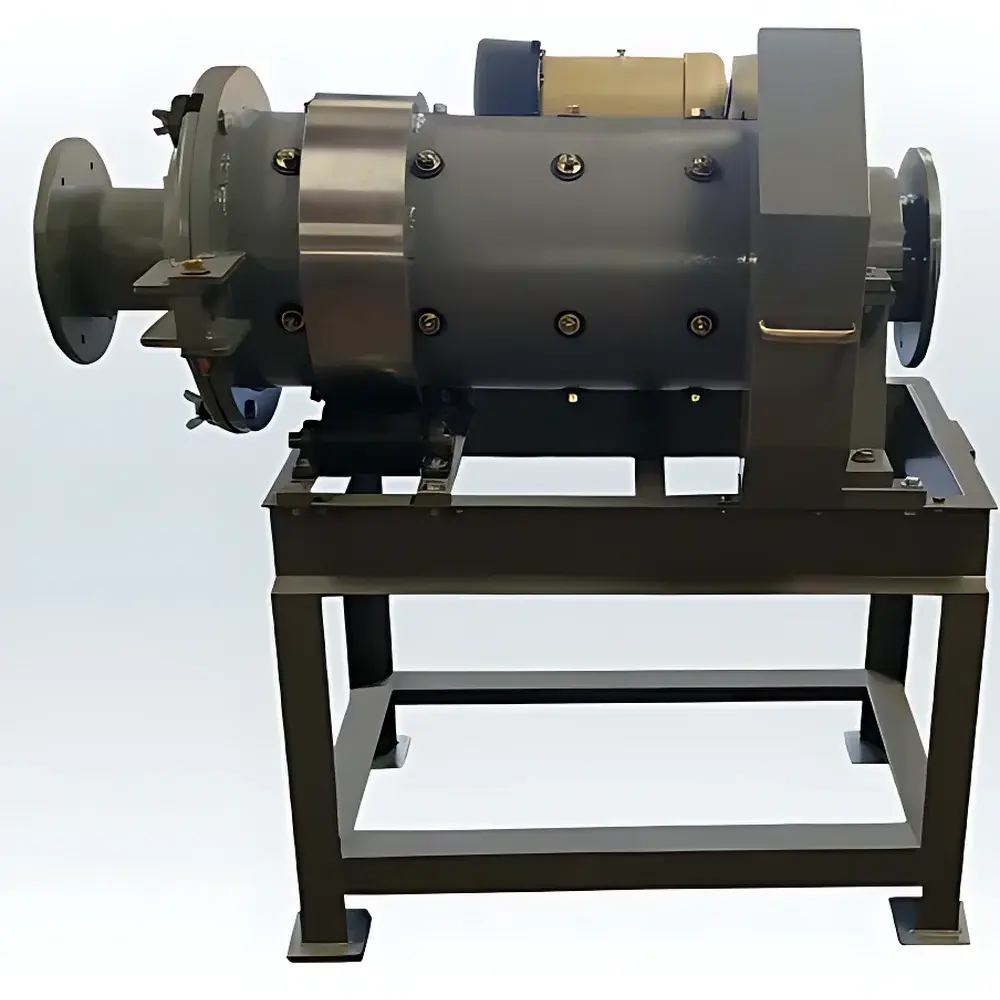
Sepor 010E-306 Continuous Rod and Ball Mill
| Origin | USA |
|---|---|
| Manufacturer Type | Authorized Distributor |
| Origin Category | Imported |
| Model | 010E-306 |
| Pricing | Upon Request |
| Voltage/Frequency | 230–460 V / 3-phase / 50–60 Hz |
| Dimensions (L × W × H) | 16 in × 32 in (drum internal) |
| Operating Capacity | 100 lb (45.4 kg) |
| Shipping Weight | 3,000 lb (1,361 kg) |
| Liner Material | Vulcanized Rubber |
| Drive System | Fully Machined Gear-Driven Assembly |
| Discharge Configuration | Patented Hinged Flange Design |
| Rollers | Precision-Machined Steel Rolls with Delrin Sleeves |
Overview
The Sepor 010E-306 Continuous Rod and Ball Mill is a laboratory- to pilot-scale grinding system engineered for reproducible, scalable comminution of hard and abrasive ores under controlled wet or dry conditions. Based on the principles of tumbling mill dynamics—where rotational energy induces cascading and cataracting motion of grinding media (steel rods or balls) within a rotating cylindrical chamber—the unit enables precise control over residence time, throughput rate, and particle size distribution. Designed for continuous operation in closed-circuit configurations with spiral classifiers, hydrocyclones, or vibrating screens, it supports systematic process development aligned with industrial-scale SAG/ball mill circuit design criteria. Its 16-inch diameter × 32-inch length grinding chamber accommodates up to 100 lb (45.4 kg) of feed material, delivering consistent performance across metallurgical testwork, mineral liberation studies, and pre-feasibility grinding optimization.
Key Features
- Vulcanized rubber mill liners providing superior abrasion resistance, extended service life, and reduced operational noise compared to manganese steel alternatives.
- Fully machined, cast-free structural components—including shell, trunnions, and drive housing—ensuring dimensional stability, torsional rigidity, and long-term alignment integrity under cyclic loading.
- Sepor’s proprietary hinged discharge flange assembly allows rapid access to the grinding chamber for liner inspection, media replenishment, or thorough cleaning without disassembling support structures.
- High-precision roller support system featuring ground-steel shafts and self-lubricating Delrin polymer sleeves, minimizing frictional losses and eliminating the need for routine grease maintenance.
- Variable-speed three-phase motor drive (230–460 V, 50–60 Hz) compatible with industrial variable-frequency drives (VFDs), enabling optimization of critical speed (typically 65–75% of theoretical critical speed) for specific ore hardness and desired P80.
- Modular foundation interface permitting integration into existing pilot plant skids or custom-engineered process loops with gravity-fed or pump-assisted slurry transfer.
Sample Compatibility & Compliance
The 010E-306 accommodates a broad range of feed materials including sulfide and oxide ores, industrial minerals (e.g., quartz, feldspar), refractory gold concentrates, and construction aggregates. It supports both autogenous and semi-autogenous grinding protocols when operated with appropriate rod-to-ball charge ratios and pulp densities. The unit complies with ANSI/ISA-12.12.01 for non-incendive electrical equipment in Class I, Division 2 hazardous locations when specified with appropriate motor enclosures. All mechanical interfaces meet ASME B16.5 flange standards, and structural welds conform to AWS D1.1 requirements. Documentation packages include CE-conformity declarations (for export configurations), RoHS-compliant material certifications, and traceable mill liner compound data sheets per ASTM D2000 elastomer classification.
Software & Data Management
While the base 010E-306 operates as a stand-alone mechanical system, it is fully compatible with third-party process monitoring platforms via analog 4–20 mA outputs (optional) for motor current, bearing temperature, and feed rate transducers. When integrated into automated pilot circuits, it interfaces seamlessly with SCADA systems compliant with IEC 61131-3 programming standards. Data logging for grinding energy consumption (kWh/ton), throughput (tph), and classifier overflow P80 (measured offline via laser diffraction or sieve analysis) supports statistical process control (SPC) and DOE-based optimization per ISO 13528 and ASTM E1169 guidelines. Audit trails for operational parameters are maintained in accordance with GLP and GMP-aligned data integrity frameworks where required.
Applications
- Grindability index determination (Bond Work Index, SPI, JK Drop Weight Test sample preparation).
- Closed-circuit grinding circuit simulation for feasibility studies and flowsheet validation.
- Mineralogical liberation analysis requiring controlled, repeatable breakage profiles.
- Reagent interaction testing under sustained grinding conditions (e.g., cyanide leach kinetics with concurrent attrition).
- Waste rock and tailings reprocessing evaluation for secondary resource recovery.
- Educational demonstration of comminution mechanics, energy-size reduction relationships, and scale-up modeling (e.g., using Austin’s population balance model).
FAQ
Can the 010E-306 operate in both rod mill and ball mill modes?
Yes—the mill accepts interchangeable rod charge configurations (typically 1.5–2.5 inch diameter, full-length rods) and ball charge setups (1–2 inch diameter forged or cast steel balls), with charge mass adjusted per Bond’s recommendations for target work index.
What is the typical residence time range achievable in continuous mode?
Residence time is adjustable from 5 to 30 minutes via feed rate modulation and classifier cut-point tuning; optimal values depend on ore competency and desired product fineness (e.g., P80 = 75–250 µm).
Is explosion-proof motor certification available?
Yes—ATEX Zone 22 or UL Class II, Division 2 motor options are available upon request, subject to regional regulatory documentation requirements.
Does Sepor provide commissioning support and operator training?
Yes—on-site or virtual commissioning, preventive maintenance scheduling, and grinding circuit troubleshooting workshops are offered through Sepor’s global distributor network.
How is wear life of rubber liners validated?
Liner wear is monitored via ultrasonic thickness mapping per ASTM E797; typical service life exceeds 6,000 operating hours under standard iron ore grinding conditions at 65% critical speed.






