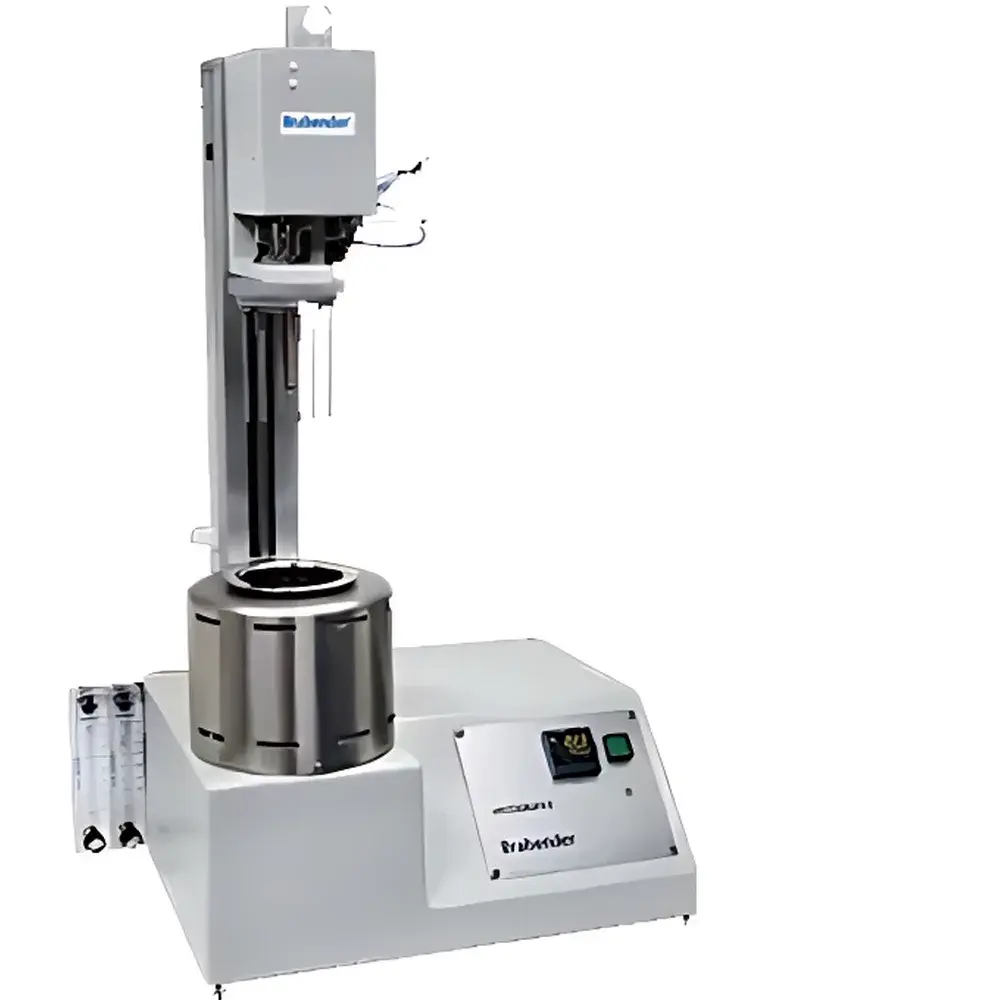
Brabender Viscograph-E Electronic Viscometer
| Brand | Brabender |
|---|---|
| Origin | Germany |
| Model | Viscograph-E |
| Temperature Ramp Rate | 0.5–3 °C/min |
| Measurement Principle | Torque-based rotational viscometry with integrated temperature-controlled sample bowl |
| Software | Viscograph Evaluation Suite (VESS) with programmable thermal profiles, automated peak detection, and multi-curve statistical overlay |
| Compliance | Designed for ASTM D445, ISO 2555, ISO 307, USP <911>, and GLP/GMP-aligned data integrity workflows |
| Data Management | Audit-trail-enabled, 21 CFR Part 11-compliant optional module available |
| Sample Handling | Integrated precision grinding unit with adjustable hammer-sieve gap, moisture-neutral milling |
Overview
The Brabender Viscograph-E Electronic Viscometer is a benchtop thermal-mechanical rheometer engineered for standardized measurement of pasting behavior and viscosity development in starches, flours, cereal products, and other thermally sensitive hydrocolloidal systems. It operates on the principle of controlled-temperature rotational viscometry: a precisely calibrated torque sensor measures resistance to rotation of a probe immersed in a sample contained within a thermostatically regulated bowl. As the sample undergoes programmed heating (e.g., from 25 °C to 95 °C) followed by controlled cooling, real-time torque values are converted into dynamic viscosity (mPa·s) using instrument-specific calibration factors traceable to NIST standards. The system captures full time–temperature–viscosity profiles—enabling quantitative identification of critical functional parameters including gelatinization onset temperature (A), peak paste viscosity (B), holding stability (B–C segment), retrogradation tendency (D), and cold-paste viscosity. Its architecture conforms to the physical measurement framework defined in ISO 2555 and ASTM D445 for solution viscosity, extended to non-Newtonian, time-dependent systems through standardized thermal protocols.
Key Features
- Integrated high-precision temperature control system with programmable ramp rates from 0.5 to 3.0 °C/min and ±0.1 °C stability over the full 25–100 °C operating range
- Dual-mode torque transducer with auto-zero compensation and resolution better than 0.01 mN·m, enabling reproducible detection of subtle viscosity transitions
- Modular grinding unit featuring continuously adjustable hammer-to-sieve clearance (0–2.5 mm), ensuring consistent particle size distribution without thermal degradation or moisture loss during sample preparation
- Self-optimizing PID temperature controller with adaptive learning for repeatable thermal profile execution across multiple runs
- Touchscreen interface with embedded VESS software supporting customizable thermal programs, real-time curve annotation, and on-device data validation
Sample Compatibility & Compliance
The Viscograph-E is validated for use with native and modified starches (corn, wheat, potato, tapioca), cereal flours, gluten-free blends, and hydroxypropyl methylcellulose (HPMC) solutions. It meets method requirements specified in Codex Alimentarius Standard 220–1995 (Starch Specifications), EU Regulation (EC) No 1333/2008 (food additives), and AOAC Official Method 981.11 (starch pasting). Instrument firmware and optional software modules support ALCOA+ data integrity principles—including attributable, legible, contemporaneous, original, and accurate records—and facilitate compliance with FDA 21 CFR Part 11 when configured with electronic signature and audit trail functionality. All calibration certificates are issued per ISO/IEC 17025-accredited procedures.
Software & Data Management
The Viscograph Evaluation Suite (VESS) provides an extensible platform for method development and regulatory reporting. Users define custom evaluation logic—such as automatic detection of gelatinization onset at dη/dT ≥ 5 mPa·s/°C, or time-to-target-viscosity at 600 mPa·s—via drag-and-drop rule builders. Up to 15 viscosity curves can be overlaid with synchronized time/temperature axes; statistical comparison includes mean, SD, CV%, and ANOVA-ready export to CSV or Excel. Raw data files (.vdf) retain full metadata (operator ID, environmental conditions, calibration history), and optional database integration enables centralized storage compliant with LIMS environments. Version-controlled method templates ensure inter-laboratory consistency and support method transfer documentation per ICH Q5E guidelines.
Applications
- Quality control of incoming starch raw materials against supplier specifications
- Formulation optimization for instant food products, sauces, and dairy analogs requiring specific hot/cold viscosity ratios
- Enzymatic modification monitoring—tracking viscosity drop during α-amylase treatment
- Stability assessment of frozen dough systems under freeze-thaw cycling protocols
- Regulatory dossier generation for novel starch ingredients submitted to EFSA or FDA
- Academic research on structure–function relationships in granular swelling kinetics and amylose leaching dynamics
FAQ
What temperature range does the Viscograph-E support?
The instrument operates from 25 °C to 100 °C with programmable heating and cooling ramps; extended low-temperature operation down to 5 °C is possible with optional chiller integration.
Can the grinding unit be bypassed for pre-ground samples?
Yes—the sample bowl accepts both directly loaded powders and slurries; the grinder is modular and may be removed or deactivated without affecting thermal or torque measurement integrity.
Is method validation support included?
Brabender provides IQ/OQ documentation templates, reference standard protocols (e.g., using NIST-traceable glycerol solutions), and GMP-aligned verification checklists upon request.
How is data backup and long-term archiving handled?
VESS supports automated network drive synchronization, encrypted local SSD storage, and scheduled SQL database dumps compatible with enterprise-grade archival systems.
Does the system comply with pharmacopoeial methods for viscosity testing?
Yes—it fulfills USP “Viscosity of Semisolid Dosage Forms” and Ph. Eur. 2.2.34 requirements when operated with certified calibration fluids and documented thermal profiles.