
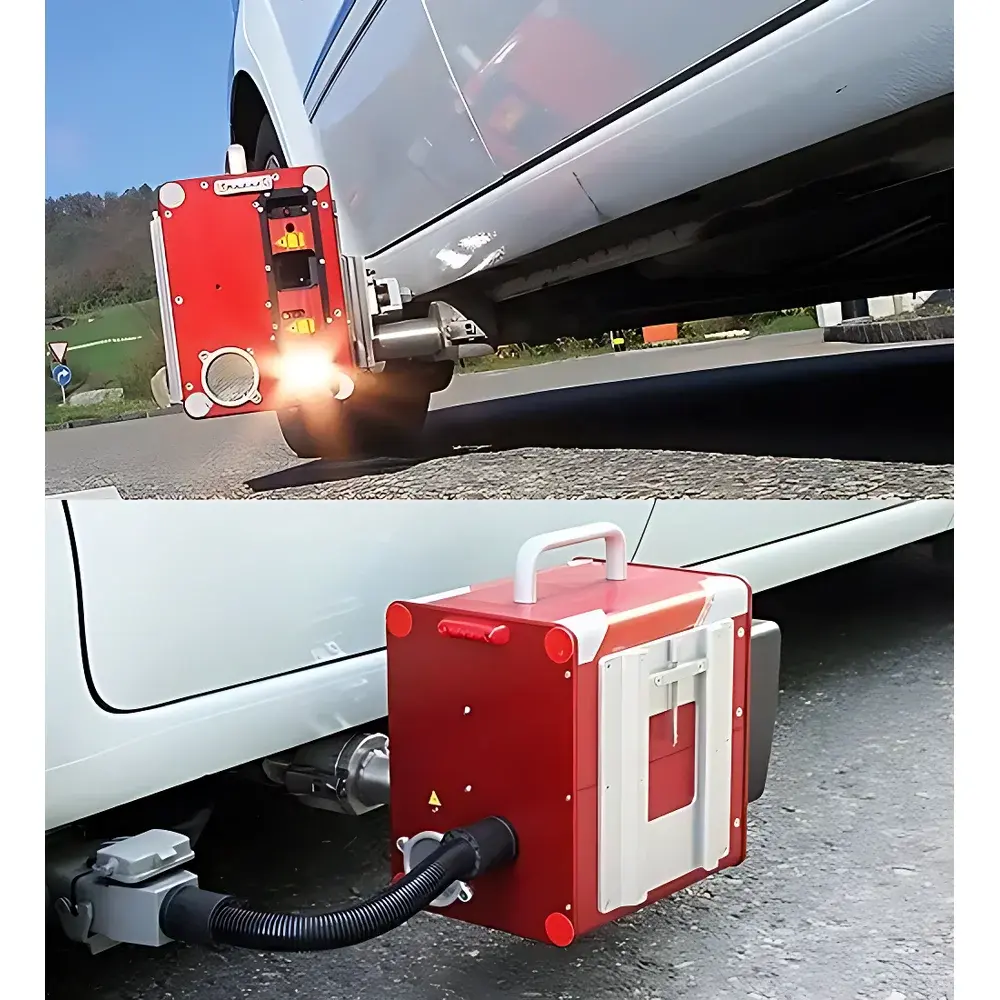
Zehntner ZDR6020 Mobile Road Marking Retroreflectometer
| Origin | Switzerland |
|---|---|
| Manufacturer Type | Authorized Distributor |
| Origin Category | Imported |
| Model | ZDR6020 |
| Price | Upon Request |
| Measurement Range | 0–4000 mcd·m²/lx |
| Measurement Distance | 6 m |
| Field of View | >1000 × 880 mm |
| Simulated Observation Distance | 30 m |
| Max. Vehicle Speed | 150 km/h |
| Light Source | Halogen lamp (1500 h lifetime) |
| Display | 11.6" color touchscreen |
| Incident Angle (ASTM E1710) | 88.76° |
| Incident Angle (EN 1436) | 1.24° |
| Observation Angle (ASTM E1710) | 1.05° |
| Observation Angle (EN 1436) | 2.29° |
| Operating Temp./RH | Integrated sensor |
| Data Logging | GPS coordinates, ambient temperature, relative humidity, speed, digital images, voice memos, timestamp |
| Compliance | EN 1436, ASTM E1710, ASTM E2176/E2177 (wet condition), StrAUS-Zert certified |
| Weight | 10.5 kg |
| Dimensions (L×W×H) | 270 × 207 × 310 mm |
Overview
The Zehntner ZDR6020 Mobile Road Marking Retroreflectometer is a high-precision, vehicle-mounted instrumentation system engineered for in-situ, dynamic measurement of retroreflective performance of road markings and traffic signs under real-world driving conditions. Based on the CIE photometric principle of retroreflection—where incident light from vehicle headlamps is reflected back toward its source—the ZDR6020 replicates the optical geometry defined by international standards including EN 1436 and ASTM E1710. It operates at a fixed observation distance of 30 m with precisely calibrated incident and observation angles (1.24°/2.29° per EN 1436; 88.76°/1.05° per ASTM E1710), ensuring metrological traceability to national calibration laboratories. Unlike static handheld devices, the ZDR6020 enables continuous, non-intrusive assessment at speeds up to 150 km/h, delivering spatially resolved RL (Retroreflection Coefficient) values in mcd·m⁻²·lx⁻¹ across extended road segments—critical for longitudinal performance monitoring, maintenance prioritization, and regulatory compliance verification.
Key Features
- True mobile retroreflectometry: Fully integrated into standard passenger vehicles without traffic disruption or lane closures.
- Simultaneous multi-parameter acquisition: Synchronizes RL measurements with GPS geotagging, ambient temperature, relative humidity, vehicle speed, time-stamped digital imagery, and optional voice annotations.
- High-fidelity optical path: Stable 6 m test-head-to-road distance maintained via precision mechanical linkage; halogen illumination ensures spectral output matching automotive headlamp emission profiles (3000 K CCT).
- Robust environmental operation: Validated for use under full daylight, overcast, and low-light conditions; no external dark enclosure required.
- Real-time visualization and diagnostics: 11.6″ industrial-grade capacitive touchscreen provides live RL trend plots, pass/fail threshold overlays, and immediate system health feedback.
- StrAUS-Zert certified design: Independently verified for conformance with German road safety infrastructure testing protocols and EU type-approval requirements.
Sample Compatibility & Compliance
The ZDR6020 is validated for measuring retroreflective performance of thermoplastic, cold plastic, preformed tape, paint-based, and glass-bead-embedded road markings—as well as raised pavement markers, delineators, and retroreflective signage. Its optical configuration satisfies the geometric constraints of EN 1436 (Class A/B/C), ASTM E1710 (Type I/II/III), and ASTM E2176/E2177 for wet-condition evaluation. All measurement data are recorded with embedded metadata required for audit-ready reporting under ISO/IEC 17025-accredited laboratories and public works procurement frameworks. The system supports traceable calibration using NIST-traceable reference standards and includes automated self-check routines prior to each measurement session.
Software & Data Management
Data acquisition and post-processing are managed through Zehntner’s proprietary ZDR-Connect software suite, compatible with Windows 10/11 and supporting export to CSV, PDF, and GIS-compatible formats (e.g., ESRI Shapefile). Each measurement record contains a unique identifier, cryptographic hash for data integrity, and full audit trail—including operator ID, calibration certificate expiry, firmware version, and environmental context. Software features include automatic anomaly detection (e.g., outlier RL spikes due to debris or moisture), georeferenced heat mapping of retroreflectivity decay, and customizable pass/fail thresholds aligned with national specifications (e.g., FHWA MUTCD Chapter 3B, UK TSRGD Schedule 12). The system complies with FDA 21 CFR Part 11 requirements for electronic records and signatures when configured with user authentication and audit logging enabled.
Applications
- Highway agency asset management: Longitudinal tracking of retroreflectivity degradation to optimize resurfacing and re-marking schedules.
- Contractor quality assurance: Real-time verification of newly applied markings against project specifications prior to final acceptance.
- Research & development: Correlation studies between material formulation, application parameters, and field performance under varying climatic exposure.
- Third-party certification: Independent verification for CE marking, DOT approval, or ISO 9001-compliant manufacturing audits.
- Post-incident forensic analysis: Spatial reconstruction of visibility conditions at accident sites using synchronized RL, GPS, and photographic evidence.
FAQ
Does the ZDR6020 require dark conditions for accurate measurement?
No. The instrument employs active illumination and narrow-band spectral filtering to reject ambient daylight interference, enabling reliable operation under full solar irradiance.
Can the system measure wet retroreflectivity?
Yes. When paired with optional calibrated water spray modules and synchronized timing logic, it supports ASTM E2176/E2177 wet-condition protocols.
Is GPS data synchronized with each RL reading?
Yes. Sub-meter GPS accuracy (SBAS-enhanced) is timestamped and georeferenced to every individual RL value at 10 Hz sampling rate.
What is the calibration interval recommendation?
Annual calibration is recommended per ISO/IEC 17025 guidelines; field verification using Zehntner-certified reference standards is advised before each daily deployment.
How is data security ensured during transfer and storage?
All exported datasets are digitally signed; local storage uses encrypted SQLite databases compliant with GDPR Article 32 technical safeguards.





