
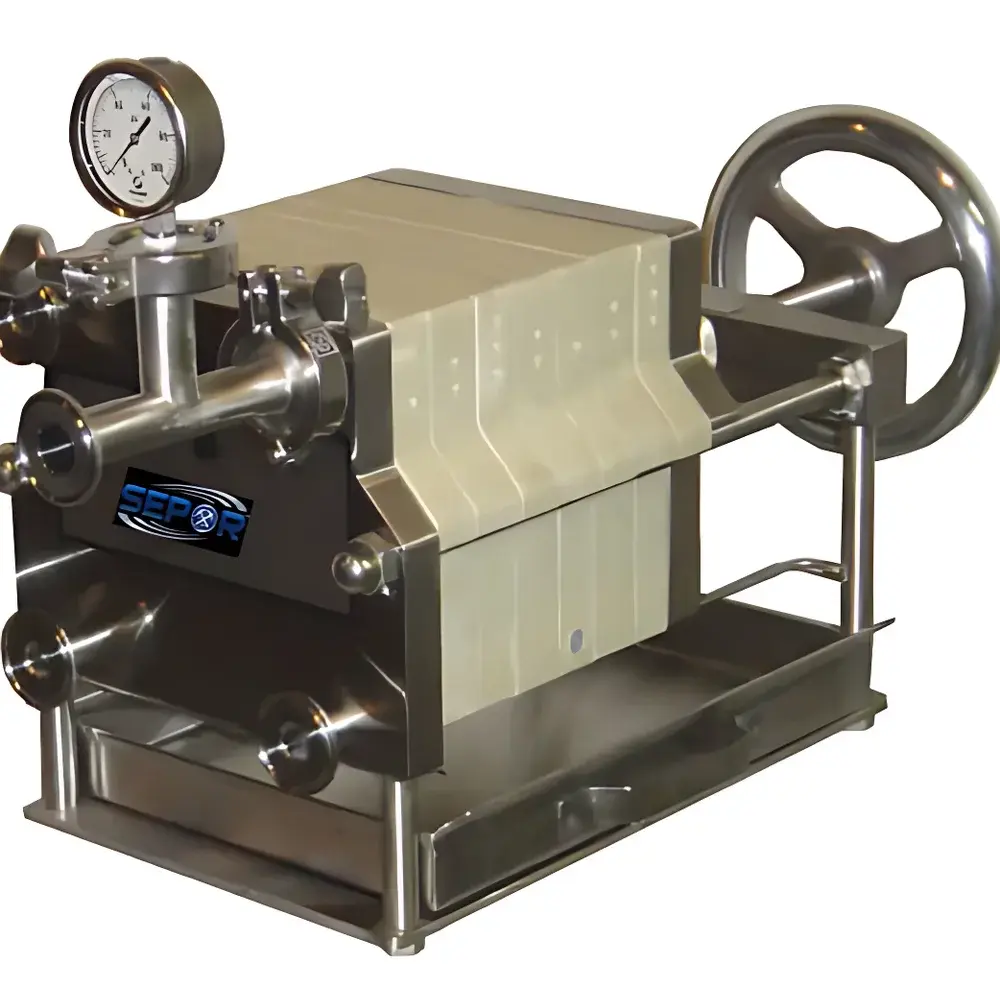
LabTech Pro Series 8-Inch Laboratory Plate & Frame Filter Press
| Origin | USA |
|---|---|
| Supplier Type | Authorized Distributor |
| Origin Category | Imported |
| Model | Lab Plate & Frame Fil |
| Pricing | Available Upon Request |
| Filtration Area | 1.7 ft² |
| Chamber Volume | 0.19 ft³ |
| Feed Flow Rate | 0.8–1.7 GPM |
| Maximum Operating Pressure | 100 psi |
| Frame Material | 316 Stainless Steel (standard) |
| Chamber Count | 6 |
| Plate Size | 8 in × 8 in |
| Actuation | Manual Handwheel with Hard-Chrome Bronze Nut & Hard-Chrome Steel Screw Shaft |
Overview
The LabTech Pro Series 8-Inch Laboratory Plate & Frame Filter Press is a precision-engineered bench-scale solid/liquid separation system designed for controlled, reproducible filtration testing under defined pressure or constant-rate conditions. Based on classical cake filtration theory—governed by the modified Darcy equation—the unit enables quantitative determination of specific cake resistance (α), compressibility coefficient (s), and filter medium resistance (Rm) across diverse slurry compositions. Its modular 6-chamber configuration, standardized 8-inch square plate geometry, and calibrated feed/air/wash pathways allow direct scale-up correlation to industrial-scale plate-and-frame systems using dimensionless similarity criteria (e.g., Reynolds, Capillary, and Froude numbers). The press operates within a validated pressure envelope up to 100 psi, supporting both filtration and air-blow drying cycles, and is routinely deployed in process development labs, wastewater treatment R&D, hydrometallurgical feasibility studies, and pharmaceutical crystallization workups where cake integrity, moisture content, and washing efficiency are critical quality attributes.
Key Features
- Structural integrity ensured by a rigid 316 stainless steel frame with hardened chromium-plated screw shaft and bronze nut assembly—engineered for >50,000 compression cycles without backlash or thread wear.
- Chemically resistant configuration available: fully polypropylene-wetted components (plates, frames, manifolds, and gaskets) for HCl, HF, or other aggressive media—certified per ASTM D543 and ISO 17359 for long-term chemical exposure stability.
- Configurable port mapping via tactile embossed indexing (1–3 dimples per plate/frame) ensures unambiguous orientation during assembly—eliminating misalignment-induced channeling or bypass leakage.
- Dual-mode operation: standard filtration mode (feed → cake formation → air blow-through) and wash mode (displacement or re-slurry washing) enabled via independent top/bottom inlet/outlet valving per chamber.
- Integrated mechanical clamping system with calibrated handwheel torque feedback—maintains uniform compressive load (±3% repeatability) across all plates to prevent edge leakage and ensure consistent cake thickness distribution.
- Modular feed manifold compatible with peristaltic, diaphragm, or progressive cavity pumps delivering 0–2 GPM at ≥60 psi head pressure—validated for shear-sensitive biopolymers and fine particulates (d50 < 5 µm).
Sample Compatibility & Compliance
The filter press accommodates slurries with solids concentrations from 1–40 wt%, particle sizes ranging from colloidal suspensions (1 mm), and viscosities up to 10,000 cP. It supports standard industrial filter media—including polyester, polypropylene, nylon, and PTFE-coated fabrics—as well as laboratory-grade membrane discs (0.2–5.0 µm pore rating). All wetted materials comply with FDA 21 CFR §177.1520 (polypropylene) and ASTM F838-22 (bacterial retention validation). When operated under documented SOPs, the system meets GLP audit requirements for data traceability and equipment qualification (IQ/OQ/PQ), and its pressure-rated design conforms to ASME B31.3 process piping safety margins for low-pressure filtration applications.
Software & Data Management
While the base model operates manually, optional digital instrumentation kits integrate pressure transducers (0–150 psi, ±0.25% FS), flow meters (Coriolis-type, 0.1–2.5 GPM, ±0.5% reading), and temperature sensors (PT100, ±0.1°C) into a USB- or Ethernet-connected DAQ module. Raw time-series data (pressure vs. time, filtrate volume vs. time, airflow rate vs. blow duration) exports natively to CSV or MATLAB .mat format. Optional LabTech Filtration Analysis Suite (v3.2) provides automated calculation of α, s, Rm, cake dryness (% moisture), and washing efficiency (ηw), with built-in templates aligned to ASTM E29-22 (significant figures), ISO 5725 (repeatability), and USP (filtration performance qualification). Audit trails and electronic signatures comply with FDA 21 CFR Part 11 when deployed on validated Windows OS platforms.
Applications
- Scale-up modeling for municipal wastewater sludge dewatering (e.g., alum- or polymer-flocculated activated sludge).
- Process optimization of Merck–Krauss-type precipitations (e.g., calcium carbonate, barium sulfate, metal hydroxides) where crystal habit and agglomeration affect cake permeability.
- Filter aid evaluation (diatomaceous earth, perlite, cellulose) under variable pre-coat thicknesses and pressure gradients.
- Pharmaceutical intermediate isolation—validating residual solvent removal kinetics and API crystal damage thresholds during air-drying cycles.
- Hydrometallurgical leach residue processing (e.g., copper SX-EW raffinates, nickel laterite residues) under acidic or oxidative conditions.
- Food-grade starch or protein recovery trials requiring sanitary-grade surface finish (Ra ≤ 0.8 µm) and clean-in-place (CIP) compatibility.
FAQ
What feed pump specifications are required to operate this press reliably?
A positive displacement pump capable of delivering 0–2 GPM at a minimum differential head of 60 psi is mandatory. Peristaltic pumps with Santoprene tubing (for shear-sensitive feeds) or air-operated double-diaphragm (AODD) pumps with EPDM or Viton diaphragms (for abrasive slurries) are recommended. Centrifugal pumps are not advised due to insufficient low-flow pressure stability.
Can the unit be configured for automated cycle control?
Yes—via the optional LabTech Automation Interface Kit, which adds solenoid valves, PLC-based sequencing logic, and HMI touchscreen for programmable multi-step cycles (fill → filter → compress → wash → blow → discharge). Fully compliant with ISA-88 batch control standards.
Is validation documentation provided for GMP environments?
Factory-supplied IQ/OQ protocols (including calibration certificates for pressure gauges and dimensional verification reports) are included. PQ support packages—featuring test slurries, reference filters, and protocol templates aligned with EU Annex 15 and WHO TRS 986—are available upon request.
How is filter cloth selection guided for optimal performance?
Selection depends on particle size distribution (verified by laser diffraction), cake compressibility (measured via pressure-step tests), and chemical compatibility. LabTech provides a Filter Media Selection Matrix (FMSM-8) correlating SDI, bubble point, and retention efficiency against 27 common industrial fabrics and membranes.
What maintenance intervals are recommended for long-term reliability?
Monthly inspection of gasket seating and screw thread lubrication (Molykote BR2 Plus); quarterly torque verification of clamping assembly; annual replacement of elastomeric seals (per ASTM D2000 classification). Full service logs are exportable via the DAQ system’s maintenance scheduler.





